Solar Panels Installed but Not Turned On? How Your Utility and Installer Work Together
Why you cannot just flip the switch
Here is the moment that confuses almost every solar customer: the crew has packed up, the panels are on the roof, the app is installed on your phone, and the system is off. It stays off, sometimes for weeks. Your installer is not stalling, and nothing is broken. The last signature in a rooftop solar project belongs to your electric utility, and until it arrives, the system is not allowed to run.
That signature is called permission to operate, or PTO. PG&E puts it bluntly in its customer guidance: "For safety reasons, don't turn on your system until PG&E gives you official written permission to operate it." The reason is genuinely about safety rather than paperwork. Your system feeds power onto shared wires, and the utility is responsible for the line workers and neighbors on the other side of them. Until the utility has confirmed the equipment, swapped your meter, and recorded the system on its side, energizing it early can put current where the grid operator does not expect it.
So a rooftop solar project is really a three-party handoff: a solar company you chose, a utility you did not choose, and a city or county inspector in between. Understanding which of the three owns each step, and how long each step takes, removes most of the anxiety from the quiet stretch after installation. That is what this article maps out, with federal timeline data and the actual response deadlines regulators impose on utilities.
Who does what, from contract to power-on
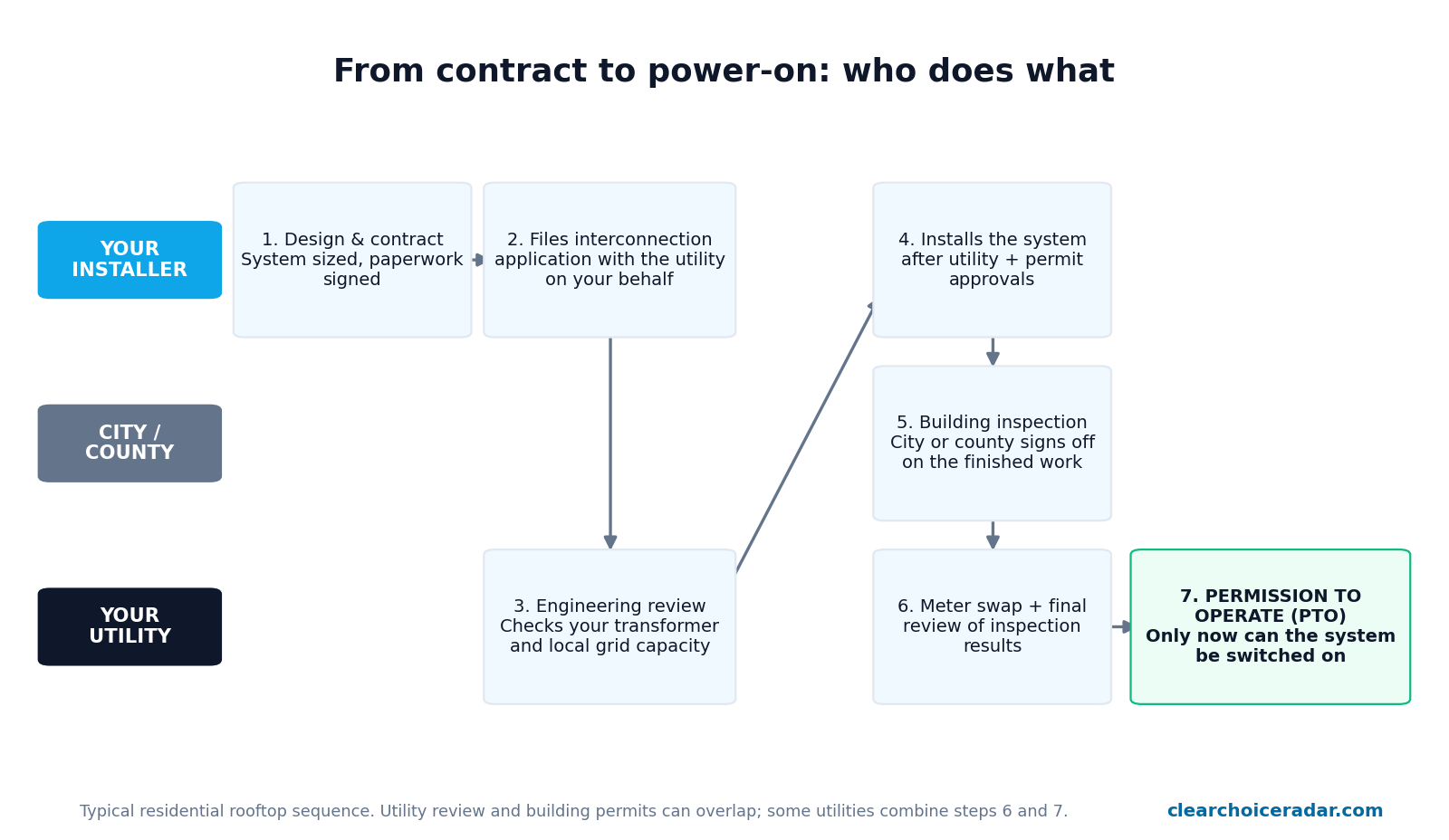
The split of responsibilities is more standardized than most shoppers expect, because utilities publish it. Start with the application: you sign the interconnection paperwork, but your installer files it. Southern California Edison tells customers directly that "most contractors will apply on your behalf." A competent installer treats the utility application as part of the job, not an extra.
PG&E describes its own role in four verbs that generalize to almost any utility: it "reviews your interconnection application, performs an engineering review, completes any necessary system upgrades, and gives final permission to operate." The engineering review is the utility checking whether your local transformer and wires can absorb what your panels will export. For a typical home system the answer is yes and the review is quick. Occasionally the answer is "yes, after we upgrade something," which is where the rare long delays come from.
In between sits local government. As the Department of Energy explains, installers pull a permit before the work starts, and after installation "a professional from the local government will inspect the new array to ensure all safety codes have been followed." Only after that inspection clears does the utility do its final piece. Sacramento's SMUD lays out the ending the same way on its getting-started page: the utility performs a final review and meter installation, and then, in SMUD's words, "your contractor turns on your system."
Notice what is not on your list. You sign documents, keep your electric account current, and stay off the switch. Everything else in the sequence belongs to the installer, the inspector, or the utility.
How long each stage really takes, according to federal data
The best public numbers on this come from the National Renewable Energy Laboratory, which tracked permitting, inspection, and interconnection timestamps on more than 100,000 residential solar projects for its November 2025 retrospective. For 2023 projects, the median gap between the final interconnection request and permission to operate was 9 business days. The full stretch from finishing installation to PTO, which includes the building inspection, ran a median of 34 business days.
Zoom out to the whole project and NREL found that in 2022 and 2023 the median solar project took roughly 100 to 115 business days from contract signing to PTO, which is about four and a half to six months. The spread matters more than the median: a quarter of projects wrapped in three months or less, while 10 percent took more than nine months. The utility approval steps are usually a modest slice of that; design, permitting, installation scheduling, and inspection queues eat most of the calendar.
Where you live changes the math. NREL's state medians put Texas projects at 55 days start to finish, Arizona at about 70, California at 113, New Jersey at 117, and Colorado at 126. The report specifically ties Colorado's longer timelines to processing delays at Xcel Energy, the state's largest utility, in 2022 and 2023. If you are comparing installer promises against reality, those are the honest baselines.
The deadlines utilities are actually held to
Utility review is not open-ended. Most states put response clocks on it, either in a commission rule or in the utility's own tariff. A few verified examples:
| Rule | Applies to | The clock |
|---|---|---|
| California Rule 21 (PG&E tariff) | Residential and small systems | 10 business days to tell you whether the application is complete; 15 business days for the fast-track technical review |
| California Rule 21 (PG&E tariff) | Net metering and net billing systems of 1 MW or less | PTO normally issued within 30 business days once the signed agreement and final inspection clearance are in |
| New York Standardized Interconnection Requirements | Systems of 50 kW or less | 10 business days to review the application for completeness and approval |
| Florida Rule 25-6.065 (Tier 1) | Systems of 10 kW or less | 10 business days to acknowledge the application or flag deficiencies; the interconnection agreement must be executed within 30 calendar days of a complete application |
| IREC model procedures (2023), adopted in various forms by states | Certified inverter systems of 50 kW or less | 10 business days for completeness, 7 business days for technical screens, and a 20 business day backstop after which the agreement is deemed effective |
Enforcement is imperfect. In an earlier NREL analysis of roughly 170,000 projects, about 8 percent of applications were not approved within their state's mandated window. But the clocks give you something concrete: if your application has sat without a response well past your state's review window, that is a specific, polite question your installer can put to the utility, with a rule number attached.
Your utility has done this before. A lot.
The waiting feels personal, but you are one file in a very large queue, and that is mostly good news. Federal Form EIA-861 data shows 5.08 million homes were interconnected under utility net metering programs nationwide by the end of 2024, up from 2.66 million at the end of 2020. That is more than 2.4 million homes added in four years, roughly 2,400 every business day, each one moving through the same application, review, inspection, and PTO sequence described above.
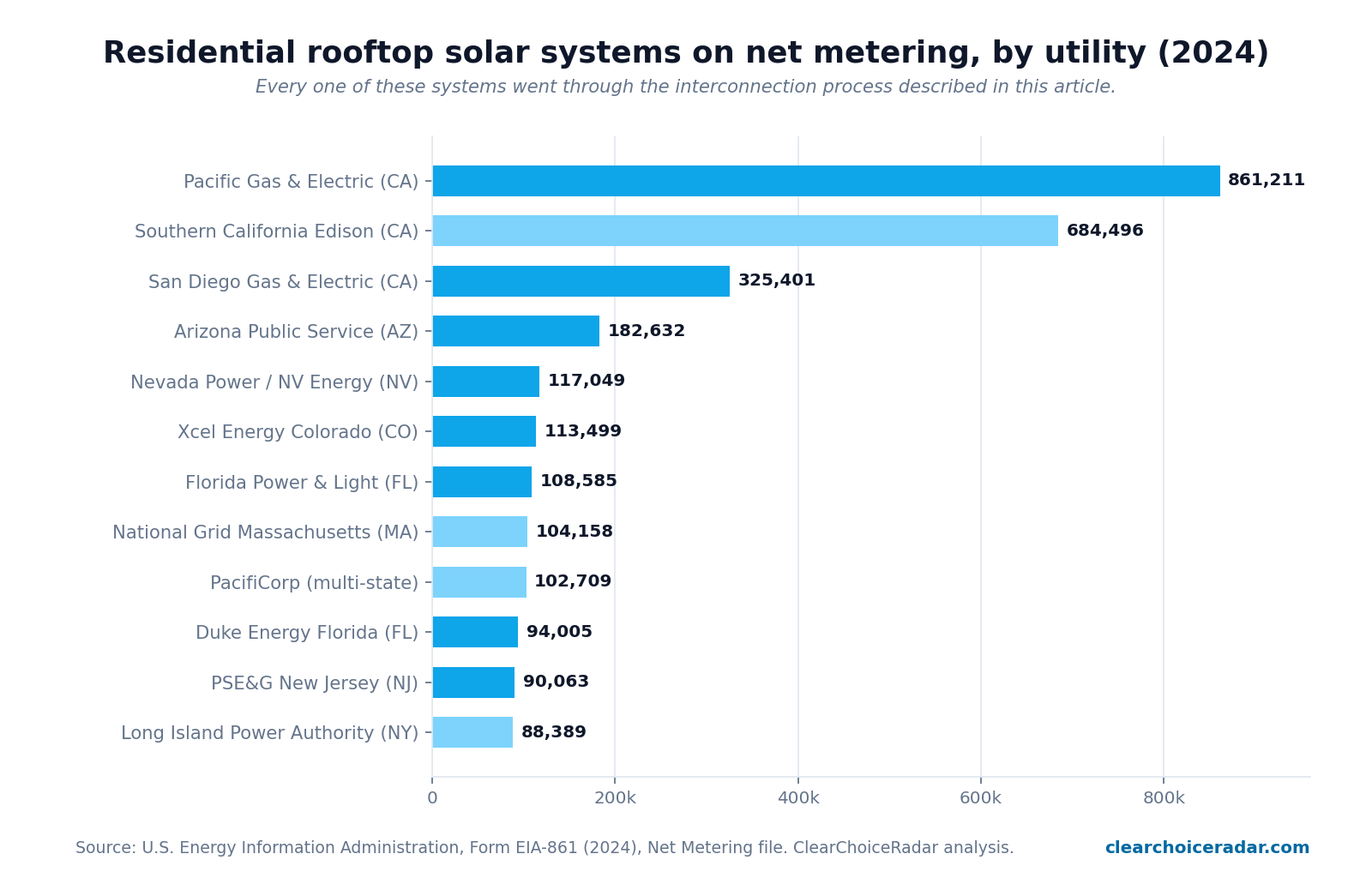
The scale at individual utilities is striking. PG&E alone had more than 861,000 residential systems on net metering in 2024. Arizona Public Service had over 182,000. Florida Power & Light, which had fewer than 23,000 in 2020, passed 108,000 by 2024. An interconnection application is not an exotic request your utility has to puzzle over; it is a production line, and your project is a routine unit on it.
How busy is your utility's solar desk?
Here is the same federal data for utilities we cover in our utility-by-utility guides, showing how many residential systems each reported under net metering tariffs in 2020 versus 2024. Click through any utility for its rates, export credit rules, and what solar changes on its bills:
| Utility | 2020 systems | 2024 systems | Added |
|---|---|---|---|
| Pacific Gas & Electric (CA) | 512,822 | 861,211 | +348,389 |
| San Diego Gas & Electric (CA) | 201,342 | 325,401 | +124,059 |
| Arizona Public Service (AZ) | 116,183 | 182,632 | +66,449 |
| Nevada Power / NV Energy (NV) | 58,104 | 117,049 | +58,945 |
| Xcel Energy Colorado (CO) | 37,169 | 113,499 | +76,330 |
| Florida Power & Light (FL) | 22,738 | 108,585 | +85,847 |
| Duke Energy Florida (FL) | 34,107 | 94,005 | +59,898 |
| PSE&G New Jersey (NJ) | 50,900 | 90,063 | +39,163 |
| Los Angeles DWP (CA) | 50,600 | 87,951 | +37,351 |
| Eversource Massachusetts (MA) | 45,866 | 80,111 | +34,245 |
| Con Edison (NY) | 33,033 | 70,078 | +37,045 |
| SMUD (Sacramento, CA) | 33,389 | 57,003 | +23,614 |
| Tucson Electric Power (AZ) | 27,838 | 51,299 | +23,461 |
Two footnotes for fairness. These counts cover systems reported to EIA under net metering tariffs, so arrangements EIA classifies separately, such as some newer net billing programs, sit outside these totals. And growth is not a quality score; a utility adding systems quickly can still be slow on individual reviews, as the Colorado example above shows. For how each utility credits the power you export, see our utility guides hub.
When utilities formally vet installers
Some utilities go a step beyond processing applications and publish vetted installer lists. Salt River Project in Arizona maintains a network of Preferred Solar Installers, telling customers that connecting with one "can help save you time and money by providing a safe and efficient installation." Arizona Public Service publishes a Qualified Technology Installer list; to stay on it for solar, a company must hold an active Arizona solar contractor license, maintain an A rating with the Better Business Bureau, and keep a physical office customers can visit.
Read these lists for what they are. A utility list screens for licensing, complaint history, and familiarity with that utility's paperwork, which genuinely reduces interconnection friction. It is not a price comparison, it is not a performance guarantee, and plenty of excellent installers simply have not joined a given utility's program. Many utilities, including SMUD, keep no solar list at all and point customers to references and review platforms instead.
The sensible use: treat a utility's list as one strong screening signal, then still collect multiple bids and compare them the way our guide to the best solar companies lays out, on warranties, equipment, financing terms, and installation quality, not just price.
What slows projects down, and who fixes what
When a project stalls in the utility phase, it is usually one of four things. First, incomplete applications: a missing signature, a wrong equipment model number, or an outdated single-line diagram bounces the file back and restarts the completeness clock. This is the most common and most preventable delay, and it is squarely the installer's job to get right. Second, grid capacity: if the engineering review finds your neighborhood transformer needs work before it can take your exports, the utility schedules an upgrade and your timeline absorbs it. Third, inspection queues at the city or county, which vary wildly by jurisdiction. Fourth, the meter swap itself, which is a short task that still has to be scheduled on a truck route.
Division of labor when things drag: your installer chases the application status, fixes deficiencies, and schedules the inspection; the utility owns the engineering review and the meter; you keep signatures moving quickly and resist the urge to energize early. SCE's guidance ties early operation directly to "compliance with our interconnection requirements," and an early switch-on discovered during final review is a genuinely self-inflicted delay.
One planning note: if your quote includes a battery, build in patience. NREL found that once California is set aside, a typical solar-only project needed about one to two weeks of utility review time, while solar plus storage needed two to four. Batteries change the electrical review, and the paperwork grows with them.
After PTO: watch your first bill
Permission to operate is also the moment your billing changes. Your net metering or net billing enrollment activates, your meter starts recording exports as well as imports, and your bill gains new line items that look nothing like the old ones. The rules differ sharply by utility: some credit exports at the full retail rate, others at a fraction of it, and the difference matters more to your payback than almost any equipment choice.
That part is worth understanding before you sign anything, not after PTO arrives. Our utility guides explain each company's export credit rules and what solar actually changes on its bills, and our solar payback calculator lets you test how those rules play out for your usage. For quick answers to specific questions, the solar answers hub covers the rest.
Related Solar guides
- How solar panels work
- Solar panel costs and ROI
- Solar incentives and rebates
- Net metering
- Solar financing
- Choosing a solar installer
- Solar batteries and backup
- Community solar
- Rising electricity rates
- Solar payback calculator
- Solar system size calculator
- Solar questions answered
- LADWP
- Sierra Pacific Power
Sources
- PG&E: Getting Started with Solar
- SMUD: Solar for Your Home, Getting Started
- SCE: Net Energy Metering
- U.S. DOE: Permitting and Inspection for Rooftop Solar
- NREL/TP-6A20-92539: PV Permitting, Inspection, and Interconnection Timelines, 2017 to 2023 (Nov 2025)
- NREL/TP-6A20-81459: Distributed Solar Interconnection Timelines and State Mandates (2022)
- PG&E Electric Rule 21 tariff
- Florida Administrative Code Rule 25-6.065
- IREC Model Interconnection Procedures, 2023 Edition
- SRP: Preferred Solar Installers
- APS: Find Qualified Installers
- U.S. EIA, Form EIA-861, Net Metering files (2020 and 2024)
General information only. Solar savings estimates depend on your location, energy usage, roof characteristics, and available incentives. Get quotes from multiple installers for accurate pricing. Last updated July 2026.