Solar Panel Cost in 2026: What You'll Pay and How to Know If It's Worth It
What Does a Solar System Cost in 2026?
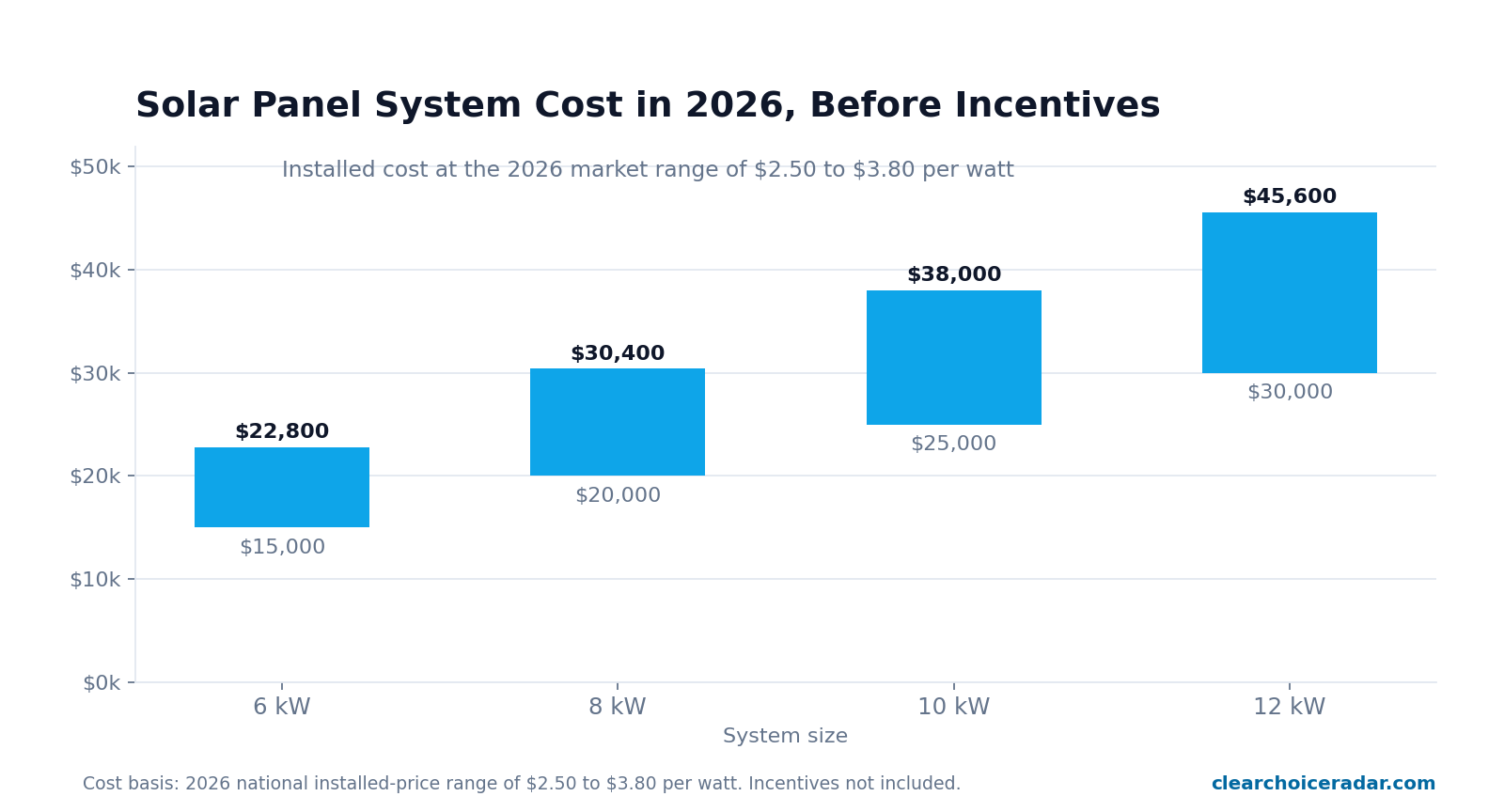
Most homes use a system sized between 6 kilowatts (kW) and 12 kW, depending on energy consumption and roof space. Using a typical 2026 installed price range of $2.50 to $3.80 per watt (SEIA), a 6 kW system runs roughly $15,000 to $22,800, while a 10 kW system runs $25,000 to $38,000 before any state or local incentives.
Several factors shift where your quote lands: system size, panel tier, roof complexity, regional labor costs, inverter type, and whether you add battery storage.
The Federal Tax Credit Situation in 2026
The Section 25D residential clean energy credit was terminated for systems placed in service after December 31, 2025 (IRS.gov). Cash and loan buyers today do not receive a 30% federal offset. Any quote or calculator still subtracting 30% is using outdated information.
Third-party owners of leased or PPA systems may be eligible to claim the Section 48E Clean Electricity Investment Credit, but eligibility is project-specific and never guaranteed (Energy.gov). Confirm your situation with a licensed tax professional.
State and Local Incentives: Where to Look
Even without the federal residential credit, meaningful incentives remain in many states: state income tax credits, sales tax exemptions, property tax exemptions, utility rebates, and performance-based incentives. Programs vary widely and change frequently.
The best single source for current, state-specific programs is the DSIRE database. Always verify directly with your utility and state energy office before counting on any incentive in your budget.
How to Run a Realistic Payback Calculation in 2026
Without the 30% federal credit, payback periods for cash buyers are longer than in prior years. The core steps: (1) get your confirmed net cost after verified incentives only, (2) estimate annual production based on your roof and location (Energy.gov), (3) multiply production by your utility rate for first-year savings, (4) account for panel degradation of 0.5 to 0.8 percent per year (Energy.gov), and (5) divide net cost by annual savings for a simple payback estimate.
Actual payback varies significantly by location, utility rates, and incentives. Any honest model must reflect degradation, not flat output for 25 years.
Net Metering and Net Billing: Why Policy Matters
How your utility compensates excess solar generation is one of the biggest variables in the payback equation. Full retail net metering credits you at the retail rate; net billing or avoided-cost compensation pays significantly less per exported kWh. Several states have restructured these programs in recent years, stretching payback periods.
Check current policy with your utility and the DSIRE database before finalizing your decision.
Is Solar Still Worth It Without the Federal Credit? A Decision Framework
There is no single yes-or-no answer. Solar is more likely to make sense if your electricity rates are high, your state has strong net metering, meaningful local incentives apply, your roof has good sun exposure, and you plan to stay in the home long enough to reach payback.
It may be a harder case if utility rates are low, net metering has been restructured unfavorably, your roof needs replacement, or your payback period extends beyond your ownership timeline. Cloudy climates are not disqualifying: states like Massachusetts and New York have high solar adoption despite moderate sun, because high electricity rates and strong incentives improve the math.
Quick Tips Before You Get Quotes
- Get at least three competing quotes; prices vary more than most homeowners expect.
- Ask each installer for a production estimate and confirm what degradation rate they used.
- Verify every incentive in your quote independently through DSIRE and your utility.
- Review panel and workmanship warranty terms, not just efficiency ratings.
- If considering a loan, compare total interest cost against projected savings over the loan term.
Related Solar guides
- How solar panels work
- Solar panel costs and ROI
- Solar incentives and rebates
- Net metering
- Solar financing
- Choosing a solar installer
- Solar batteries and backup
- Community solar
- Rising electricity rates
- Solar payback calculator
- Solar system size calculator
- Solar questions answered
- LADWP
- Sierra Pacific Power
Sources
- SEIA - Solar Industry Research Data
- Energy.gov - Homeowner's Guide to Going Solar
- Energy.gov - Federal Solar Tax Credits for Businesses and Residents
- IRS.gov - Residential Clean Energy Credit
- Energy.gov - Solar Performance and Efficiency
- DSIRE - Database of State Incentives for Renewables and Efficiency
General information only. Solar savings estimates depend on your location, energy usage, roof characteristics, and available incentives. Get quotes from multiple installers for accurate pricing. Last updated June 2026.