Is Solar Worth It When Utilities Pay Less for Exports? Myths vs. Reality in 2026
Myth 1: Net Metering Still Works the Same Way Everywhere
"Net metering" used to mean a near-universal deal where every kilowatt-hour you sent to the grid knocked one kilowatt-hour off your bill at full retail price. That model still exists at some utilities, but it is no longer the default.
California replaced traditional net metering with NEM 3.0 in April 2023. Under NEM 3.0, exported energy earns avoided-cost rates that average roughly 3 to 8 cents per kWh, depending on the hour, rather than full retail rates that can exceed 30 cents in some California tiers. Arizona moved to a similar "net billing" structure. These are not minor tweaks. A system that earns 5 cents on an export instead of 30 cents earns 83 percent less on that kilowatt-hour.
To understand how net metering policies vary by state, check our full guide.
Myth 2: The Export Rate Is the Same Across All Utilities
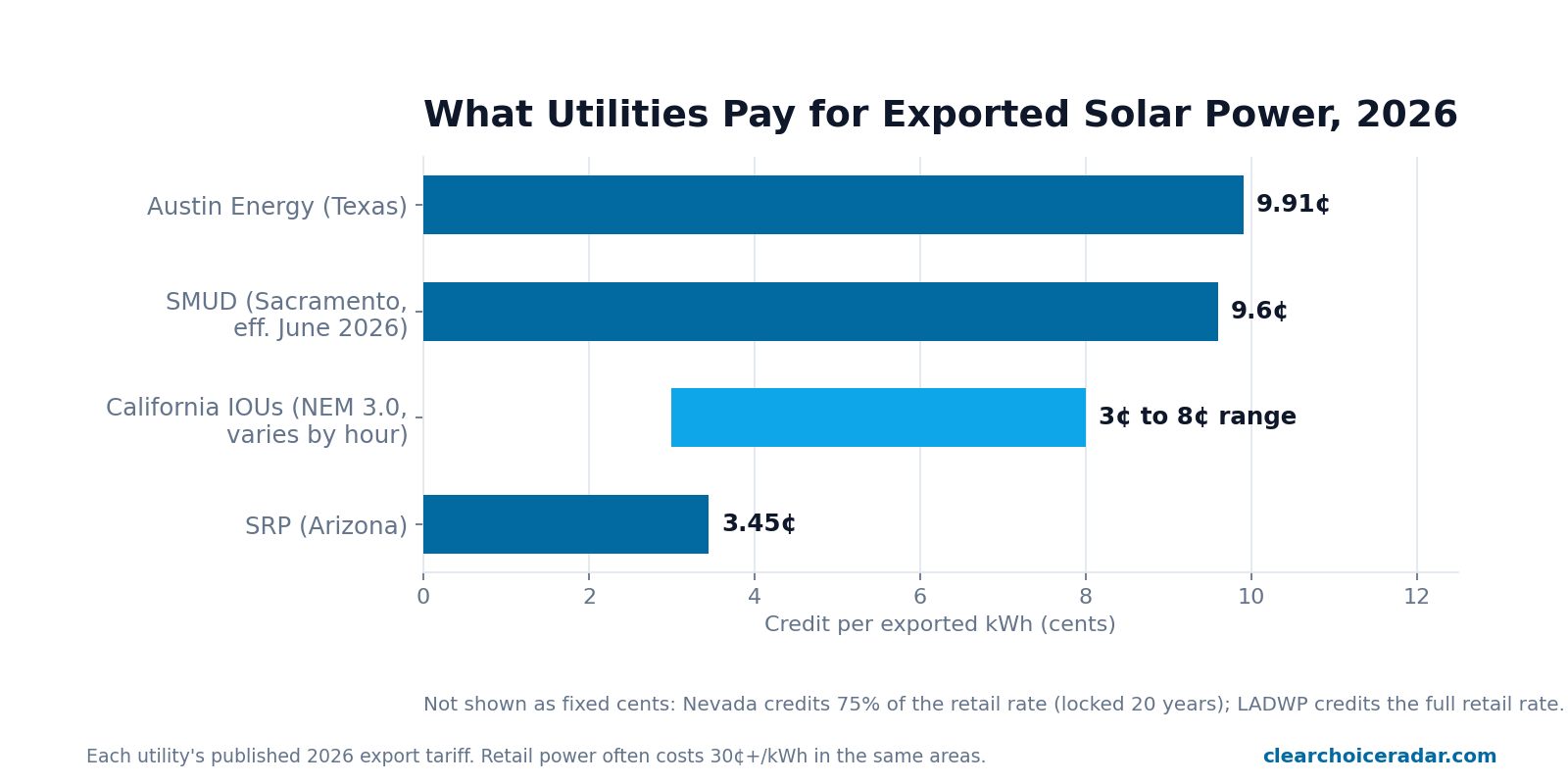
Export rates vary more than most shoppers realize, and even utilities within the same state can pay very different amounts. Here is a verified snapshot as of mid-2026:
| Utility / Program | Export Compensation Model | Approximate Rate |
|---|---|---|
| LADWP (Los Angeles) | Full retail credit | Retail rate |
| SMUD (Sacramento) | Flat export rate | 9.6 cents/kWh (effective June 2026) |
| California IOUs (NEM 3.0) | Avoided-cost, time-varying | ~3 to 8 cents/kWh |
| Nevada (Tier 4 NEM) | 75% of retail, rate locked | 75% of retail for 20 years |
| SRP (Arizona) | Flat export rate | 3.45 cents/kWh |
| Austin Energy (TX) | Value of Solar tariff | 9.91 cents/kWh on all production |
| Texas deregulated areas | No state mandate, varies by plan | Depends on retail plan |
These differences are enormous. The gap between full-retail crediting and a 3.45-cent flat rate compounds significantly over a 20-year system life.
Myth 3: Solar Panels Pay Off the Same Way They Did Five Years Ago
The math changed when export rates changed. Under old full-retail net metering, oversizing a system was a straightforward way to maximize returns. Under NEM 3.0 or Arizona net billing, oversizing works against you: extra exports earn only a few cents, while you still pay full retail for any grid power you buy.
The new math rewards self-consumption. Energy you use directly the moment your panels produce it saves you the full retail rate. Energy you export earns only the export rate, which can be a fraction of retail. That gap is now the central design question for any California, Arizona, or similar-state system.
Solar panel costs and ROI look very different depending on which utility serves your home. Always verify the current export rate before accepting any payback estimate.
Myth 4: Batteries Are a Luxury Add-On You Can Skip
Under full-retail net metering, a battery was genuinely optional for most homeowners. Under low-export-rate regimes, a battery often changes the economics more than adding extra panels does.
If your utility pays 5 cents for exports but charges 32 cents for evening grid power, every kilowatt-hour you shift from afternoon export to evening self-use saves 27 cents instead of earning 5 cents. That is a 440 percent improvement on that unit of energy. California's NEM 3.0 was explicitly designed to reward pairing solar with storage rather than exporting surplus power.
Our solar batteries and backup guide explains how to size storage for your usage pattern.
Myth 5: The 30% Federal Tax Credit Still Applies to Your Purchase
This is one of the most dangerous myths circulating in 2026. The residential solar tax credit under Section 25D, which was 30 percent under the Inflation Reduction Act, was terminated by the One Big Beautiful Bill Act for systems placed in service after December 31, 2025. If you buy or finance a solar system as a homeowner in 2026 or later, you do NOT receive the 30% federal credit (IRS.gov).
Any installer quote or online calculator still showing a 30 percent federal credit subtracted from your net cost is using expired law. Do not base a purchase decision on that number.
Third-party owners of leased or PPA systems may potentially claim a commercial credit under Section 48E (the Clean Electricity Investment Credit). But that credit belongs to the leasing company, not you, and it is not automatic. Eligibility is fact-specific, requires meeting prevailing-wage and apprenticeship rules for the full rate, and has its own deadlines. This is general information, not tax advice. Confirm any credit eligibility with a licensed tax professional (Energy.gov). Check our solar incentives and rebates guide for state-level programs that remain available.
Myth 6: If Your Utility Pays Low Export Rates, Solar Is Not Worth It
Low export rates do not make solar worthless; they change how you design and use the system. Rising electricity rates work in your favor for self-consumed power. Every kilowatt-hour your panels produce and you use directly offsets power you would have bought at retail, and retail rates have risen significantly across most U.S. utilities in recent years (SEIA).
Panels also degrade slowly. Typical degradation runs 0.5 to 0.8 percent per year (Energy.gov), meaning a 25-year-old system still produces roughly 80 to 88 percent of its original output. That is a long earning window. Check DSIRE for state incentives that may still apply in your area, and track how rising electricity rates in your region affect the self-consumption side of the equation.
What to Actually Do Before Signing a Solar Contract
Step 1: Look up your utility's current export compensation. Call your utility or visit their website and ask specifically what rate you will receive for exported solar kilowatt-hours and whether that rate is locked for any period.
Step 2: Ask for a self-consumption estimate, not just a production estimate. A reputable installer will model how much of your production you will use directly versus export, based on your actual usage data.
Step 3: Run the math with the actual export rate. If your utility pays 5 cents for exports and your retail rate is 28 cents, exports and self-use are not the same thing in your payback calculation.
Step 4: Price out a battery if you are in a low-export-rate territory. Under NEM 3.0 or Arizona net billing, a battery often improves project economics more than adding an extra panel or two.
Step 5: Verify incentives through primary sources. The federal residential credit is gone for 2026 purchases. State credits and utility rebates may still apply. Check DSIRE and confirm tax eligibility with a licensed tax professional.
Step 6: Get multiple quotes. Use our list of best solar companies to start your search, and review our guide to choosing a solar installer before signing anything. For background on how solar panels work, our basics guide is a good starting point.
Legal Disclaimer
General information only. Solar savings estimates depend on your location, energy usage, roof characteristics, and available incentives. Get quotes from multiple installers for accurate pricing. Tax credit information is general educational content, not tax advice. Confirm current eligibility with a licensed tax professional.
Related Solar guides
- How solar panels work
- Solar panel costs and ROI
- Solar incentives and rebates
- Net metering
- Solar financing
- Choosing a solar installer
- Solar batteries and backup
- Community solar
- Rising electricity rates
- Solar payback calculator
- Solar system size calculator
- Solar questions answered
- LADWP
- Sierra Pacific Power
Sources
- IRS.gov - Residential Clean Energy Credit
- Energy.gov - Federal Solar Tax Credits for Businesses and Residents
- Energy.gov - Solar Performance and Efficiency
- SEIA - Solar Industry Research Data
- DSIRE - Database of State Incentives for Renewables and Efficiency
- Energy.gov - Homeowner's Guide to Going Solar
General information only. Solar savings estimates depend on your location, energy usage, roof characteristics, and available incentives. Get quotes from multiple installers for accurate pricing. Last updated July 2026.