Can an HOA Stop You From Going Solar? The Law in California, Texas, Florida, Arizona, and Nevada
The Short Answer: In These Five States, Usually Not
There is no federal law that guarantees a homeowner the right to install solar over an HOA's objection. The FCC rule people sometimes cite, the one that protects satellite dishes, covers broadcast antennas only; solar panels appear nowhere in it (47 CFR 1.4000). Solar access rights are state law.
The good news: all five of the states we cover with dedicated solar guides, California, Texas, Florida, Arizona, and Nevada, have solar access statutes that make outright HOA prohibitions void or unenforceable. What HOAs keep is a narrower power to regulate placement and aesthetics within specific statutory limits, and those limits differ enough by state that the details below are worth reading before you submit an application, not after a denial.
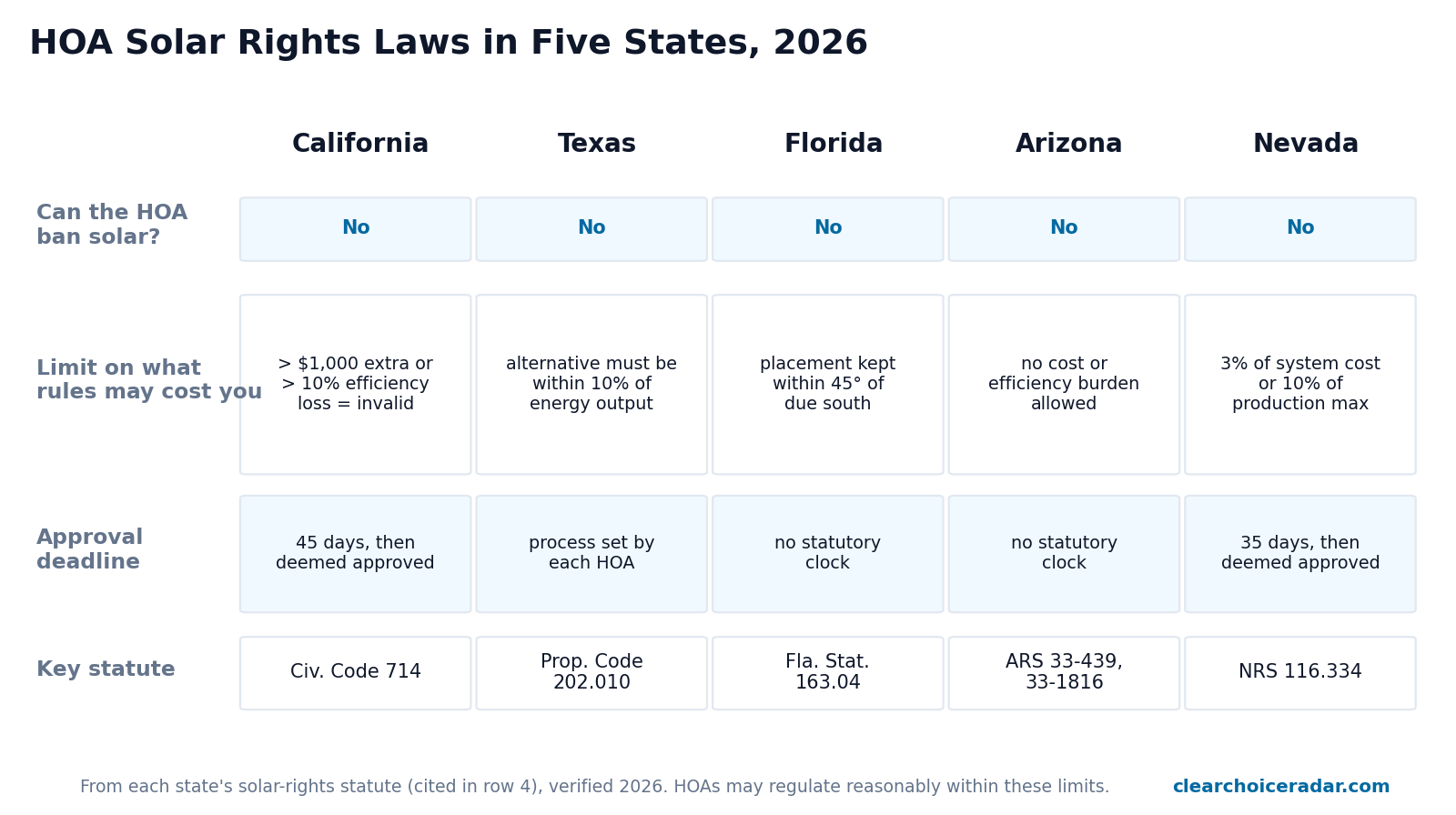
California: The Solar Rights Act and a 45-Day Clock
California Civil Code section 714 voids any covenant, restriction, or condition that effectively prohibits or restricts installing or using a solar energy system (Civ. Code 714). HOAs may impose only reasonable restrictions, and the statute defines the word: for a photovoltaic system, a restriction that adds more than $1,000 to the system's cost or cuts its efficiency by more than 10 percent is not reasonable. Solar water heating systems get a similar test with their own thresholds.
Two procedural rights do a lot of work here. Your application must be processed the same way as any architectural modification request, and if the association does not deny it in writing within 45 days of receipt, it is deemed approved, unless the delay comes from a reasonable request for more information.
Condo and townhome owners have their own protection: an association may not adopt a general policy prohibiting rooftop solar on the building the owner lives in, or on an adjacent garage or carport assigned for the owner's exclusive use (Civ. Code 714.1). On shared multifamily roofs, expect the association to require a solar site survey by a licensed contractor and proof of liability insurance within 14 days of approval (Civ. Code 4746). Timing also matters more in California than anywhere else right now; see our California solar guide for the property tax deadline most sites miss.
Texas: No Prohibitions, but a Detailed Rulebook on Placement
Texas Property Code section 202.010 bars property owners' associations from prohibiting or restricting solar energy devices, then lists the specific situations where an association can still say no (Prop. Code 202.010). The real list: devices located on association-owned or common property; devices somewhere other than the roof or a fenced yard or patio; roof-mounted panels that extend above the roofline, do not follow the roof slope with the top edge parallel to the roofline, or use frames, brackets, or visible wiring in a color other than silver, bronze, or black tone; yard devices taller than the fence; installations that void material warranties; installations a court has found to threaten health or safety or violate law; and installations done without required prior approval.
Two pro-homeowner details hide in there. The association can designate where on the roof panels go, but not if your preferred location beats theirs by more than 10 percent in estimated annual energy production. And if your application meets the written standards, the association cannot withhold approval unless it determines in writing that the placement substantially interferes with neighbors' use and enjoyment; written sign-offs from your adjoining neighbors are statutory evidence in your favor, so collect them with your application. In 2025 Texas also extended protections to solar roof tiles, closing a gap for shingle-style products.
Registration rules for solar sellers are changing in Texas too; our Texas solar guide covers what takes effect in September 2026.
Florida: HOAs Choose the Spot Only Inside a South-Facing Window
Florida Statute 163.04 says a deed restriction, covenant, declaration, or similar binding agreement may not prohibit, or have the effect of prohibiting, solar collectors and other renewable energy devices (F.S. 163.04).
The association's remaining power is narrow and unusually concrete: it may determine where on the roof collectors go, but only within an orientation to the south or within 45 degrees east or west of due south, and only if its choice does not impair the system's effective operation. An HOA that forces panels onto a shaded north face is outside its statutory authority twice over.
Florida sweetens enforcement: the prevailing party in a lawsuit under this section is entitled to costs and reasonable attorney's fees, which gives associations a real incentive not to test it. One carve-out to know: the statute does not apply to patio railings in condominiums, cooperatives, or apartments. Why nearly all Florida offers are purchases or leases rather than PPAs is its own story, covered in our Florida solar guide.
Arizona: Rules Cannot Touch Cost or Efficiency
Arizona attacks the problem from two directions. A.R.S. 33-439 voids any covenant, restriction, or condition in a deed or other instrument that effectively prohibits the installation or use of a solar energy device (A.R.S. 33-439). And for planned communities, A.R.S. 33-1816 says an association shall not prohibit solar devices and may adopt reasonable placement rules only if those rules do not prevent installation, impair the device's functioning, restrict its use, or adversely affect its cost or efficiency (A.R.S. 33-1816). That cost-or-efficiency clause is one of the stronger homeowner standards in the country: a rule that makes your system meaningfully more expensive or less productive fails, full stop. Courts can award attorney fees to an owner who substantially prevails against a violating board.
The definition of a protected solar energy device is broad, covering systems that produce electricity, heating, cooling, or daylighting (A.R.S. 44-1761). One nuance: 33-1816 covers planned communities; condominium owners lean on the general deed-restriction protection of 33-439 instead. For what Arizona's lifetime state credit and 2026 utility export rates mean for the economics, see our Arizona solar guide.
Nevada: The 2025 Rewrite Most Websites Have Not Caught Up With
Nevada's long-standing rule, NRS 278.0208, voids restrictions that prohibit or unreasonably restrict solar, and it defines unreasonable to include rules that cut a system's efficiency or performance by more than 10 percent without allowing a comparable alternative (NRS 278.0208). It even specifically protects black solar glazing.
Then, in 2025, the Legislature added two new sections to the common-interest community law that give Nevada HOA applicants some of the sharpest procedural teeth anywhere (NRS 116.333 and 116.334):
- A 35-day decision clock with deemed approval. If an association with adopted solar rules does not approve or deny within 35 days, the request is deemed approved. A resubmission after a denial gets a 15-day clock, again with deemed approval.
- No rules, no leverage. An association that never adopted solar rules must approve a request within 15 days and may not deny it or impose conditions.
- A 3 percent cost cap on aesthetics. Aesthetic placement rules cannot be enforced if complying would cost more than 3 percent of the installation's cash cost, which you prove with an itemized estimate from an unaffiliated licensed installer.
- An objective production test. Associations may require panels not to face the street only if that costs no more than 10 percent of production, measured with NREL's PVWatts calculator, not anyone's opinion.
Rules must also respect the electrical code and require a licensed solar installer. Between this and the 2026 rate design changes, Nevada's solar picture moved a lot recently; our Nevada solar guide has the full landscape.
How to Actually Get Your Application Approved
Across all five states, the winning pattern is the same: use the process, in writing, and let the statutory deadlines work for you.
- Submit a complete architectural application with the system layout, panel placement, and installer details. Incomplete applications legitimately stop the clock in states with deemed-approval deadlines.
- Track the deadline. California's 45 days and Nevada's 35 (or 15) days run from receipt, and silence becomes approval. Send the application in a way you can date-stamp.
- Collect neighbor sign-offs in Texas. Written approval from adjoining owners is statutory evidence against a substantial-interference denial.
- Answer aesthetics with numbers. Production-impact estimates (PVWatts in Nevada, the 10 percent tests in Texas and Nevada, impairment in Florida, efficiency thresholds in California and Arizona) convert a taste argument into a math problem the statute settles.
- Get denials in writing. Every one of these statutes constrains what a valid denial can say, and several award attorney's fees to homeowners who prevail.
A good installer has handled your HOA before and will often prepare the application package; our guide to choosing a solar installer covers how to vet that experience, and our solar questions answered hub handles the other questions that come up alongside this one.
Key Takeaway: The Law Is on Your Side, the Process Is on Theirs
In California, Texas, Florida, Arizona, and Nevada, an HOA that flatly refuses solar is acting outside its authority. What associations legitimately control is process and placement, within statutory limits that are specific enough to check yourself: dollar and percentage thresholds, orientation windows, color rules, and decision deadlines that turn silence into approval. Read your state's statute before you apply, document everything, and remember this is general information rather than legal advice; for an actual dispute with your association, a lawyer licensed in your state is the right next call.
Related Solar guides
- How solar panels work
- Solar panel costs and ROI
- Solar incentives and rebates
- Net metering
- Solar financing
- Choosing a solar installer
- Solar batteries and backup
- Community solar
- Rising electricity rates
- Solar payback calculator
- Solar system size calculator
- Solar questions answered
- LADWP
- Sierra Pacific Power
Sources
General information only. Solar savings estimates depend on your location, energy usage, roof characteristics, and available incentives. Get quotes from multiple installers for accurate pricing. Last updated July 2026.