How to Keep Scorpions Out of Your House in Arizona: What Actually Works
Start with the sentence that should change your strategy
Most Arizona homeowners fight scorpions with a spray schedule. The state's own university entomologists say that is the wrong lead. The University of Arizona Cooperative Extension's scorpion publication puts it plainly: scorpions "are difficult to manage with pesticides alone," and "pest-proofing your home or structure is by far the most effective way to reduce scorpion contact and potential scorpion stings."
That single sentence reorders the whole to-do list. The winning strategy is physical: seal the routes in, strip away the places they hide, remove a few of the things that feed them, and use targeted treatment as a supporting act rather than the plan. This guide walks through exactly that, using only what University of Arizona and Texas A&M extension publications actually recommend, plus poison center data on when Arizona's sting season peaks.
If you are staring at a scorpion right now and want to know whether it is the dangerous one, start with our guide to identifying an Arizona bark scorpion and what to do if you find one, then come back here to keep the next one out.
Know your enemy: why bark scorpions end up inside
The Arizona bark scorpion is built to defeat casual defenses. UA describes it as "a proficient climber" that "will make its way across interior flooring, can scale walls, and traverse across ceilings." It is a climbing species that never burrows, which means walls, trees, and rooflines are highways rather than barriers.
Your yard is also better scorpion habitat than the open desert. UA notes that "homes and buildings with irrigated landscapes can support healthy populations much higher than in desert wild-land areas," because watered landscaping concentrates the insects scorpions eat. And the entry points are mundane: UA lists poorly fitted doorways, window vents, openings under exterior walls, and "even weep-holes in the weep screed." Once inside a wall, "they can easily move throughout the envelope of a building and access interior spaces around electrical faceplates, pipe collars, etc."
One more number worth knowing, because it explains so many Arizona backyards: in harborage research UA cites, "95% of the scorpions preferred hollow block walls as refuge places compared with the many other options around buildings and landscapes." That block privacy wall around your yard is, from a scorpion's perspective, an apartment complex.
When scorpion season actually runs
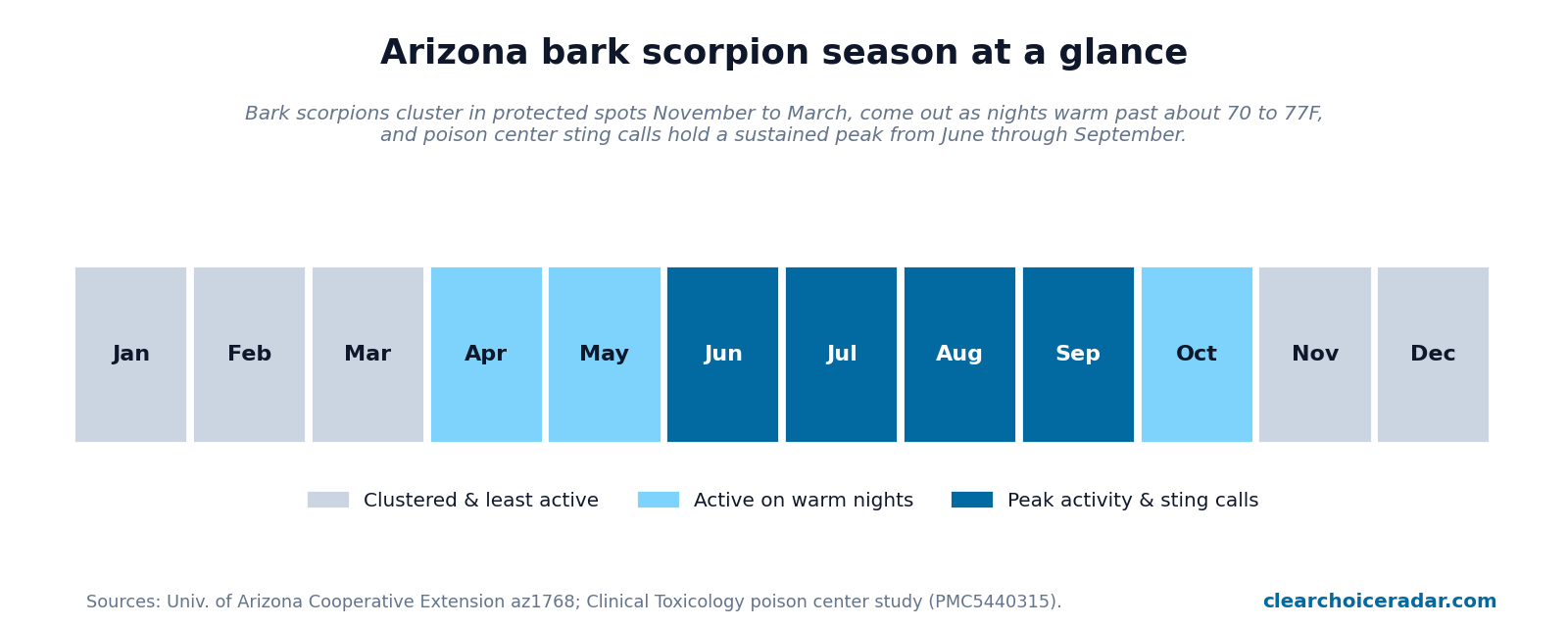
Bark scorpions are active most of the year in Arizona's low desert, and temperature runs the schedule. UA's main publication calls nighttime temperatures above 70 F "ideal," while its Backyard Gardener bulletin says scorpions are only active once nighttime lows exceed about 77 F. Split the difference in practice: when overnight lows settle into the 70s, they are out. Most movement happens "between 7pm-11pm, and 3am and sunrise," per UA.
During the coolest months, November through March, they go quiet. UA explains that they cluster in "weather protected, enclosed, and undisturbed spaces called hibernacula," and bark scorpions are unusual among scorpions for overwintering in groups. That is why disturbing one winter hiding spot can turn up a pile of them at once.
The sting data tracks the activity data. A peer-reviewed study of US poison center calls from 2005 to 2015 found Arizona averaged about 11,500 scorpion exposures per year, with "a sustained peak from June-September" and a low season from December through February. The practical takeaway cuts against instinct: the best time to seal and clean up is late winter and early spring, before the wave, not in July when you spot one on the ceiling.
The seal-up checklist, straight from the extension literature
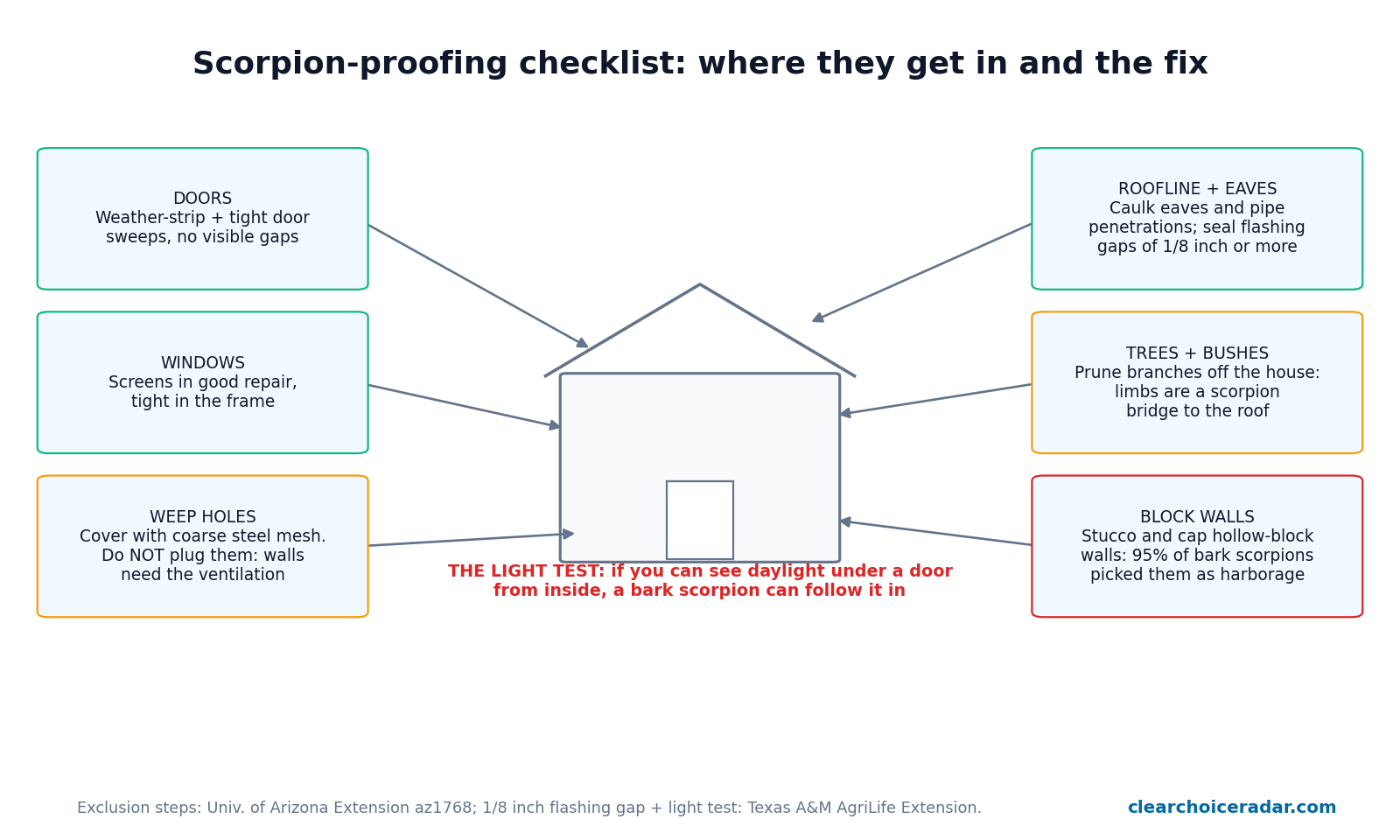
Here is the exclusion list the University of Arizona actually publishes, in its own words where it matters:
- Doors: "Install weather-stripping around doors and windows and ensure a snug fit" and "ensure door sweeps are tight fitting with no gaps." Texas A&M's school IPM plan adds the field test: check "whether light can be seen under the doorway from the inside." If light gets in, so can a bark scorpion.
- Windows: "Keep window screens in good repair. Make sure they fit tightly in the window frame."
- Weep holes: "Screen weep holes in brick veneer or weep screed with coarse steel mesh." Note the crucial second half: "the holes should not be plugged or sealed as they are important for the ventilation of wall spaces." Sealing them shut trades a scorpion problem for a moisture problem.
- Roofline and penetrations: "Caulk around roof eaves, pipes and any other points and wall penetrations into the building." Texas A&M gets specific about size: seal gaps under flashing "that are an 1/8 inch or larger, scorpions will chase their prey even at roof lines."
- Block walls: "Stucco and cap hollow-block walls to make them less inviting harborage zones." Given the 95 percent harborage figure above, capping open block cells is one of the highest-value fixes on the list.
None of this requires special products, just a caulk gun, weather-stripping, steel mesh, and a Saturday. It also compounds: the same sealing that blocks scorpions blocks the crickets and roaches they hunt.
Fix the yard so the house is not worth visiting
Exclusion keeps them out of the house; harborage removal shrinks the population living next to it. The UA list is short and blunt:
- "Do not allow wood, rocks, clutter or debris to build up against the home."
- Firewood: "If you bring firewood in from outdoor storage areas, place it directly on the fire; do not store woodpiles inside the home."
- "Keep grass closely mowed near the home. Prune bushes and overhanging tree branches away from the structure. Tree branches can provide a path to the roof for scorpions. Minimize low growing ground cover vegetation."
Texas A&M adds replacing loose mortar in brick or stone walls, and clearing construction materials, excessive mulch, and loose stones. On the food supply, UA is careful with expectations: "eliminating their food sources (crickets and other insects) can help, but will not eliminate scorpions from around the home." Fewer porch-light insects means a less attractive hunting ground, so tightening up outdoor lighting and reducing standing water helps at the margin. It is support work, not the main event.
What works, what helps, and what has no evidence
Scorpion control attracts more folklore than almost any other Arizona pest problem. Here is the honest scoreboard from the extension literature:
| Method | Verdict | What the sources actually say |
|---|---|---|
| Sealing and pest-proofing | The core strategy | UA: "by far the most effective way to reduce scorpion contact and potential scorpion stings" |
| Capping and stuccoing block walls | High value | UA recommends it directly; 95% of bark scorpions in cited research chose hollow block walls as harborage |
| Nighttime UV blacklight removal | Recommended | UA: scorpions "glow brightly" under UV; inspect before bedtime, collect with boots and long tongs; Texas A&M notes daytime searching "is inefficient and often unsuccessful" |
| Sticky traps | Monitoring tool | Texas A&M: they "readily catch scorpions and can be used to identify entry points." No source treats them as population control |
| Removing yard debris and prey insects | Helps, will not finish the job | UA: it "can help, but will not eliminate scorpions from around the home" |
| Insecticide sprays alone | Limited | UA: scorpions are "difficult to manage with pesticides alone." Texas A&M: sprays "should not be relied on as a sole control method" and should generally be restricted to outdoor areas |
| Ultrasonic repellers | Not advised | UA's device review: sonic pest devices "have not been shown to be effective in scientific studies... use of these devices is not advised" |
| Mothballs, cedar, other folk repellents | No evidence found | No extension publication we reviewed supports them for scorpions; mothballs used outside their label are also an EPA violation |
On chemicals, one nuance worth knowing before you buy anything: Texas A&M notes that newer-generation pyrethroid products hold up better outdoors than older ones, but frames all of it as suppression around the structure, not elimination. UA goes further about scale: eliminating scorpions from a landscape "would require extremely unhealthy and illegal chemical use that would at best, be a temporary eradication." Anyone promising to wipe them out is selling something the science does not support.
The blacklight ritual, and when to hand it to a pro
The cheapest monitoring tool in this entire fight is a UV flashlight. Scorpions fluoresce a bright blue-green under blacklight and, per UA's Backyard Gardener bulletin, "can easily be located from a distance of several yards." UA suggests UV sweeps "several times during summer months between 8-11pm," wearing boots, using long tongs to collect, and even releasing captures back into open desert since scorpions are beneficial predators. Indoors, a quick UV pass before bedtime is the habit UA specifically recommends for households that keep finding them.
When does it stop being a DIY project? A reasonable line: if you are still finding bark scorpions inside after a real sealing pass and a summer of UV checks, if you have an infant or young children at home, or if the population next door (that uncapped block wall) is not yours to fix. Poison center data is clear about the stakes for small kids: in the national study, children under 10 accounted for two-thirds of the cases with major medical effects. Arizona poison control's advice for any sting is the Poison Help line at 1-800-222-1222, and our bark scorpion guide covers what severe symptoms look like.
If you do bring in a company, verify the license before the truck arrives; our Arizona license lookup guide shows exactly how. We also keep local guides for Phoenix, San Tan Valley, Queen Creek, and the rest of our Arizona coverage, and quick answers to common pest questions live in the pest control answers hub.
Related Pest Control guides
Sources
- University of Arizona Cooperative Extension, az1768: Scorpions of the Desert Southwest United States
- University of Arizona Extension, Backyard Gardener #184: Scorpions
- Texas A&M AgriLife Extension: IPM Action Plan for Bark Scorpions
- University of Arizona Extension, az1639: Sonic Pest Repellents
- Arizona Poison and Drug Information Center: Scorpions
- Clinical Toxicology: US poison center scorpion exposure data, 2005 to 2015 (PMC5440315)
- Arizona Department of Health Services, Director's Blog: An AZ Monsoon Staple, the Scorpion
- Banner Poison and Drug Information Center: bark scorpion stings on the rise
- University of Arizona News: scorpion antivenom gains FDA approval
General information only; not professional pest-control, pesticide, or medical advice. Pesticide products must be used according to their label and local regulations. For an infestation, consult a licensed pest control professional in your area. Last updated July 2026.