How to Tell if You Have Termites: The Signs in Arizona, Texas, and Florida
The Four Signs That Actually Mean Termites
Skip the folklore; extension entomologists list four physical signs worth your attention (Texas A&M E-368, University of Arizona):
- Mud tubes. Pencil-diameter earthen tunnels on foundation walls, crawl space piers, or near utility openings. Subterranean termites build them from soil and saliva to travel protected between ground and wood.
- Discarded wings. Texas A&M notes the first sign homeowners usually notice is swarming reproductives, or their shed wings on windowsills, in spider webs, or near indoor lights. Swarmers inside the house usually indicate an active infestation in the structure.
- Damaged wood. Wood that sounds dull or thudding when struck, or that a screwdriver sinks into, revealing galleries that follow the grain and are lined with dried mud or pale fecal spotting.
- Pellet piles (drywood termites). Hard, dry fecal pellets accumulating in small piles beneath tiny round kick-out holes. This is the signature of drywood species, which never touch soil and build no tubes.
Termite or Flying Ant? The Ten-Second Check
Winged ants swarm in the same seasons and cause a lot of false alarms. Three differences settle it, straight from the extension diagrams (AZ1356, E-368):
- Antennae: elbowed on ants; straight on termites.
- Waist: ants are pinched behind the wings; termites are straight-bodied with no narrow waist.
- Wings: ants carry two pairs of unequal size; termite wings are four, equal in size and shape, and detach easily, which is why you find piles of identical wings with no insects attached.
If what you swept off the windowsill has equal wings and no waist, keep reading.
Found a Mud Tube? Here Is the One Useful Thing to Do
The internet will tell you not to touch anything. Extension guidance is more practical: Texas A&M says mud tubes should be broken open to check for live termites, and the University of Arizona recommends collecting a few specimens in alcohol so the species can be identified (AZ1356). An empty tube does not mean the colony is gone, but live workers inside settle the question, and the species determines the treatment.
What you should not do is start ripping out walls or spraying store-bought products at the visible spot. Subterranean termites work slowly; the Arizona extension is explicit that structural damage usually takes years to develop, so you have time to do this right. Confirm, collect, then get a professional inspection.
One detail worth knowing: tubes do not only climb up. Arizona's field guide describes four tube types, including drop tubes that hang down from ceilings and beams back toward the soil, a hallmark of the desert subterranean termite that startles a lot of Phoenix-area homeowners.
Arizona: Monsoon Swarms and Tubes From the Ceiling
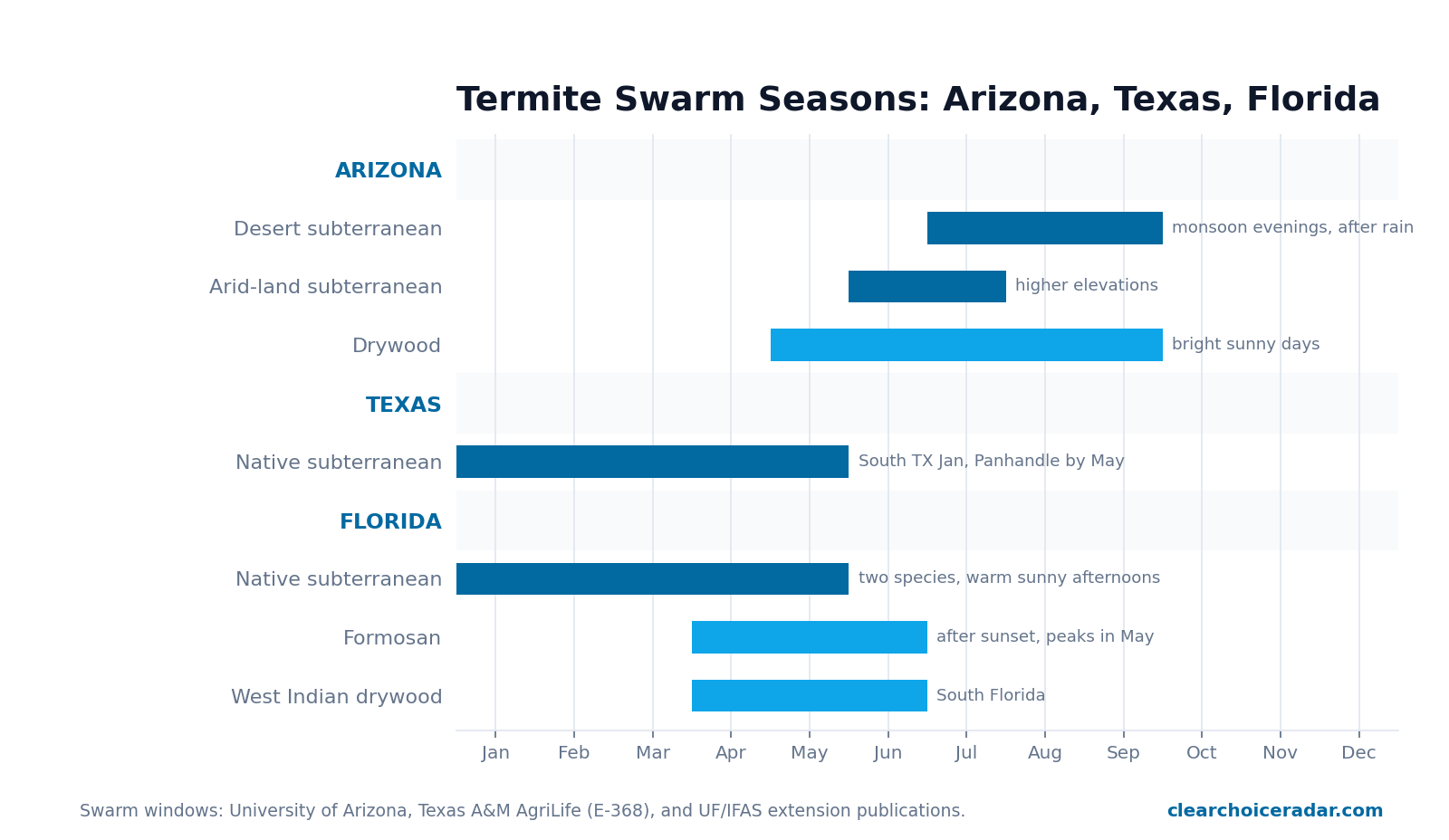
Arizona's most destructive species is the desert subterranean termite, which the University of Arizona calls the most economically damaging termite in the Southwest because heat and dryness barely slow it down (UA field guide). Its tubes are solidly built, round in cross-section, and lighter in color than other species' tubes. Winged adults fly after rain during monsoon season, July to September, so a burst of insects on a humid summer evening deserves the wing check above. At higher elevations, the arid-land subterranean termite swarms in June and July instead.
Arizona also hosts drywood termites, which fly on bright sunny days from May to early September and leave the telltale pellet piles. The extension's homeowner advice: check the stem wall where soil meets foundation about twice a year, once in spring and again near the end of monsoon season, and have a professional inspection annually. What roaches and scorpions look like across the Valley's suburbs is covered in our Arizona pest guides.
Texas: A 70 Percent Chance Over 25 Years
Texas A&M's numbers explain why termite clauses appear in every Texas real estate contract: subterranean termites cause about $500 million in damage per year in Texas alone, and an unprotected home has about a 70 percent probability of suffering some termite damage within 25 years (E-368).
The native subterranean termite is the default threat statewide; a mature colony runs to roughly a quarter million workers. Swarms start in South Texas as early as January and February and reach the Panhandle by April or May. The bigger concern along the Gulf Coast is the Formosan subterranean termite, an invasive species notorious for enormous colonies and rapid wood consumption that Texas A&M reports is moving north from the coastal counties.
Texas-specific paperwork worth knowing: state law requires a Wood Destroying Insect report with each formal termite inspection, and inspectors are licensed through the Structural Pest Control Service at the Texas Department of Agriculture. Local pest pressure across the growth suburbs is in our Texas pest guides.
Florida: Three Termite Problems at Once
Florida runs the fullest termite menu of any state we cover, per UF/IFAS entomology:
- Native subterranean termites statewide, with swarm flights on warm, sunny, windless early afternoons, one species flying January to April and another February to May (UF/IFAS).
- Formosan subterranean termites throughout the state, mainly in dense urban areas. Colonies can contain several million individuals, fill wall voids with carton nest material, and swarm shortly after sunset from early April to late June, peaking in May (UF/IFAS).
- West Indian drywood termites, the dominant drywood pest in South Florida, living entirely inside the wood. Watch for blistered or peeling surface wood and the hexagonal fecal pellets pushed out of millimeter-scale kick-out holes; mating flights run April to June (UF/IFAS).
Evening swarms after sunset in late spring point Formosan; afternoon swarms in late winter point native; pellets with no mud anywhere point drywood. Our Florida pest guides cover the rest of the local cast.
What to Do the Day You Find Signs
The extension consensus is consistent across all three states (UF/IFAS, AZ1356, E-368):
- Do not panic, and do not DIY the treatment. Arizona's extension says plainly that attempting termite control on your own is not recommended, and UF/IFAS states termites generally require a pest management professional.
- Confirm and collect. Break open a tube to check for live termites and save a few in alcohol for identification; species drives treatment.
- Get more than one inspection. University of Kentucky's homeowner guidance recommends estimates from multiple companies precisely because it verifies whether an infestation is real.
- Verify the license. Termite work runs through the Structural Pest Control Service at the Texas Department of Agriculture, the Pest Management Division of the Arizona Department of Agriculture, and FDACS in Florida. Our license lookup guide has the exact steps.
On treatment, the broad landscape from extension sources: liquid soil termiticides remain the primary approach for subterranean species, baits work by suppressing the colony itself, and whole-structure fumigation is the tool for drywood termites since they live entirely inside the wood. Which fits your house is exactly what competing inspections should tell you; our buyer's guide covers how to compare the proposals.
Prevention Extension Entomologists Actually Recommend
Every source converges on the same unglamorous list:
- Keep soil and wood apart. No wood-to-soil contact anywhere: fence posts, trellises, stair casings, door facings. Exterior wood should sit at least 6 inches above grade, and Texas A&M wants 6 to 8 inches of visible foundation below any wall covering.
- Move the water. Grade soil to slope away from the structure, aim irrigation heads away from walls, and in Arizona keep main irrigation lines and plantings at least 18 inches off the stem wall.
- Clear the buffet. Remove stumps, form stakes, and wood scraps from around and under the foundation; Arizona's guidance extends that to within 25 feet of the structure.
- Leave an inspection strip. UF/IFAS recommends keeping at least 6 inches between the soil or mulch line and the bottom of wall siding, so tubes have nowhere to hide.
- Look on schedule. Annual professional inspections, plus your own stem-wall check twice a year in the desert Southwest.
Key Takeaway: Species First, Then Treatment
Termites nationally cause billions of dollars in damage a year, but an individual infestation is a slow-moving problem you can handle methodically: confirm live termites, identify the species (mud tubes mean subterranean, pellet piles mean drywood), get multiple licensed inspections, and match the treatment to the species rather than to the scariest sales pitch. The state matters more than most guides admit, because an Arizona monsoon swarm, a Texas Gulf Coast Formosan colony, and a South Florida drywood infestation are three different problems with three different answers.
Related Pest Control guides
Sources
- Texas A&M AgriLife Extension: Subterranean Termites (E-368)
- University of Arizona Extension: Termite Management for Homeowners (AZ1356)
- University of Arizona: Structural Pests, Termites
- UF/IFAS: Formosan Subterranean Termite
- UF/IFAS: Native Subterranean Termites
- UF/IFAS: West Indian Drywood Termite
- UF/IFAS: Termite Prevention and Control
- University of Kentucky Extension: Termite Control Answers for Homeowners
General information only; not professional pest-control, pesticide, or medical advice. Pesticide products must be used according to their label and local regulations. For an infestation, consult a licensed pest control professional in your area. Last updated July 2026.