Does Seeing One Cockroach Mean You Have an Infestation?
The Short Answer: It Depends on Which Cockroach You Saw
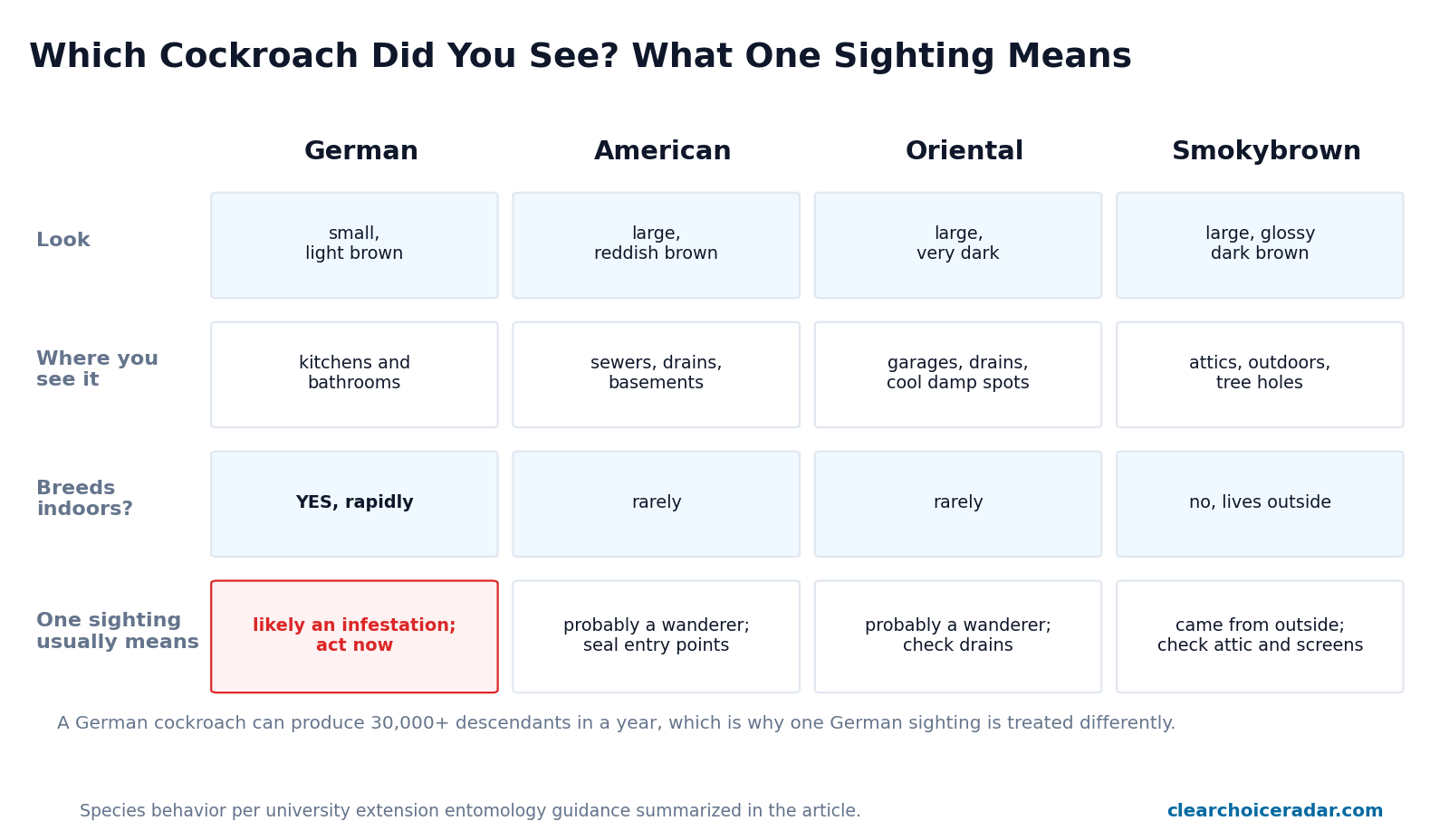
One cockroach is a data point, not a verdict. The question that actually matters is what species it was. The German cockroach is the most common indoor cockroach in the United States, and it lives and breeds inside buildings (UC IPM). If you saw one of those, there is a real chance more are hiding nearby, because a lone German cockroach far from other roaches is unusual.
Large roaches are a different story. American, Oriental, and smokybrown cockroaches live mostly outdoors, in sewers, drains, woodpiles, and mulch, and they wander indoors while foraging for food, water, or mates (UC IPM). A single big roach on the bathroom floor at midnight is often exactly what it looks like: one insect that came in from outside, not evidence of a colony in your walls.
Which Cockroach Did You See? Species Changes Everything
German cockroach. Small and light brown, and by far the most common roach found breeding indoors. University of Minnesota Extension notes it favors warm, humid spots around 70 to 75 degrees, which is why kitchens and bathrooms are its favorite rooms (UMN Extension). It hides in cracks near sinks, dishwashers, and ovens.
American cockroach. Much larger and reddish brown. It readily lives outdoors and is commonly found in sewers and basements, occasionally foraging up into the ground floor of buildings (University of Florida). In Florida it is the classic palmetto bug.
Oriental cockroach. Dark and drawn to cool, damp places like garages, basements, water meter boxes, and drains. It migrates into buildings looking for food and water (UC IPM).
Smokybrown cockroach. An outdoor species common across the South, living in tree holes, woodpiles, and attics (University of Florida).
The pattern to remember: small roach in the kitchen means investigate now. Big roach near a door, drain, or garage usually means the outdoors came to visit.
Why One German Cockroach Is a Bigger Deal
German cockroaches earn their reputation through reproduction. A female produces four to eight egg cases in her lifetime, and each case holds 30 to 40 eggs (University of Florida IFAS). UC IPM puts the math bluntly: this species has the fastest reproductive cycle of the common pest cockroaches, and a single female and her offspring can produce over 30,000 individuals in a year (UC IPM).
That is why one German cockroach warrants a closer look even if you never see a second one. The population that produced it is usually close by, tucked into a crack within a few feet of food, warmth, and moisture. NC State Extension points to the spots people miss: under the sink, next to the dishwasher, behind the oven (NC State Extension).
Saw It During the Day? Here Is What That Actually Means
Cockroaches are mostly nocturnal. During the day they hide in warm, dark, moist crevices, and they come out at night to feed (UC IPM). You may have heard that a roach out in daylight proves a massive hidden infestation. Extension sources do not actually state it that strongly, so we will not either.
What is fair to say: daytime activity is atypical for an insect that normally hides while the lights are on, so a daytime sighting is a reason to check the real evidence described below rather than shrug it off. One nighttime sighting of an outdoor species, by contrast, is the least alarming version of this event.
The Real Signs of an Infestation (Check These Before Panicking)
UC IPM lists the physical evidence that separates a stray wanderer from a breeding population (UC IPM):
- Fecal spotting. Accumulations of dark spots or smears, often in cabinet corners, along shelf edges, and near cracks.
- Cast skins. Roaches shed their skins as they grow; finding them means roaches are living and molting there.
- Egg cases. Small, purse-shaped capsules called oothecae, whole or hatched.
- Live or dead cockroaches in cabinets, under appliances, or in stored boxes.
- Stains and unpleasant odors on surfaces where roaches congregate.
The best way to confirm what you are dealing with is embarrassingly low-tech: sticky traps. UC IPM calls glue boards the best way to detect and monitor cockroach populations. Place them where walls meet floors, under the sink, and behind appliances, then check them for a few nights. What you catch, and where, tells you the species and the hot spots.
What to Do Tonight: The Steps That Actually Work
Whether you saw a wanderer or the first scout of a colony, the same integrated pest management playbook applies, straight from extension guidance (UC IPM, UMN Extension):
- Cut off food and water. Clean crumbs and spills right away, store food in airtight containers, keep garbage in containers with tight lids, and fix plumbing leaks. The EPA repeats the same list in its asthma guidance for a reason (EPA).
- Seal the doors they used. Caulk cracks and gaps, and add door sweeps and weather stripping. This matters most for the outdoor species that wander in.
- Set sticky traps to confirm species and locations before treating anything.
- Prefer baits over sprays. UC IPM notes bait products are the primary pesticides used against cockroach infestations, while insecticide sprays do not provide long-term control.
- Skip the bug bomb. Total-release foggers are often ineffective because they never reach the crevices where roaches actually live, and they can be hazardous (UC IPM). Minnesota Extension is even more direct: do not use aerosol foggers and bombs.
Any pesticide you do use must be used according to its EPA-registered label, including baits and gels sold to consumers.
When One Roach Justifies Calling a Professional
Call sooner rather than later if the roach was a German cockroach, if traps catch roaches on multiple nights, if you find droppings or egg cases, or if you live in an apartment or townhome where roaches move between units through shared walls and plumbing.
There is also a health reason not to wait out a growing population. The EPA notes that proteins in cockroach droppings and saliva can cause allergic reactions or trigger asthma symptoms in some people, and shed skins carry allergens too (EPA). UC IPM likewise identifies indoor cockroach infestations as a risk factor for asthma development in children (UC IPM).
If you decide to hire help, our guide on how to choose a pest control company walks through licensing, service agreements, and red flags, and our local pest control guides cover what roach pressure looks like in specific Arizona, Texas, and Florida communities.
Key Takeaway: Identify First, Then Act
One big outdoor roach near a door or drain is usually a wanderer; seal the gap it used and move on. One German cockroach in a kitchen or bathroom deserves immediate attention, because that species breeds indoors fast. Either way, sticky traps and a hard look for droppings, cast skins, and egg cases will tell you the truth within a few nights, and sanitation plus exclusion plus baits beats panic-spraying every time.
Related Pest Control guides
Sources
General information only; not professional pest-control, pesticide, or medical advice. Pesticide products must be used according to their label and local regulations. For an infestation, consult a licensed pest control professional in your area. Last updated July 2026.