How Do You Know If You Have Bed Bugs? The Evidence That Actually Counts
The Evidence That Actually Confirms Bed Bugs
The EPA's identification guidance is refreshingly concrete (EPA, life cycle page):
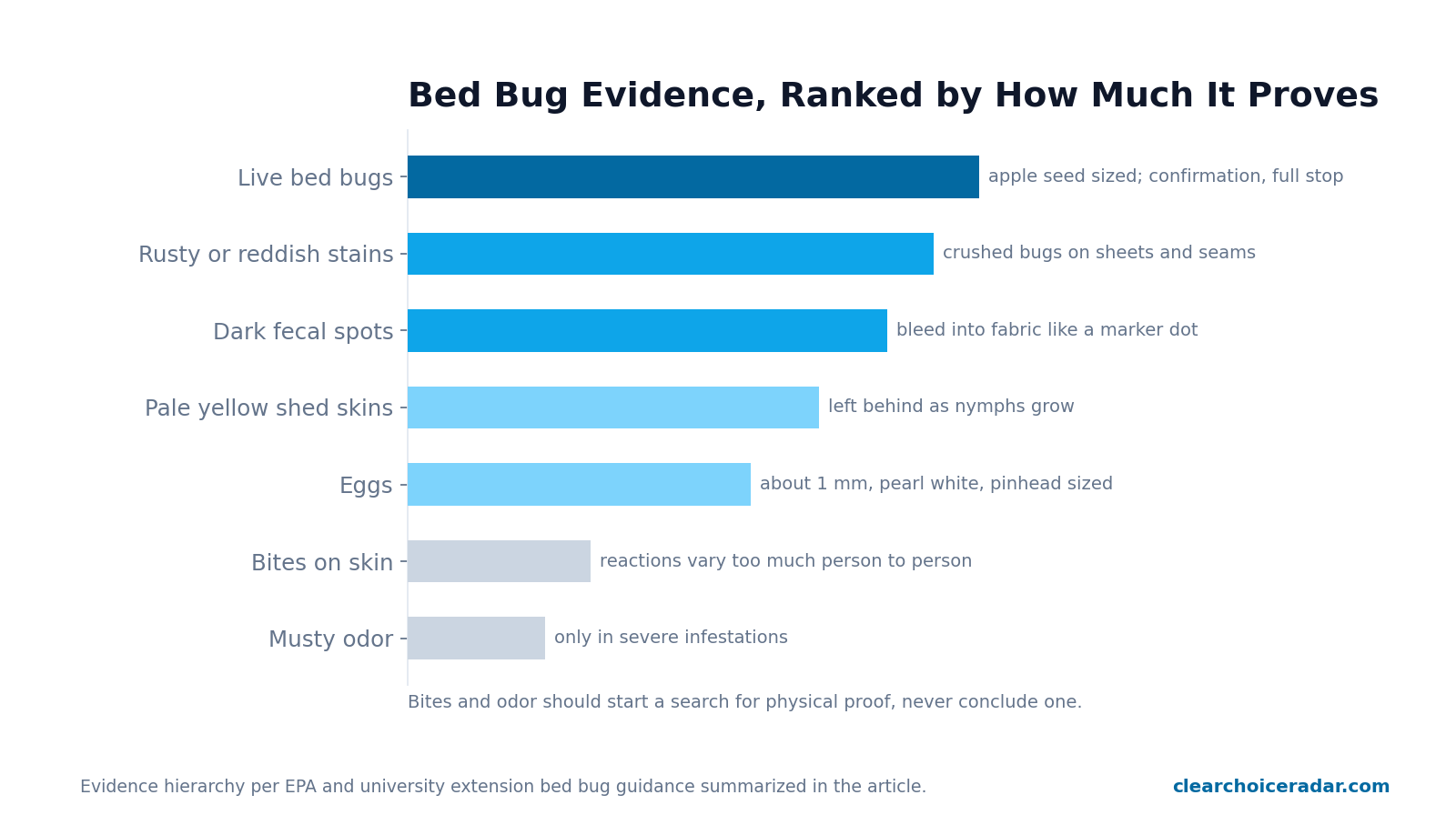
- Live bugs. Adults are about the size of an apple seed, flat and oval when unfed, and balloon-like, reddish brown, and more elongated after feeding. Young nymphs are translucent to whitish yellow and, if unfed, can be nearly invisible to the naked eye.
- Rusty or reddish stains on sheets or the mattress, from bugs being crushed.
- Dark spots of excrement that, in the EPA's memorable phrasing, may bleed on fabric like a marker would.
- Pale yellow shed skins that nymphs leave behind as they grow.
- Eggs and eggshells, about a millimeter, pearl white, pinhead sized.
One sign to discount: the famous musty-sweet odor. Extension sources describe it only in severe or heavy infestations, and the EPA's own detection checklist does not list smell as a sign at all. If your only evidence is an odor, keep looking for the physical proof above.
Why Bites Are the Worst Evidence You Have
The EPA states it flatly: bites on the skin are a poor indicator of a bed bug infestation (EPA). Reactions vary from person to person, bites resemble mosquito or chigger bites, rashes, or hives, and some people do not react at all, which means two people sharing a bed can wake up with completely different evidence.
On health, the careful official framing is worth quoting: bed bugs have not been shown to transmit disease, but they cause real negative effects, including allergic reactions ranging from nothing to, in rare cases, anaphylaxis, secondary skin infections from scratching, and documented mental health effects such as anxiety and insomnia (EPA public health page). Taking an infestation seriously is justified; panicking about disease is not.
Where to Actually Look
Bed bugs hide close to where people sleep and sit. The EPA's checklist of hiding spots, roughly in order of usefulness (EPA):
- Mattress piping, seams, and tags, and the box spring's seams and frame
- Cracks in the bed frame and headboard
- Seams of chairs and couches and the spaces between cushions
- Curtain folds, drawer joints, and under loose wallpaper
- Electrical outlets, appliances, wall and ceiling junctions, even screw heads
Detection tools help when a visual search is inconclusive: interceptor traps placed under furniture legs catch bugs climbing up and are checked weekly, per the EPA's do-it-yourself guidance. A confirmed catch in an interceptor is exactly the kind of specimen evidence that makes a professional's job faster.
The Dirty House Myth
UC IPM's entomologists put this one to rest: bed bug infestations were long assumed to belong to crowded, dilapidated housing, but the modern resurgence reaches, in their words, even the finest hotel and living accommodations (UC IPM). Bed bugs feed on people, not filth; they arrive by hitchhiking on luggage, clothing, bedding, and especially secondhand mattresses and furniture, and in multi-unit buildings they travel between adjacent apartments.
Where housekeeping does matter is hiding places: clutter gives bed bugs more harborage and makes control harder, which is why decluttering appears in every treatment plan. But a spotless home with a recently traveled suitcase is a perfectly plausible infestation site, and nobody should let embarrassment delay dealing with it.
What You Can Usefully Do Yourself
Several homeowner measures genuinely help, per the EPA and Minnesota Extension (EPA, UMN):
- Encase the mattress and box spring. Sealing covers trap the bugs inside, where they die, and you usually do not need to throw the mattress away.
- Launder hot. Wash and dry bedding and clothing at the hottest safe setting; UF/IFAS notes that drying above 122 degrees Fahrenheit for 20 minutes kills all life stages.
- Vacuum with a crevice tool, then seal the bag tightly and dispose of it in an outdoor container immediately.
- Set interceptors under bed and furniture legs, and caulk cracks and crevices.
- Declutter to shrink the hiding territory, and avoid relocating belongings to other rooms while the infestation is active, which spreads it.
Why the Full Fix Is Usually Professional Work
The honest limits of DIY, from the same sources:
- Foggers backfire. The EPA notes fogger pesticides must contact the pest to kill it and will not reach the cracks and crevices where bed bugs hide, and says foggers should not be the sole source of bed bug control (EPA). UC IPM goes further: total release foggers have been shown to be ineffective for bed bug control.
- Resistance is real. UC IPM reports some bed bug populations have developed resistance to pyrethroid insecticides, the active ingredients in most store products, which it does not generally recommend.
- Heat works, but not DIY heat. Professional heat treatment holds rooms at 118 degrees Fahrenheit for at least 70 minutes per UF/IFAS; the EPA warns that improvising with space heaters does not work and is dangerous.
Minnesota Extension's bottom line matches the EPA's: bed bugs are very difficult to control on your own, and working with a professional is recommended. If that is where you land, verify the license first with our state license lookup guide, ask whether the plan is heat, insecticide, or both, how many follow up visits are included, and what preparation they require of you. Our buyer's guide covers comparing the proposals, and our local guides cover what to expect from companies in your area.
Key Takeaway: Confirm With Physical Evidence, Then Move Fast
Skip the bite forensics and hunt the physical signs: live bugs the size of an apple seed, rusty stains, marker-like dark spots, shed skins, and pinhead eggs in mattress seams and furniture joints. A clean house is no defense and no embarrassment is warranted; luggage and used furniture are how they arrive. Encasements, hot laundry, vacuuming, and interceptors are worth doing immediately, and for the infestation itself, the evidence points one way: this is the pest where hiring a licensed professional is the plan, not the fallback.
Related Pest Control guides
Sources
General information only; not professional pest-control, pesticide, or medical advice. Pesticide products must be used according to their label and local regulations. For an infestation, consult a licensed pest control professional in your area. Last updated July 2026.