Your SAVE Plan 90 Day Notice: What the Deadline Really Is, and What Happens If You Ignore It
First, a correction most coverage has not caught up to
SAVE is not being paused, and it is not winding down. It was stopped by a court. Federal Student Aid's own page, last updated July 1, 2026, puts it plainly: "On March 10, 2026, a federal court issued an order preventing the U.S. Department of Education (ED) from implementing the SAVE Plan and parts of other income-driven repayment (IDR) plans."
What remains is the residual forbearance that SAVE borrowers were parked in, and that is what the current notices are moving people out of. In FSA's words, borrowers "who have loans in forbearance because they enrolled in or applied for the Saving on a Valuable Education (SAVE) Plan must select a new repayment plan." The Education Department put the affected population at 7.5 million borrowers.
The 90 day clock is yours alone, and the official site will not tell you about it
This is the part worth reading twice. There is no single national deadline. Servicers began issuing exit notices on July 1, 2026, and each borrower gets 90 days from the notice they received. The Education Department has said the notices are staggered, and its June 2026 court filing describes "transitioning borrowers in tranches." Press coverage of that filing characterizes the rollout as potentially stretching over a prolonged period.
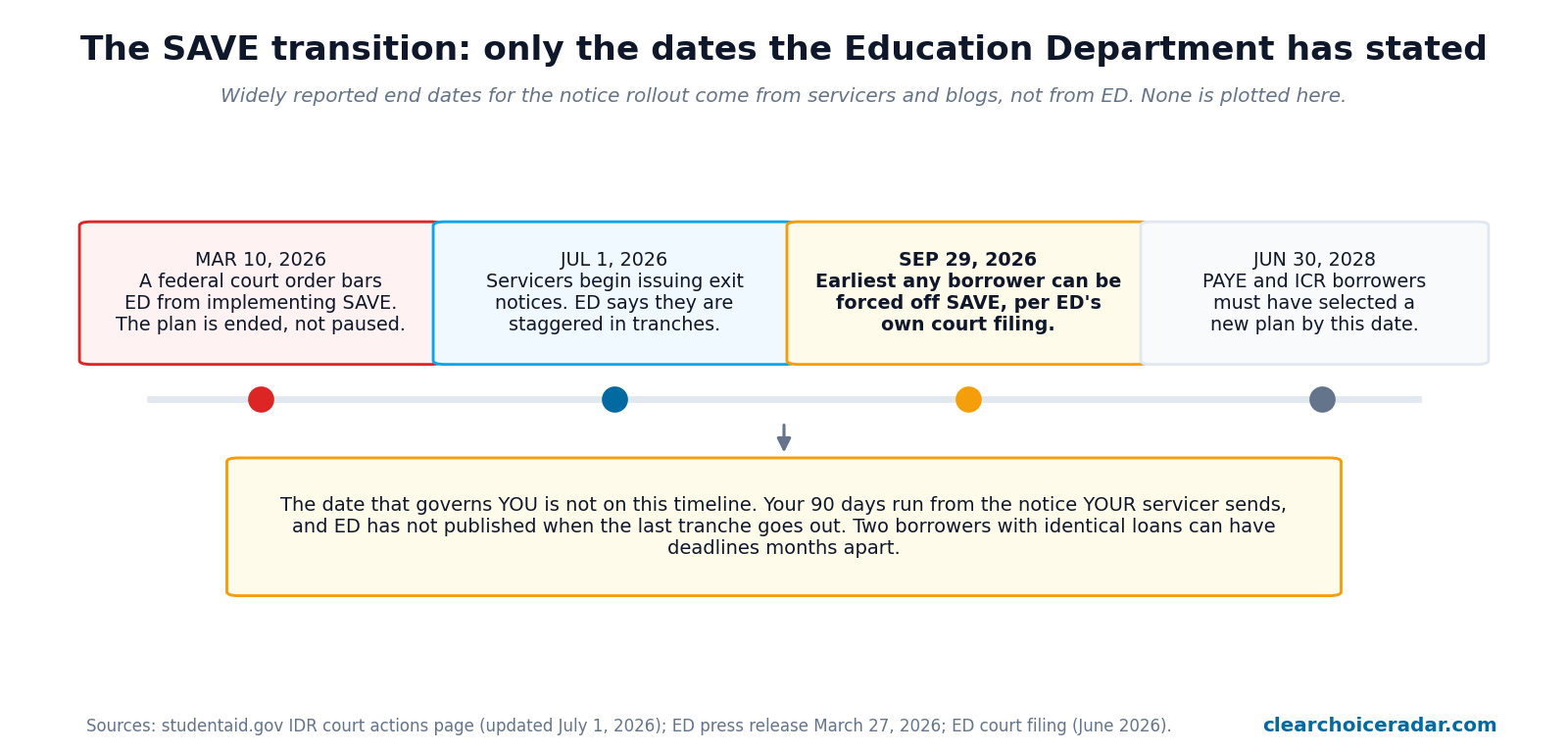
The earliest anyone can be pushed off is September 29, 2026, which is 90 days after the first notices. That figure comes from ED's own court filing: "No borrower will be required to move off the SAVE Plan until September 29, 2026 at the earliest."
Now the part that should bother you. That 90 day window does not appear anywhere on the borrower-facing pages of studentaid.gov. A borrower who does the responsible thing, ignores the noise and goes straight to the official site, will not learn that a clock is running on their account. The window is stated in an ED press release and in a court filing. So the practical advice is unusually blunt: find the notice from your servicer and read the date on it. That document, not any article including this one, is what governs your deadline.
You should also know that ED has not published when the last tranche goes out. You will see confident end dates in circulation. They trace back to servicer guidance and blog posts, they conflict with each other, and at least one has already been revised. Do not plan around one.
What actually happens if you do nothing
Almost every article you will find says you get automatically enrolled in the Standard Repayment Plan. That is a compression of what the Education Department said, and the missing half matters.
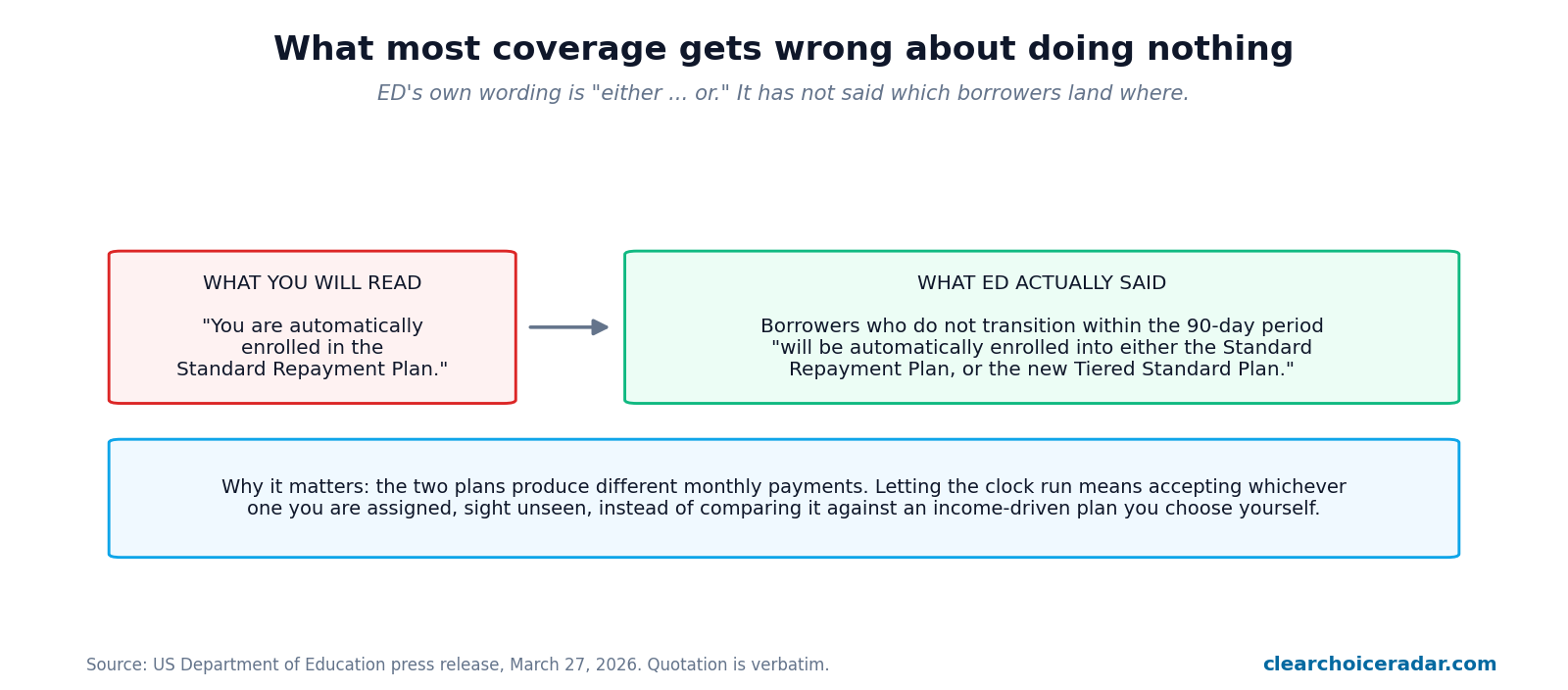
The March 27, 2026 release says borrowers who do not transition within the 90 day period "will be automatically enrolled into either the Standard Repayment Plan, or the new Tiered Standard Plan." ED has not published the tie-breaker. FSA's own phrasing is softer still: if you do not select a plan, "your loan servicer will move you to a different plan."
Those two plans do not produce the same monthly payment, and neither is income-driven. Letting the clock run means accepting whichever one you are handed without seeing it first, rather than comparing it against a plan you pick deliberately. That is the real cost of inaction here, and it is not dramatic. It is just worse than choosing.
Interest has been running since August 2025
If you have not looked at your balance in a while, look now. The Education Department announced on July 9, 2025 that it had instructed servicers "to begin charging interest on impacted loans starting on August 1, 2025." ED also said interest "will not be assessed retroactively," so the accrual starts from that date rather than reaching backward.
Worth flagging for anyone trying to verify this themselves: that date is no longer on studentaid.gov's SAVE and forbearance pages. It is documented in the ED press release. This is a recurring theme in this whole episode, which is that the official borrower-facing site and the department's press output do not contain the same facts.
What the forbearance months did and did not buy you
Be careful here, because this is where hopeful assumptions do real damage.
The general rule on FSA's forbearance page is that for "(PSLF) or income-driven repayment forgiveness, forbearance will not allow you to make progress toward forgiveness." FSA has not published SAVE-specific language contradicting that, so plan on those months not counting rather than hoping they will.
For public service borrowers there is one concrete, SAVE-specific rule in FSA's IDR court-actions guidance: if the start or end date of the forbearance period you want to buy back falls on or after July 1, 2024, then the buyback amount "cannot be based on the SAVE Plan formula." Buyback also requires that you already have 120 months of qualifying employment.
One more practical note: FSA has said the court actions require it to modify the display of IDR payment counters. If your count looks wrong or missing right now, that is a known display situation and not necessarily evidence that your progress was erased.
The plans you can actually choose, and the 2028 cliff behind them
Two things are happening at once: the immediate 90 day decision, and a longer restructuring that will force a second decision for many people.
IBR remains. Income-Based Repayment is written into statute and is not part of the sunset described below.
RAP became available July 1, 2026. The Repayment Assistance Plan works differently from the income-driven plans people are used to, and the difference is routinely described wrong. The base payment is an annual figure, between 1% and 10% of adjusted gross income rather than discretionary income, which is then divided by twelve, then reduced by $50 per dependent, with a floor of $10 a month. The bracket rises one percentage point per $10,000 of AGI. Forgiveness comes after 360 qualifying payments, which is 30 years. It also carries an unpaid interest waiver: interest accrued and not paid for a month is not charged to the borrower.
Note the eligibility wording carefully, because it is not the phrase most articles use. The statute keys to loans made on or after July 1, 2026, not loans first disbursed on that date. Borrowers in that category have a narrower menu: the Tiered Standard plan or RAP, with RAP as their only income-driven option.
The 2028 sunset. A final rule published in the Federal Register on May 1, 2026 implements a sunset Congress wrote into law: income-contingent repayment plans are no longer available after July 1, 2028. Because PAYE and SAVE were both created under ICR authority, all three go together. FSA has told PAYE and ICR borrowers they "must select a new repayment plan no later than June 30, 2028." If you are choosing a plan this quarter, it is worth knowing which ones have an expiration date attached.
Nobody can do this for you, and nobody should be charging you for it
A deadline affecting 7.5 million people with a confusing, under-documented rollout is exactly the condition that produces a wave of paid "help." Some plain statements to keep you out of trouble:
- Selecting a repayment plan is free. You do it at studentaid.gov or through your servicer. There is no version of this process that requires a paid intermediary.
- Debt relief companies cannot help with this. Federal student loans are not what debt settlement, debt consolidation, or debt management plans address. Those are tools for unsecured consumer debt such as credit cards. A company offering to settle or consolidate your federal student loans is describing something it cannot deliver.
- Nobody has special access. There is no expedited channel, no insider enrollment, and no application that a third party can file that you cannot.
- Be skeptical of a firm final deadline. Anyone quoting you a single hard nationwide cutoff is quoting something ED has not published. Urgency about a date nobody can source is a sales tactic.
If you want help, the free and legitimate route is your servicer, studentaid.gov, or a nonprofit credit counseling agency. Our debt relief guide covers what those programs do and do not cover, and our debt relief answers hub has plain answers to the common questions.
One more thing, about collections
If your loans are already in default, the current picture is better than most reporting suggests, and the widely repeated restart date is not something the Education Department has announced.
On January 16, 2026, ED said it "will delay the implementation of involuntary collections on federal student loans, including Administrative Wage Garnishment (AWG) and the Treasury Offset Program (TOP)." Both are paused, not just wage garnishment, and that release names no resumption date. You will see a fall 2026 restart cited in places. It traces to anticipatory language on a personal finance blog rather than any ED announcement.
That is not a reason to relax. The same release notes that ED "reports student loan defaults to credit reporting agencies, which may adversely impact borrower credit reports." A pause on collection is not a pause on credit damage.
And a distinction worth making, since the two get conflated: administrative wage garnishment for federal student loans operates under its own federal rules, not the Consumer Credit Protection Act limits that govern most consumer debt garnishments. If you are trying to understand the CCPA side for non-student debts, that is what our wage garnishment calculator and garnishment guide cover. Do not apply those numbers to a federal student loan.
Related Debt Relief guides
- Debt settlement
- Debt consolidation
- Debt management plans
- Alternatives to bankruptcy
- Time-barred debt
- Medical debt
- Canceled debt
- Debt relief scams
- Debt payoff
- Debt collection process
- Debt validation notice
- Sued for a debt
- Wage garnishment limits
- Wage garnishment calculator
- Debt-to-income calculator
- Debt validation letter generator
- Statute of limitations on debt by state
- Debt collection complaint statistics
- Average credit card interest rate
- Debt collection questions answered
Sources
- Federal Student Aid, IDR Plan Court Actions: Impact on Borrowers (updated July 1, 2026)
- US Department of Education press release, March 27, 2026: next steps for borrowers enrolled in the SAVE Plan
- US Department of Education press release, July 9, 2025: loans in the SAVE Plan begin accruing interest August 1
- US Department of Education press release, January 16, 2026: delay of involuntary collections
- 20 U.S.C. 1087e (Repayment Assistance Plan and repayment plan authority)
- Federal Student Aid, Public Service Loan Forgiveness Buyback
General information only; not financial or legal advice. Debt relief options carry risks including credit score impact and potential tax liability. Consult a qualified financial advisor for advice specific to your situation. Last updated July 2026.