What Happens If You Ignore a Debt Collector? The Stage-by-Stage Truth
The Short Answer: Ignoring Changes the Timeline, Not the Debt
The CFPB answers this question directly: ignoring or avoiding a debt collector is unlikely to make them stop contacting you, and they may use other methods to collect, including filing a lawsuit (CFPB). Depending on your contract and state law, interest and fees may also continue to accrue while you wait.
What ignoring really does is walk you through the collection process's stages without using the leverage each stage offers. Here is that walk, stage by stage, including the one scenario where doing nothing is genuinely the smart move.
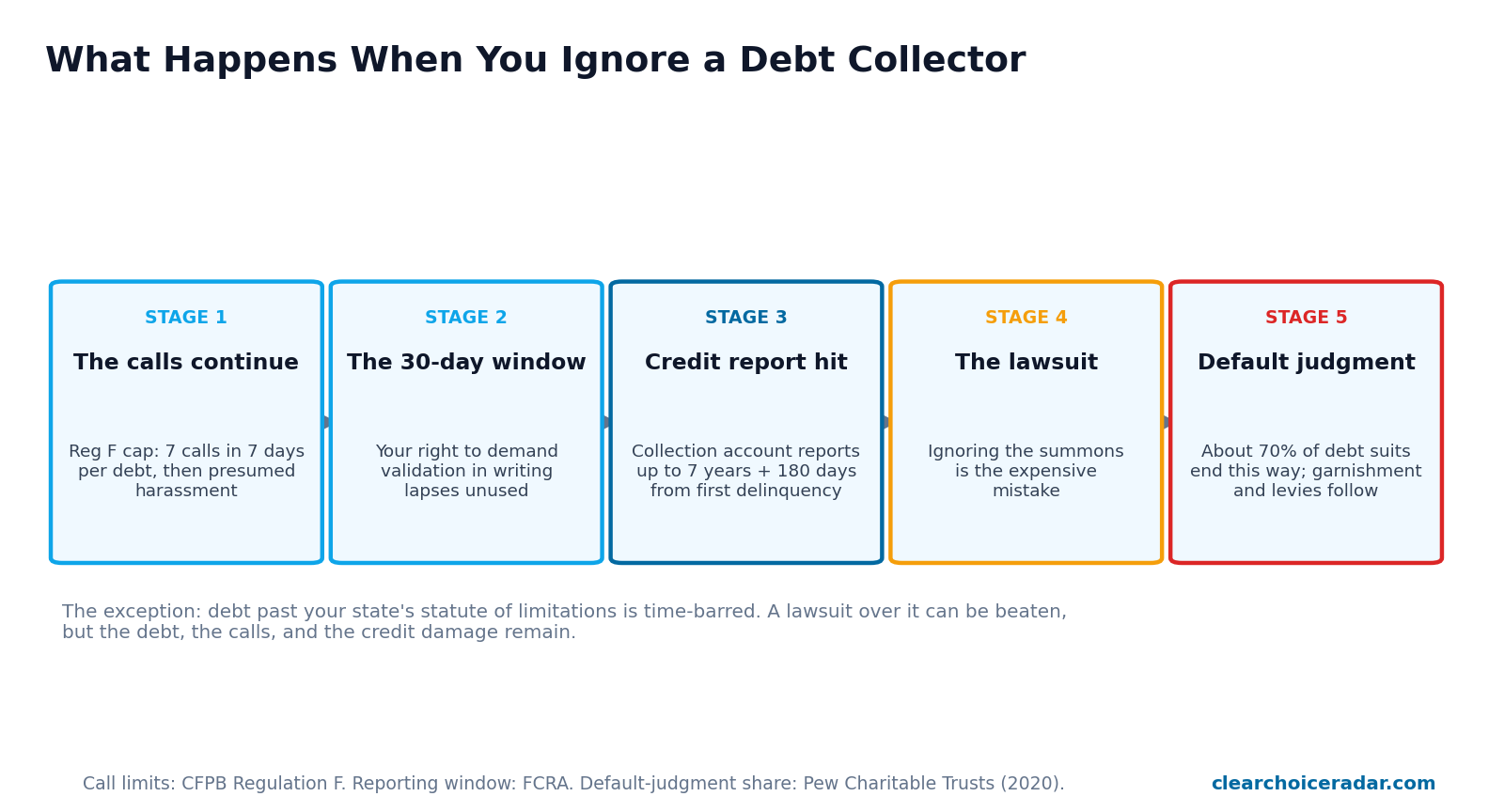
Stage 1: The Calls Continue, Within Legal Limits
Federal rules cap the pressure. Under Regulation F, a collector is presumed to violate the law's harassment prohibition if it calls you about a particular debt more than seven times within seven consecutive days, or within seven days after speaking with you about that debt (12 CFR 1006.14). Two honest footnotes: it is a presumption rather than an absolute cap, and it applies per debt, so three debts can lawfully mean more total calls.
The thing is, you do not have to choose between answering every call and pretending your phone is broken. You can demand in writing that a collector contact you only by mail, which is one of the options built into our validation letter generator. Silence gives up that control; a one-page letter keeps it.
Stage 2: The 30-Day Window You Are Letting Expire
Early in collection you receive a validation notice, and it starts a 30 day clock with real power attached. Dispute the debt in writing within that window and the collector must stop collecting until it sends verification; request the original creditor's name and address in writing and collection pauses until you get it (12 CFR 1006.38).
Ignore the notice and nothing dramatic happens on day 31, but the automatic pause is gone for good. You can still dispute a debt you believe is wrong later; the collector just no longer has to stop collecting while it responds. Our validation notice decoder covers the stage in detail, and the letter tool builds the response in a few minutes.
Stage 3: Your Credit Report Takes the Hit on Its Own Schedule
While you ignore the letters, the collection account sits on your credit report, and ignoring does not shorten its stay. Under the Fair Credit Reporting Act, a collection account can be reported for up to seven years plus 180 days from the date the account first went delinquent (15 U.S.C. 1681c). Two details people get wrong: the clock runs from the original delinquency, not from when the debt was sold or placed with a new collector, and this reporting clock is completely separate from your state's statute of limitations on lawsuits.
That separation cuts both ways: a debt can become too old to sue on while still appearing on your report, or drop off your report while remaining legally collectible. Our 50 state statute of limitations table covers the lawsuit clock.
Stage 4: The Lawsuit, Where Ignoring Costs the Most
If the collector sues, ignoring stops being passive and becomes the losing move itself. In jurisdictions with available data, Pew found courts resolved more than 70 percent of debt collection lawsuits with default judgments for the plaintiff, meaning the consumer never responded (Pew, 2020). The collector did not have to prove the debt was valid, correctly calculated, or within the statute of limitations, because nobody showed up to ask.
The CFPB adds the part that stings later: a judgment entered because you did not respond can limit your ability to dispute the debt afterward, even if it was already paid or never yours (CFPB). The response deadline is printed on the summons and is commonly measured in weeks. Whatever you have ignored up to this point, do not ignore this; our debt lawsuit decoder walks through the answer step by step.
Stage 5: After a Default Judgment
A judgment converts a collector's phone calls into court-backed tools. Per the CFPB, a creditor with a judgment may be able to garnish wages or levy bank accounts, subject to federal and state limits and exemptions, and depending on your state a judgment can also attach as a lien to property. Federal law caps ordinary wage garnishment, and several states protect more or bar consumer garnishment entirely; our garnishment calculator runs your actual numbers.
Even here, options exist: exemptions must often be actively claimed, some default judgments can be set aside promptly for valid reasons, and judgment creditors negotiate. The judgment stage decoder covers what remains on the table.
The One Time Waiting Is a Strategy: Time-Barred Debt
There is a scenario where minimal engagement is genuinely rational: debt older than your state's statute of limitations. Regulation F prohibits collectors from suing or threatening to sue on time-barred debt (12 CFR 1006.26), though the CFPB notes that in most states they may still ask you to pay voluntarily.
The trap is revival. The CFPB warns that making a partial payment, or even acknowledging you owe an old debt, may restart the limitations period depending on your state (CFPB). A few states bar revival outright and two extinguish expired debt entirely, which is exactly what the badges on our statute of limitations table mark. Before saying anything to a collector about an old debt, know which kind of state you are in.
What to Do Instead of Ignoring
Each stage has a cheaper move than silence:
- At first contact: make them prove it. A written validation request costs a stamp and forces documentation; the letter generator builds it in your browser.
- If the debt is real and recent: deal with it on your terms, whether that is negotiating directly, a payment plan, or comparing the structured options in our side by side guide.
- If a summons arrives: answer it by the deadline, every time, even when you plan to settle. Responding is how the 70 percent statistic stops applying to you.
- If the debt is old: check the statute of limitations before any payment or admission.
Key Takeaway: Silence Is a Decision With a Price List
Ignoring a debt collector does not end anything; it forfeits the validation pause, lets the credit damage run its full seven plus years, and, if a lawsuit comes, converts a contestable claim into a default judgment with garnishment behind it. The lone exception is properly time-barred debt, where saying less is safer, provided you say nothing that revives it. At every other stage, a written response you control beats a silence you do not.
Related Debt Relief guides
- Debt settlement
- Debt consolidation
- Debt management plans
- Alternatives to bankruptcy
- Time-barred debt
- Medical debt
- Canceled debt
- Debt relief scams
- Debt payoff
- Debt collection process
- Debt validation notice
- Sued for a debt
- Wage garnishment limits
- Wage garnishment calculator
- Debt-to-income calculator
- Debt validation letter generator
- Statute of limitations on debt by state
- Debt collection complaint statistics
- Average credit card interest rate
- Debt collection questions answered
Sources
- CFPB: What may happen if I ignore or avoid a debt collector?
- 12 CFR 1006.14 (call frequency)
- 12 CFR 1006.34 and 1006.38 (validation and disputes)
- Pew: How Debt Collectors Are Transforming the Business of State Courts
- CFPB: What happens if I ignore a court summons?
- 15 U.S.C. 1681c (credit reporting limits)
- CFPB: Statute of limitations on debt
- 12 CFR 1006.26 (time-barred debt)
General information only; not financial or legal advice. Debt relief options carry risks including credit score impact and potential tax liability. Consult a qualified financial advisor for advice specific to your situation. Last updated July 2026.