Is There an $8 Credit Card Late Fee Cap in 2026? No, and Here Is What Actually Applies
What happened to the $8 cap
In March 2024 the CFPB finalized a rule that would have capped late fees at $8 for the largest credit card issuers, those with a million or more open accounts. It was one of the most publicized pieces of the junk-fee push, and the $8 number stuck in a lot of people's memory as the new law.
It never took effect. Banking trade groups sued, and on April 15, 2025 a federal court in the Northern District of Texas vacated the rule. Unusually, the CFPB itself agreed to that outcome and asked the court to enter the judgment, conceding the cap did not let issuers charge fees reasonable and proportional to the violation, as the CARD Act requires.
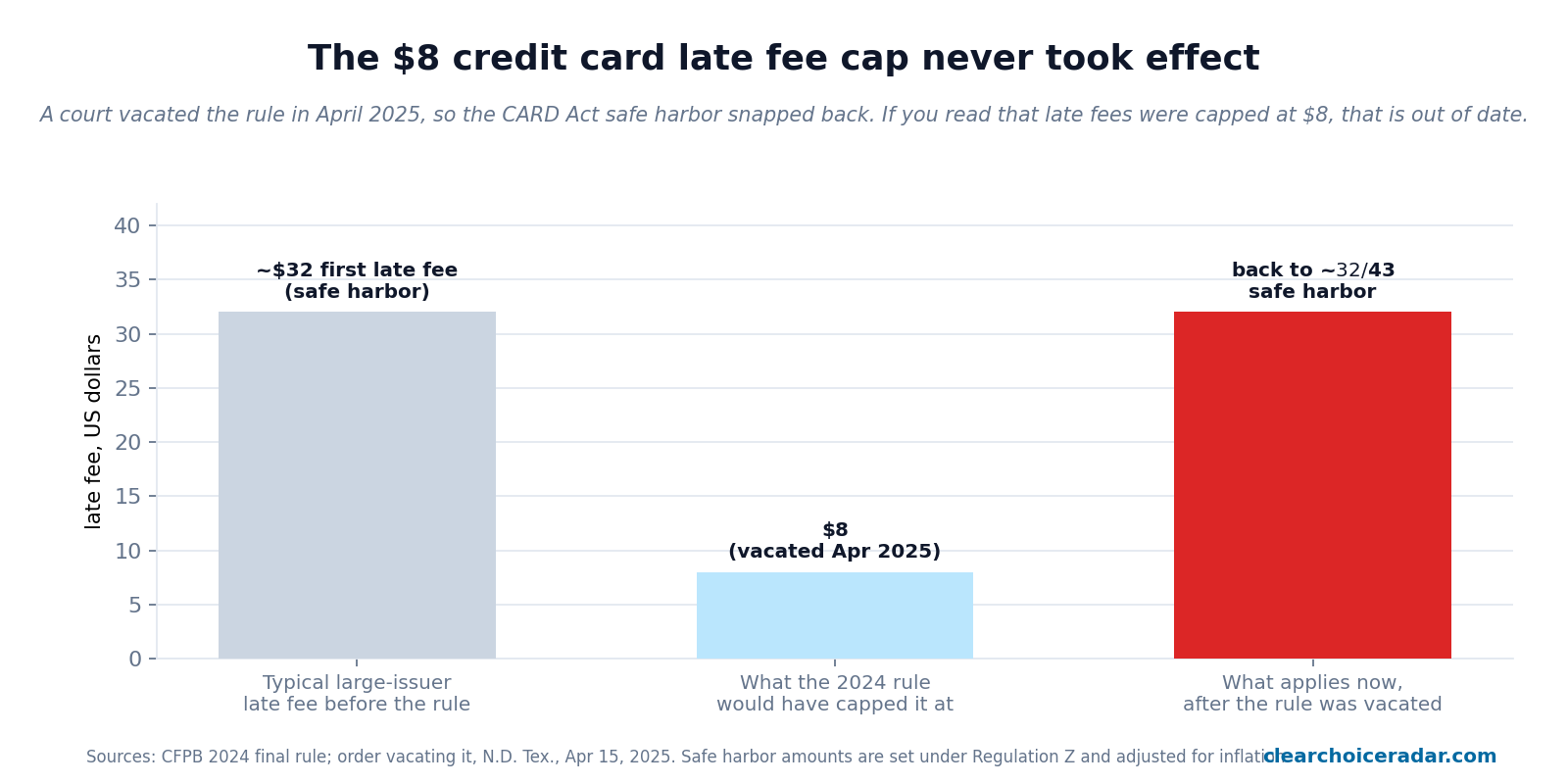
So if you have read that credit card late fees are capped at $8, that information is out of date. One quirk to know if you go looking: the CFPB's own rule page still describes the rule as "stayed" rather than vacated, so even a government page can lag the actual status.
What issuers can actually charge now
With the rule gone, credit card late fees fall back to the long-standing safe harbor amounts set under Regulation Z, which the CFPB adjusts for inflation. In round numbers, an issuer can charge about $32 for a first late payment and about $43 for another late payment within the next six billing cycles, without having to justify the amount against its costs.
| Situation | Typical late fee |
|---|---|
| First late payment (safe harbor) | about $32 |
| Another late payment within six billing cycles | about $43 |
| What the vacated 2024 rule would have allowed | $8 |
Two clarifications worth making, because coverage of the $8 rule often blurred them:
- The $8 cap would only ever have applied to the largest issuers. Smaller issuers were always outside it and used the safe harbor, so for many cards nothing was going to change even if the rule had survived.
- A late fee generally cannot exceed your minimum payment. If your minimum payment due was $20, the late fee for missing it is limited to $20. That is a separate protection that did not depend on the vacated rule.
The CFPB may not be done with this
Here is the twist. In mid-2026 the CFPB signaled it may revisit credit card late fees, including putting a request for information about issuers' late fees into the regulatory pipeline. That is notable because the agency is the same one that agreed to kill its own rule the year before.
Read that for what it is: a signal, not a rule. Nothing about it changes what you can be charged today, and past experience with this exact topic is a good reminder not to plan around a fee change that has been announced, proposed, or hinted at rather than actually put in force. When and if something concrete lands, the number that matters is what is in effect, not what is under consideration.
We track this alongside the broader picture of what borrowing costs on our credit card interest rates page, which follows the average APR from Federal Reserve data.
The move that beats any cap
Whether the fee is $8 or $43 is close to irrelevant if you never trigger it, and the tools to avoid it are more reliable than any rule.
- Autopay at least the minimum. Setting automatic payment of the minimum turns the late fee from a monthly risk into a non-event. You can still pay more manually; the autopay is just a floor so a busy month never costs you $43.
- Ask for a waiver on a first slip. Issuers routinely waive a first late fee for an account otherwise in good standing. A short call or chat asking for a one-time courtesy waiver works more often than people expect, and it costs nothing to ask.
- Move the due date. Most issuers let you change your payment due date to line up with your pay schedule, which removes the cash-flow reason a payment slips in the first place.
- Watch the bigger number. A late fee is a one-time charge. A late payment reported to the credit bureaus, generally once you are 30 days past due, does far more lasting damage than the fee. Protecting the payment protects both.
If late fees are a symptom of balances you cannot keep up with, the fee is not really the problem. Our debt payoff calculator shows how long your balances take to clear and what the interest costs, our debt-to-income calculator shows how much room you actually have, and our debt relief guide covers the options when the balances themselves are the issue. Short answers are on the debt relief answers hub.
Related Debt Relief guides
- Debt settlement
- Debt consolidation
- Debt management plans
- Alternatives to bankruptcy
- Time-barred debt
- Medical debt
- Canceled debt
- Debt relief scams
- Debt payoff
- Debt collection process
- Debt validation notice
- Sued for a debt
- Wage garnishment limits
- Wage garnishment calculator
- Debt-to-income calculator
- Debt validation letter generator
- Statute of limitations on debt by state
- Debt collection complaint statistics
- Average credit card interest rate
- Debt collection questions answered
Sources
General information only; not financial or legal advice. Debt relief options carry risks including credit score impact and potential tax liability. Consult a qualified financial advisor for advice specific to your situation. Last updated July 2026.