Is Medical Debt Still on Your Credit Report in 2026? The Federal Rule Died, Your State Law Probably Did Not
What actually happened
In January 2025 the CFPB finalized a rule that would have barred consumer reporting agencies from including most medical debt on credit reports. On July 11, 2025, a federal court in the Eastern District of Texas vacated that rule nationwide, holding it exceeded the Bureau's authority under the Fair Credit Reporting Act.
An unusual detail: the CFPB did not defend the rule to the end. Under new leadership the agency changed position and joined the industry plaintiffs in asking the court to enter judgment against it. The rule was vacated with the agency's agreement.
So the federal answer to "can medical debt appear on my credit report" is that there is no federal ban.
The part most coverage gets wrong
The opinion also said that a state law barring a credit bureau from reporting coded medical debt would be inconsistent with the Fair Credit Reporting Act and therefore preempted. A great deal of coverage repeated that as though the state laws had been struck down.
They were not, and the distinction is not a technicality.
No state statute was before that court. The case was about a federal rule. A statement on an issue the court was not asked to decide is dicta: it can persuade later judges, but it does not itself invalidate anything. Consumer advocates, including the National Consumer Law Center, have argued the language has no direct effect on state laws. Industry groups are citing it to attack those laws. That fight is live and unresolved.
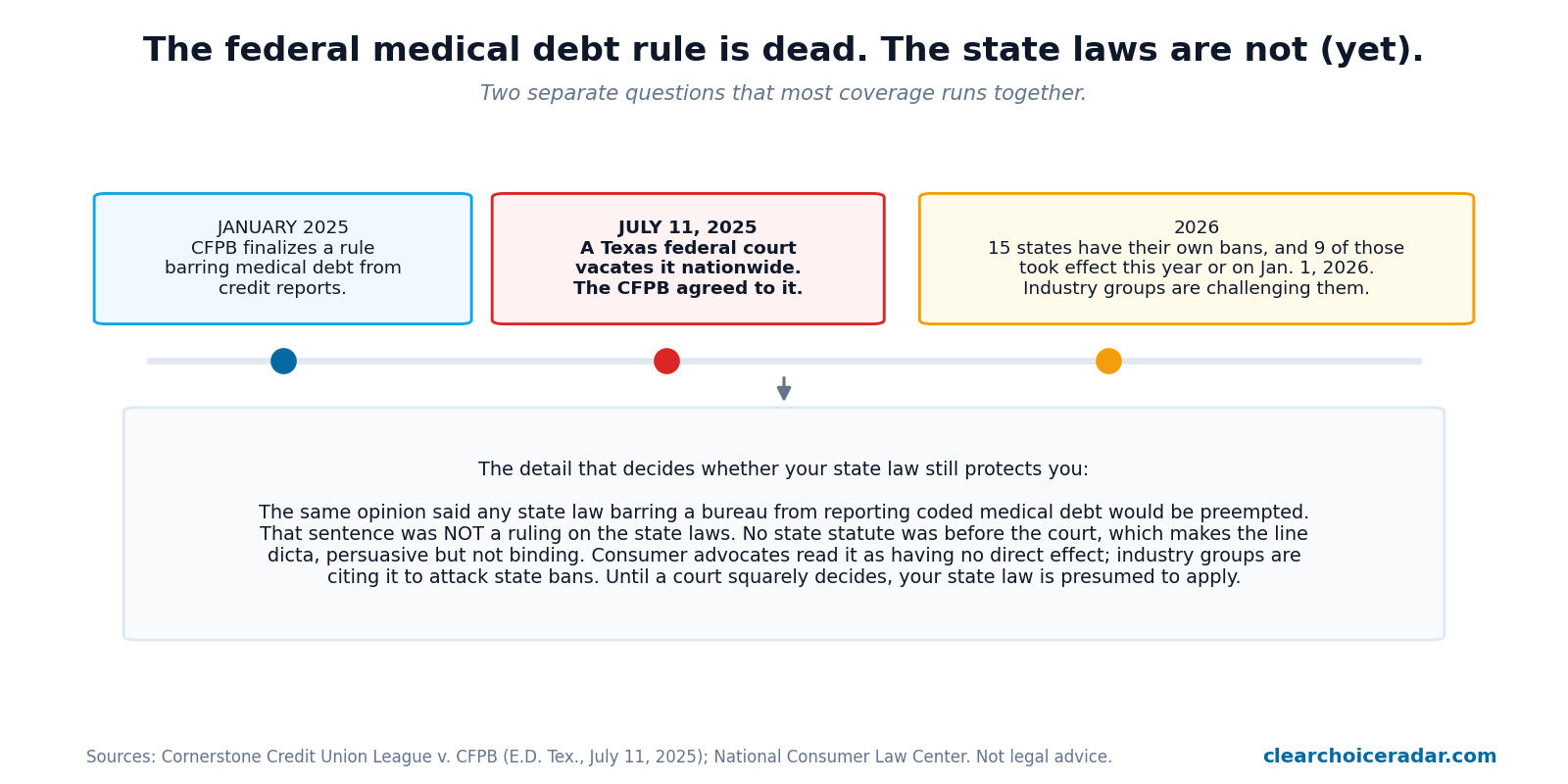
The practical posture today: if your state has a law, treat it as applying to you unless and until a court squarely holds otherwise. If a bureau or furnisher tells you your state's protection is void, that is a legal position being asserted by an interested party, not a settled fact.
The 15 states with their own restrictions
Fifteen states have enacted laws restricting medical debt on credit reports: California, Colorado, Connecticut, Delaware, Illinois, Maine, Maryland, Minnesota, New Jersey, New York, Oregon, Rhode Island, Vermont, Virginia and Washington.
These are not all old laws quietly sitting on the books. Nine of them took effect during 2026 or on January 1, 2026, which is part of why the preemption question is being litigated now rather than having been settled long ago.
What the laws do varies. Some bar reporting of medical debt outright, some restrict furnishing by providers, some apply only above or below certain amounts. If you live in one of these states, the specific text of your state's law is what governs, and your state attorney general's office is the right place to find its current status.
What is true regardless of where you live
Two protections do not depend on the vacated rule or on your state:
The bureaus' own voluntary changes still stand. In 2023 Equifax, Experian and TransUnion removed paid medical collections regardless of amount, and stopped reporting medical collections under $500. Those were business decisions rather than legal requirements, which means they could be revisited, but they are in effect now and they cover a large share of medical collections by count.
Your dispute rights under the Fair Credit Reporting Act are unchanged. The vacatur removed a proposed restriction on what may be reported. It did nothing to your right to dispute information that is inaccurate, incomplete, or unverifiable, and a medical bill is an unusually error-prone thing: wrong amounts, bills that insurance should have covered, duplicates after a billing system change, and debts reported before the provider finished processing a claim are all common.
Concretely, what to do:
- Pull all three reports at AnnualCreditReport.com, the federally authorized source. Medical collections do not always appear on all three.
- Check the amount and the date against your own records and against your explanation of benefits, not against what the collector says.
- If a collector contacted you, request validation in writing. Our debt validation letter generator produces the request, and our validation notice guide explains what they owe you in response.
- Dispute inaccuracies with the bureau and the furnisher.
- Check how old the debt is. A time-barred debt can still be reported for the period the law allows while no longer being enforceable in court, and those are two different clocks. See our statute of limitations by state table and our time-barred debt rights guide.
If a bureau or collector will not fix a genuine error, you can file a complaint with the CFPB.
A caution about who is selling what right now
Confusion about a legal change is reliably followed by offers to resolve it for a fee. Some things worth knowing before you pay anyone:
- Disputing an error is free and you can do it yourself with the bureaus and the furnisher.
- Accurate information cannot be removed by anyone, regardless of what a credit repair pitch implies. What can be removed is information that is wrong, and you do not need to buy that outcome.
- Paying a medical collection may not restore a score the way you expect, and under the bureaus' voluntary policy a paid medical collection should come off entirely. Confirm it did.
- Be wary of anyone citing the court decision to tell you your state law no longer protects you. As above, that is a contested position, not a settled one.
Our debt relief scams and the advance fee ban page covers what companies may and may not charge for, and the debt relief answers hub has short answers to related questions.
Related Debt Relief guides
- Debt settlement
- Debt consolidation
- Debt management plans
- Alternatives to bankruptcy
- Time-barred debt
- Medical debt
- Canceled debt
- Debt relief scams
- Debt payoff
- Debt collection process
- Debt validation notice
- Sued for a debt
- Wage garnishment limits
- Wage garnishment calculator
- Debt-to-income calculator
- Debt validation letter generator
- Statute of limitations on debt by state
- Debt collection complaint statistics
- Average credit card interest rate
- Debt collection questions answered
Sources
- Consumer Financial Protection Bureau, Prohibition on Creditors and Consumer Reporting Agencies Concerning Medical Information (Regulation V)
- National Consumer Law Center, The Latest on Keeping Medical Debt Out of Credit Reports
- Consumer Financial Protection Bureau, Fair Credit Reporting Act
- AnnualCreditReport.com (the federally authorized source for free reports)
- Consumer Financial Protection Bureau, Submit a complaint
General information only; not financial or legal advice. Debt relief options carry risks including credit score impact and potential tax liability. Consult a qualified financial advisor for advice specific to your situation. Last updated July 2026.