The IRS Raised the Mileage Rate on July 1. You Now File 2026 With Two Different Rates
Both rates, in one table
The IRS revised the optional standard mileage rates part way through 2026. Miles driven on or after July 1, 2026 use a higher rate than miles driven before that date, so a single tax year now has two sets of numbers.
| Purpose | Jan 1 to Jun 30, 2026 | Jul 1 to Dec 31, 2026 | Change |
|---|---|---|---|
| Business | 72.5 cents | 76 cents | up 3.5 cents |
| Medical | 20.5 cents | 23.5 cents | up 3 cents |
| Moving (Armed Forces only) | 20.5 cents | 23.5 cents | up 3 cents |
| Charitable | 14 cents | 14 cents | no change |
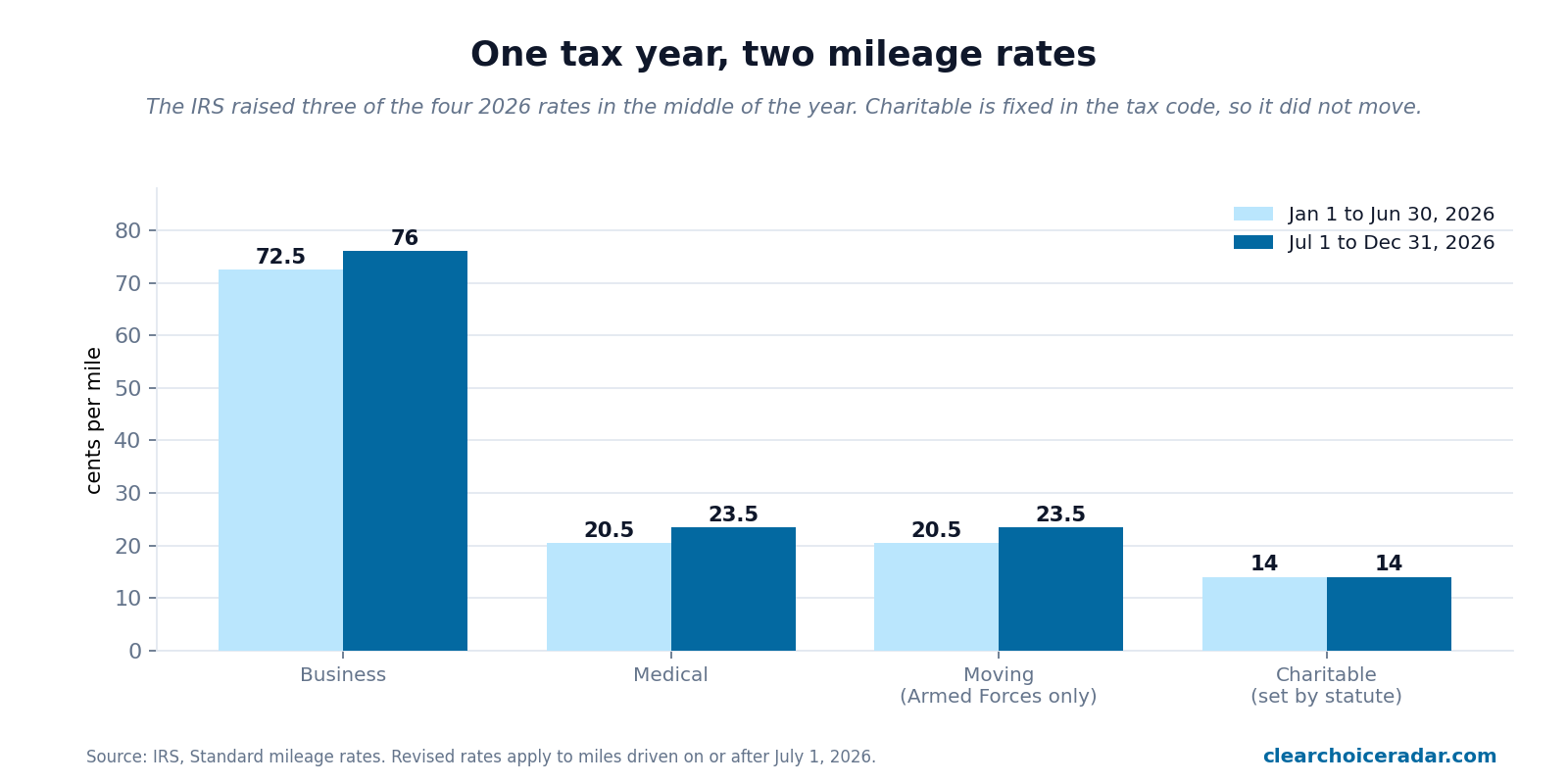
The charitable rate is the odd one out for a reason worth knowing: it is written into the tax code at 14 cents rather than recalculated by the IRS, so it does not move when driving costs move. Only Congress can change it.
The moving rate is also narrower than most people assume. It applies to active duty members of the Armed Forces moving under military orders, not to a general household move.
Why a mid-year change is unusual
The IRS normally sets these rates once, in the fall, and leaves them alone for the whole calendar year. It revised them mid-year here because fuel prices moved sharply after the original 2026 rates were set, and the standard business rate is built on an annual study of the fixed and variable costs of operating a car.
Mid-year revisions are rare enough that most working accountants can name the last one from memory. The practical significance is not the size of the increase. It is that a rule which is normally "one number per year" quietly stopped being that, and a lot of mileage logs and expense reimbursement policies were written on the assumption that it would not.
How to actually split the miles
The split is by date driven, not by when you were paid, not by when you invoiced, and not by when you bought the fuel. A trip on June 30 uses the first-half rate. The same trip on July 1 uses the second-half rate.
A worked example, for a driver with 12,000 deductible business miles evenly split across the year:
| Period | Miles | Rate | Deduction |
|---|---|---|---|
| Jan 1 to Jun 30 | 6,000 | 72.5 cents | $4,350 |
| Jul 1 to Dec 31 | 6,000 | 76 cents | $4,560 |
| Total | $8,910 | ||
Using 76 cents for the whole year would overstate that deduction by $210. Using 72.5 cents for the whole year would understate it by the same amount. Neither is a rounding error to the IRS if the return is ever examined.
Three things worth doing before December:
- Make sure your log has dates on it, not just totals. A yearly odometer figure cannot be split after the fact, and reconstructing it later is exactly the kind of estimate that does not hold up.
- Check your employer's reimbursement rate. If a company is still reimbursing at 72.5 cents for second-half miles, that is allowed, but the gap is generally not separately deductible for employees under current law.
- Do not mix methods. The standard mileage rate is an alternative to deducting actual vehicle costs. There are rules about which one you may use and when you may switch, and they are in Publication 463.
Where this shows up if you already owe the IRS
An understated deduction is not the only way this costs money. If mileage is a meaningful part of your self-employment income and your estimated payments were built on the old rate, your quarterly math for the back half of the year is slightly off in your favor, which is the direction that produces a balance due rather than a refund.
If that lands you with a balance you cannot pay in full, the shape of the problem is ordinary and the options are documented: our IRS payment plans guide covers installment agreements, and our penalty and interest calculator separates what is penalty from what is interest, which are treated very differently if you later ask for relief.
One thing not to assume: a mileage error is not by itself a reason the IRS waives anything. Penalty relief runs on compliance history or a documented reasonable cause, not on the fact that a rule changed mid-year. Our penalty relief guide covers what actually qualifies.
Related Tax Relief guides
- 1099-R distribution codes
- Offer in Compromise
- IRS Fresh Start Program
- Does tax relief actually work
- IRS tax relief programs
- Best tax attorneys
- How to choose a tax relief company
- IRS penalty relief
- Currently not collectible
- Installment agreement
- IRS collections statistics
- IRS audit statistics
- What tax relief costs
- Penalties and interest
- IRS notice decoder
- California FTB notice decoder
- CP2000 notice
- Tax debt questions answered
- Final notice of intent to levy
Sources
General information only; not legal or tax advice. No attorney-client relationship is created by viewing this content or sending information through this site. Consult a qualified tax professional for advice specific to your situation. Last updated July 2026.