Do You Still Have to Ask the IRS for First Time Abate? What Changed in July 2026
The short version
On July 8, 2026, the IRS announced a new automatic process for penalty relief in news release IR-2026-83. The headline is simple: for eligible taxpayers, the relief that used to require a phone call or a written request is meant to be applied by the IRS on its own.
Three things are worth pinning down before you do anything, because the announcement date and the date it affects your return are not the same date:
- The IRS expects the automatic exemption to phase in during summer 2026, starting with tax year 2025 returns and 2026 quarterly returns.
- It fully replaces First Time Abate for eligible returns whose original due date falls on or after January 1, 2027.
- During the transition, First Time Abate still exists, and you may still need to ask for it.
If you are holding a penalty notice right now, the practical answer is in the last bullet. Do not assume the system already took care of it.
Why an automatic process was a big deal in the first place
First Time Abate has been available for years. The catch was always that it was a request, not a right that applied itself. You had to know the program existed, know you qualified, and then ask.
The National Taxpayer Advocate put numbers to that gap on the same day as the IRS announcement. Nearly 220,000 taxpayers actually received First Time Abate relief in fiscal year 2025 through the manual request process. The Taxpayer Advocate Service estimated that more than 1.5 million taxpayers would have qualified had the relief been applied automatically.
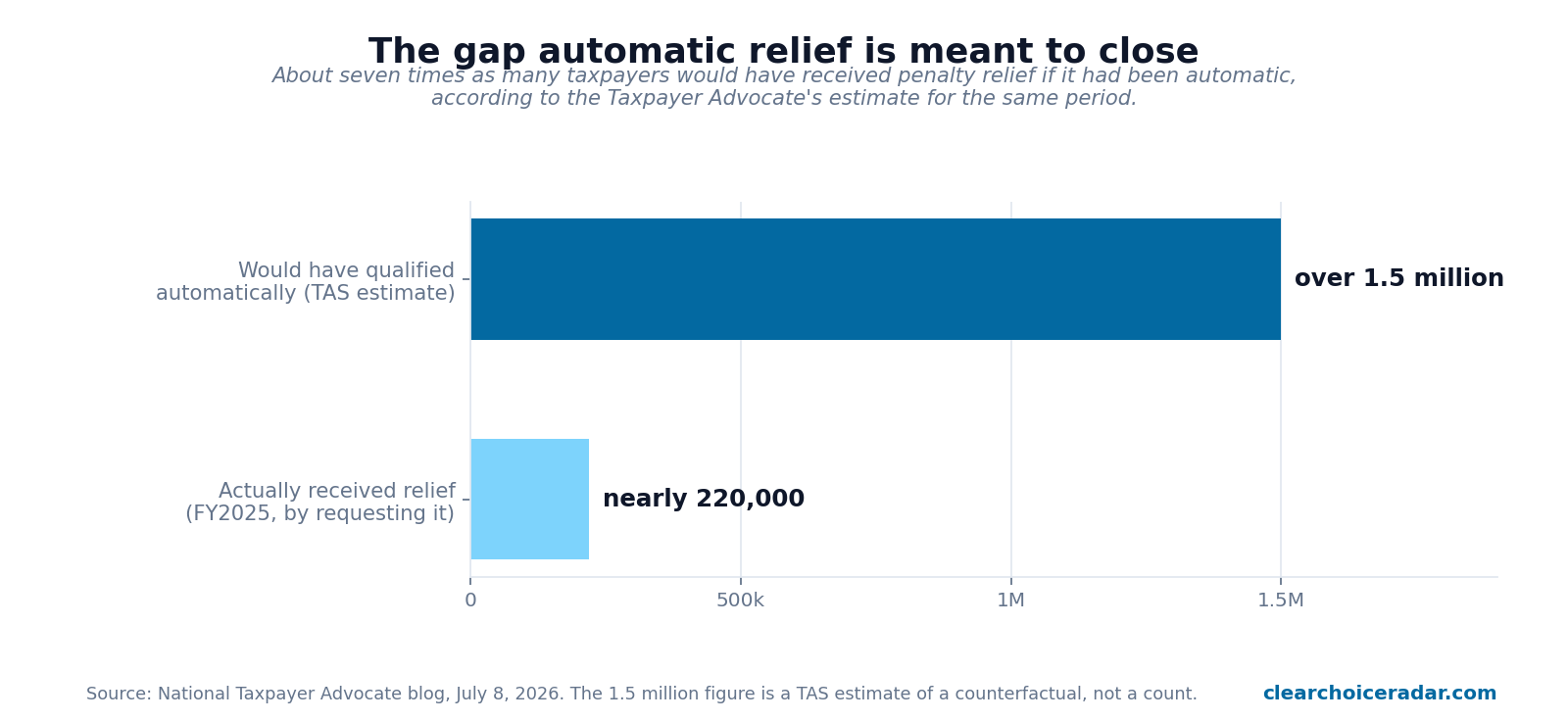
Treat those two numbers carefully, because they are different kinds of numbers. The 220,000 is a count of what happened. The 1.5 million is an estimate of what would have happened under a different system. But even with that caveat, the shape of the gap is the whole argument for automating it: the old process rewarded the taxpayers who happened to know the rules.
What the automatic exemption covers
Per IR-2026-83, the automatic process applies to the three penalties that account for most ordinary taxpayer penalty notices:
- Failure to file, the penalty for filing a return late
- Failure to pay, the penalty for paying the balance late
- Failure to deposit, the penalty that hits employers who miss a payroll tax deposit deadline
Eligibility follows the same clean-history logic that First Time Abate always used. Broadly, you need a compliant record for the three prior tax years, or for the twelve consecutive quarters before the period in question if you file quarterly. Filed on time, paid on time, no prior penalties of this type.
Certain return types are excluded. The announcement carves out information returns, along with returns filed only for specific transactions or infrequent events such as Form 706 estate tax returns and Form 709 gift tax returns, which generally are not eligible. If your penalty is attached to one of those, the automatic process is not the path, and you would be looking at reasonable cause instead.
The timeline that actually determines whether this applies to you
This is where most of the confusion is going to come from. The cutover is keyed to a return's original due date, not to when you filed it, not to when the penalty was assessed, and not to the date of the announcement.
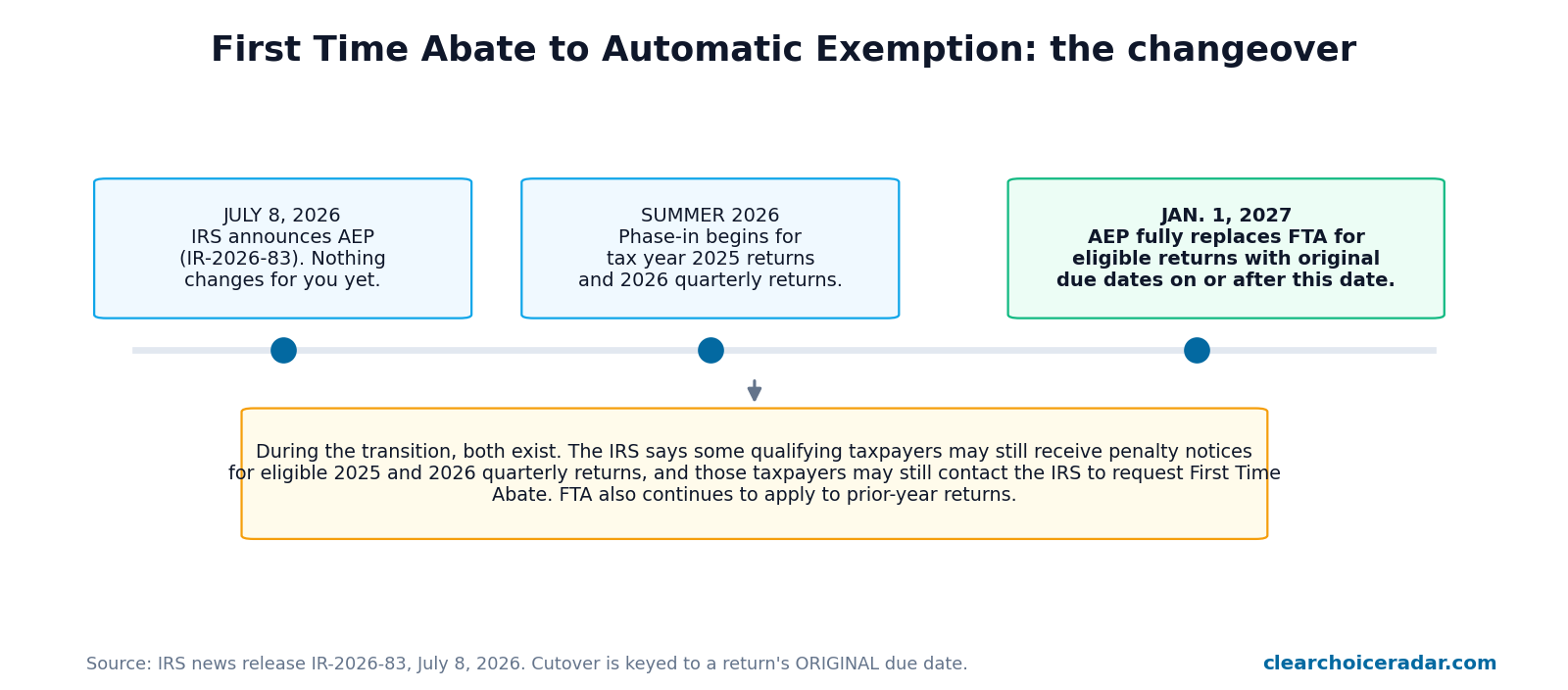
So a 2026 individual return, ordinarily due in April 2027, falls on the automatic side. A 2024 return you are only now cleaning up does not, and First Time Abate remains the route for it.
The IRS also flagged something important about the phase-in window: some qualifying taxpayers may still receive penalty notices for eligible 2025 returns and 2026 quarterly returns, and those taxpayers may still contact the IRS to request First Time Abate. In other words, a notice arriving in your mailbox is not proof that you were found ineligible. It may just mean the automatic process had not caught up to your account.
The catch the Taxpayer Advocate raised
The National Taxpayer Advocate supported automating the relief and still published a caution alongside it, and it is worth understanding before you shrug and let the system run.
Administrative relief like this is a limited resource in a specific sense: using it on one year is exactly what makes you ineligible for a clean-history waiver on a later year. Reasonable cause relief, the separate statutory route for taxpayers who had a genuine reason (serious illness, a natural disaster, destroyed records), does not work that way and is not limited by prior use.
The Advocate's concern is that an automatic waiver applied to a small penalty could quietly consume relief that a taxpayer would rather have had available for a much larger one, without that taxpayer ever making a choice about it. The Advocate also noted that the IRS did not adopt a taxpayer safeguard it had previously committed to in writing.
The practical takeaway is narrow but real. If you are facing a substantial penalty and you have a documented reasonable cause story, that is a situation worth talking through with a licensed tax professional rather than accepting the automatic path by default.
Interest is a separate thing, and it does not go away
Penalty relief is not interest relief. Interest accrues on an unpaid balance by statute, and the IRS generally cannot waive it simply because it waived a penalty. Interest can be reduced only when the underlying penalty it accrued on is removed, or in narrow situations involving IRS error or delay.
This trips people up constantly, because a notice shows one total. If you want to see how the two pieces stack up on your own balance, our IRS penalty and interest calculator separates them using the published quarterly rates.
What to do with a penalty notice in the meantime
A sane order of operations while the two systems overlap:
- Identify the notice. The number in the corner tells you what stage you are at and how much time you have. Our IRS notice decoder covers the common ones, including CP14, the first bill.
- Check the return's original due date. That single fact tells you whether you are on the automatic side of the changeover or the First Time Abate side.
- Do not wait for the system to fix it. During the phase-in the IRS itself says qualifying taxpayers may still get notices and may still request relief. Deadlines on a notice keep running either way.
- Ask whether reasonable cause is the better argument before you use up clean-history relief, especially on a large balance.
Our penalty relief guide walks through both routes in more detail, including what the IRS looks for in a reasonable cause explanation.
Related Tax Relief guides
- 1099-R distribution codes
- Offer in Compromise
- IRS Fresh Start Program
- Does tax relief actually work
- IRS tax relief programs
- Best tax attorneys
- How to choose a tax relief company
- IRS penalty relief
- Currently not collectible
- Installment agreement
- IRS collections statistics
- IRS audit statistics
- What tax relief costs
- Penalties and interest
- IRS notice decoder
- California FTB notice decoder
- CP2000 notice
- Tax debt questions answered
- Final notice of intent to levy
Sources
General information only; not legal or tax advice. No attorney-client relationship is created by viewing this content or sending information through this site. Consult a qualified tax professional for advice specific to your situation. Last updated July 2026.