Is Tax Relief Worth It for $10,000, $50,000, or $100,000 of IRS Debt?
The thing nobody tells you about tax debt cost
Search whether tax relief is worth it and you get a wall of "it depends." It does depend, but on one specific thing, and once you see it the question gets a lot clearer.
The IRS's own price to resolve your debt does not go up with the size of the debt. A $205 Offer in Compromise application fee is $205 whether you owe $8,000 or $800,000. Setting up a payment plan online is the same $22 to $69 at every level. So resolving IRS debt yourself costs roughly the same flat amount no matter how much you owe.
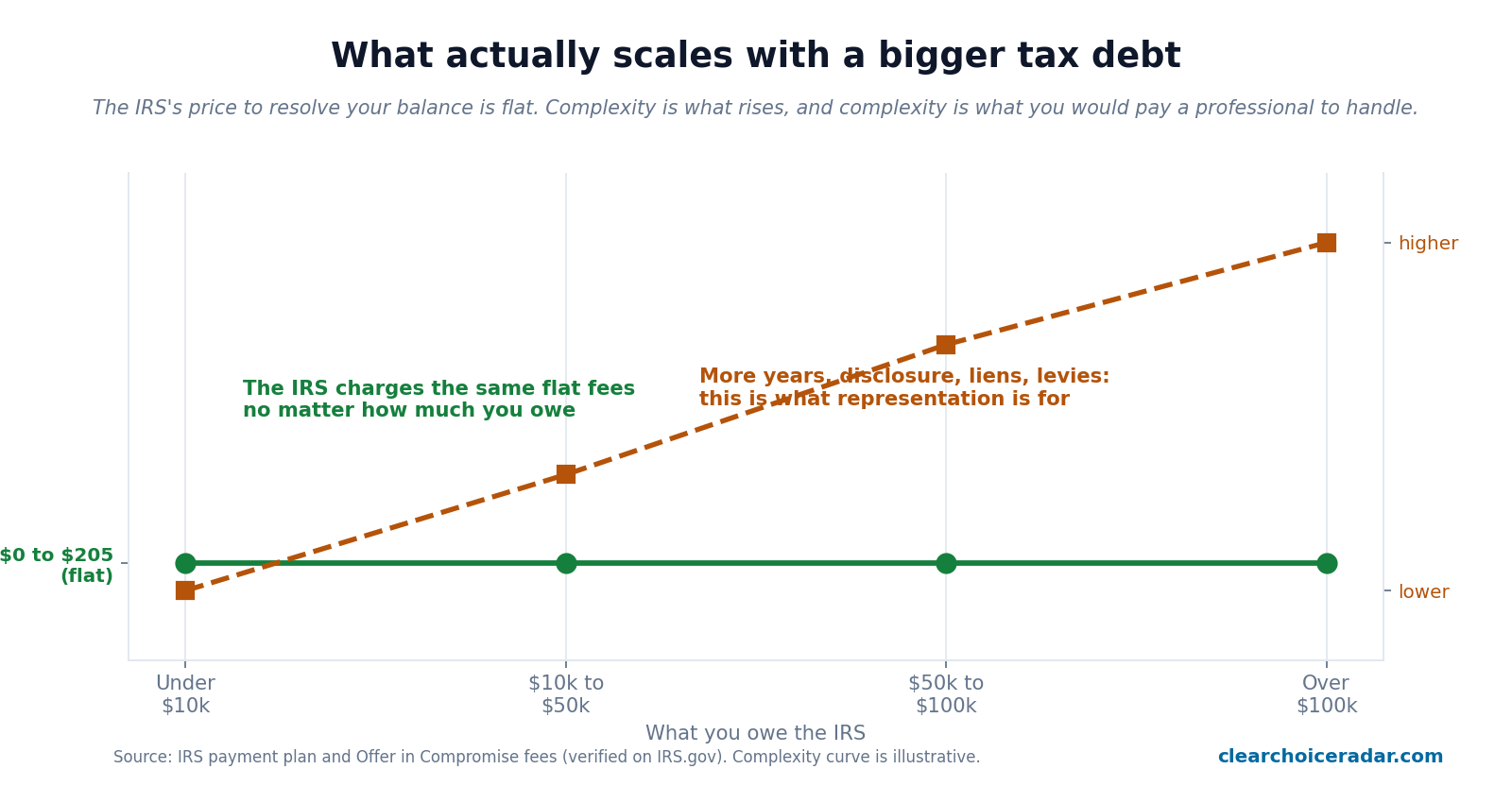
What changes with a larger balance is complexity: more tax years, financial disclosure requirements, liens, an active levy. And complexity, not the balance, is what you would be paying a professional to handle. So "is tax relief worth it for $50,000" is really "is my situation complex enough that representation beats doing it myself." Here is how that tends to break down.
Under $10,000: almost always do it yourself
At this level the math rarely favors paying someone. You can typically set up a payment plan online in a few minutes, and many balances this size qualify for a streamlined agreement with no financial disclosure. The IRS's cost is $0 for a short-term plan or $22 to $69 for a longer online installment agreement.
A tax relief company's fee for a case this simple can easily exceed a year of the penalties it might save you. Before paying anyone, run your balance through our penalty and interest calculator to see what it is actually costing per month, and check whether penalty relief can remove part of it for free. For most small balances, the honest answer is that tax relief is not worth paying for.
$10,000 to $50,000: it depends on complexity, not the number
This is the real gray zone. Individuals can often still self-apply online for a payment plan in this range, and the IRS's fees are still the same flat figures. So the balance alone does not make it worth hiring help.
What tips it toward paying for representation is complexity stacking up:
- Several tax years, or unfiled returns that have to be prepared first
- A business balance tangled up with a personal one
- A lien already filed, or a levy or wage garnishment in motion
- An Offer in Compromise you are not sure you qualify for (check the IRS's free Pre-Qualifier before paying anyone to prepare one)
If none of those apply and you owe a clean $20,000 for one year, a payment plan you set up yourself is usually the right call. If two or three of them apply, representation starts to earn its fee.
$50,000 to $100,000: representation earns its fee more often
Above $50,000, two things change. The IRS generally wants more financial documentation before it approves a plan, and the negotiation gets more involved. The IRS's own fees are still flat, but the work required to get the best available outcome is now real enough that skilled representation more often pays for itself.
That is a judgment call about your own time, comfort dealing with the IRS, and how much is at stake, not a rule. What it is not is a reason to panic about cost: the IRS did not get more expensive because you owe more. If you do hire, our guide to choosing a legitimate tax relief company covers what to verify first, and the full cost breakdown shows exactly what the IRS charges so you can tell the government fees from the company's.
Over $100,000: usually yes, but for the right reason
At six figures and up, high-balance cases can be assigned to a Revenue Officer, appeals and collection alternatives get technical, and the downside of a misstep is large. Representation is frequently worth it here.
But hold onto the reason, because it is the whole point of this post: it is worth it because of the complexity and the stakes, not because the IRS charges more. Its fees are the same $0 to $205 they are for a $9,000 balance. Anyone who quotes you a fee as a flat percentage of your tax debt is pricing off the balance, and the balance is not what drives the IRS's cost. Ask what the work actually is.
Before you decide, the free options that can represent you
Two of the most useful cost-cutters have nothing to do with a company:
- Low Income Taxpayer Clinics represent taxpayers generally below 250 percent of the federal poverty guidelines, usually for disputes under $50,000, free or nearly so. That is real representation, not just advice.
- The Taxpayer Advocate Service is free and exists for problems stuck in the IRS's normal channels.
And the decision itself is easier with numbers in front of you. Our what tax relief actually costs page lays out the IRS's fee for every program in one table, our penalty and interest calculator shows the running cost of the balance, and the tax relief answers hub has short answers to the related questions. Price the free and flat-fee routes first; then decide whether your situation justifies paying for help on top of them.
Related Tax Relief guides
- 1099-R distribution codes
- Offer in Compromise
- IRS Fresh Start Program
- Does tax relief actually work
- IRS tax relief programs
- Best tax attorneys
- How to choose a tax relief company
- IRS penalty relief
- Currently not collectible
- Installment agreement
- IRS collections statistics
- IRS audit statistics
- What tax relief costs
- Penalties and interest
- IRS notice decoder
- California FTB notice decoder
- CP2000 notice
- Tax debt questions answered
- Final notice of intent to levy
Sources
General information only; not legal or tax advice. No attorney-client relationship is created by viewing this content or sending information through this site. Consult a qualified tax professional for advice specific to your situation. Last updated July 2026.