The July 4 Solar Deadline Passed. Here Is What a Homeowner Can Still Get in 2026
The two deadlines, and which one applies to you
Federal support for residential solar changed twice in about eighteen months, and the two changes hit different people.
If you buy the system, with cash or a loan, the Residential Clean Energy Credit under Section 25D was the one you claimed on your own return. It ended for property placed in service after December 31, 2025. There is no federal credit on a homeowner-owned residential system installed today.
If a company owns the system and you sign a lease or a power purchase agreement, a different credit is in play: the clean electricity investment credit under Section 48E. That one is claimed by the business that owns the equipment. July 4, 2026 mattered because of when construction began: projects that began construction by that point follow the ordinary completion timeline, while projects starting after it face a hard placed-in-service deadline of December 31, 2027.
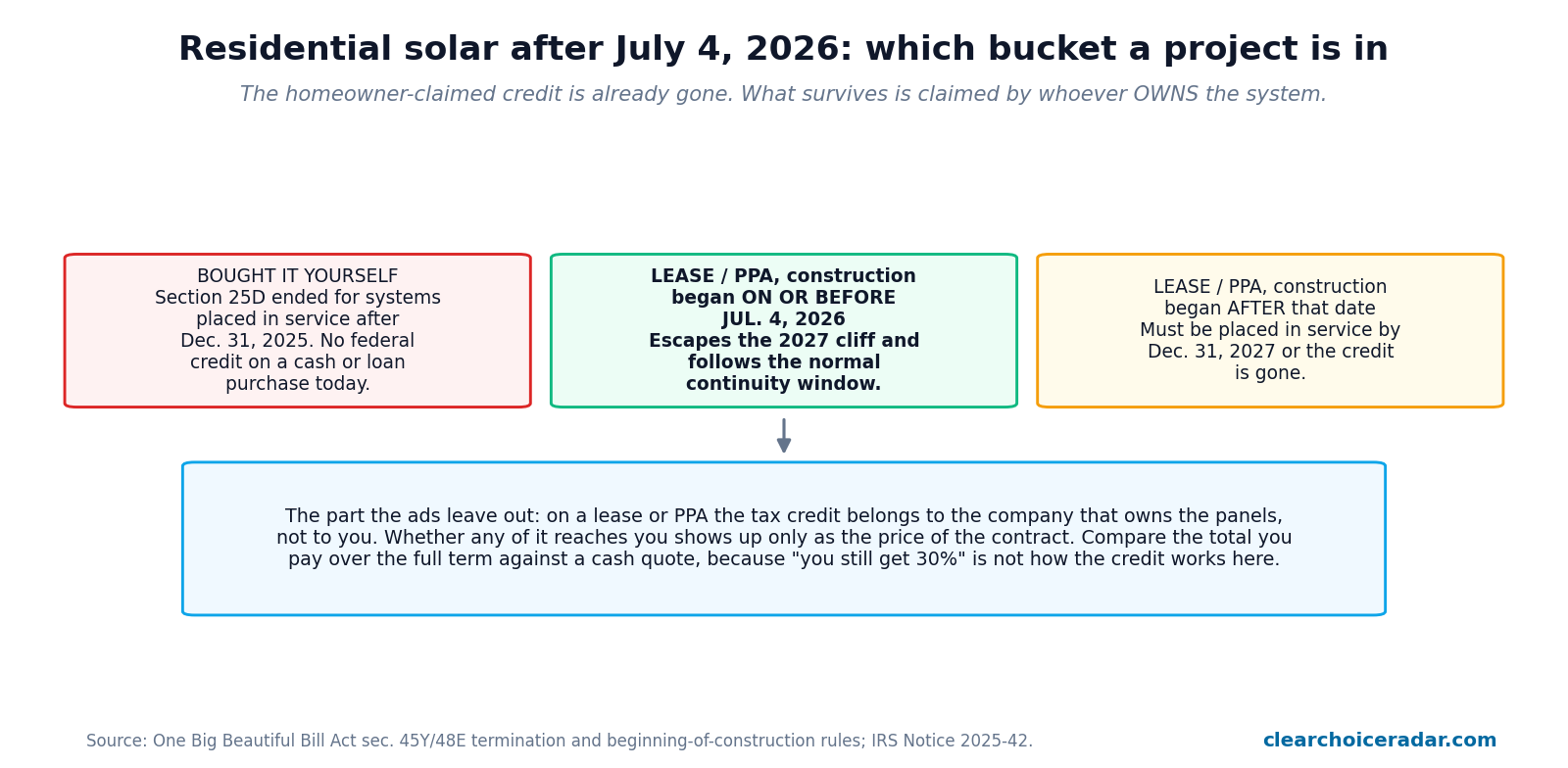
Neither deadline created a new benefit for homeowners. Both narrowed one.
The sentence to watch for in a sales pitch
"You still get the 30% tax credit" is the claim to slow down on.
On a lease or PPA, you do not get a tax credit. You never file for it, it never appears on your return, and it does not depend on your tax liability. The company that owns the panels claims it. Whether any of that value reaches you is purely a matter of how they priced your contract, and that is a business decision, not a tax rule.
This is not an accusation that lease and PPA offers are bad deals. Some are reasonable, especially for households with too little tax liability to have used the old credit anyway. It is a statement about how to evaluate one: compare the total dollars you will pay over the full term against a cash quote for a comparable system. That comparison is unaffected by who claims which credit, which is exactly why it is the honest one.
Questions worth asking in writing before signing:
- What is the total of all payments over the full term, including every escalator?
- Does the payment escalate annually, and by what percentage?
- What happens at the end of the term: purchase option, removal, renewal, and at what cost?
- What has to happen if I sell the house before the term ends?
- Who is responsible for repairs, monitoring, and inverter replacement?
Our guide to choosing an installer covers how to compare offers that are structured differently.
What is actually driving payback now
With the homeowner credit gone, the numbers that decide whether solar pays for itself are the ones that were always local: what your utility charges you per kilowatt hour, and what it credits you for the power you export.
Those two figures vary far more between utilities than most national articles admit, and export compensation has been moving downward in a number of states. That makes the rate structure on your specific bill more important to your payback math than any federal policy currently is.
We publish per-utility figures built from the Energy Information Administration's Form EIA-861 data rather than from installer marketing. Start with our solar utility pages for your own utility, and our net metering guide for how export rules work. To run your own numbers, the solar payback calculator takes your rate and system size directly.
A note on state and utility programs: they did not disappear with the federal credit. Some states have their own credits, rebates, performance payments, or property and sales tax exemptions. Those are worth checking before concluding solar no longer pencils where you live. Our incentives guide covers the categories to look for.
What we are not going to tell you
We are not going to tell you whether Congress restores a residential credit, or when. Proposals circulate constantly and reporting on them tends to describe possibilities as though they were schedules. Decide based on the rules that exist.
We are also not going to tell you that solar is or is not worth it generally. That answer is mostly determined by your utility rate, your roof, your consumption pattern, and how long you plan to stay in the house. Those are knowable. Run them.
If you want to sanity check a quote first, our solar costs and ROI guide covers what a reasonable installed price per watt looks like, and the solar answers hub has short answers to the common questions.
Related Solar guides
- How solar panels work
- Solar panel costs and ROI
- Solar incentives and rebates
- Net metering
- Solar financing
- Choosing a solar installer
- Solar batteries and backup
- Community solar
- Rising electricity rates
- Solar payback calculator
- Solar system size calculator
- Solar questions answered
- LADWP
- Sierra Pacific Power
Sources
General information only. Solar savings estimates depend on your location, energy usage, roof characteristics, and available incentives. Get quotes from multiple installers for accurate pricing. Last updated July 2026.