Washington Started Taxing Bullion on January 1. The 2026 Sales Tax Map for Gold and Silver
What Washington changed
Washington had long excluded precious metal bullion and monetized bullion from the definition of a retail sale, which is the mechanism that kept sales tax off it. That exclusion was repealed effective January 1, 2026.
The Department of Revenue's own notice is direct about the consequence: sales of precious metal bullion and monetized bullion to consumers are now subject to retail sales tax, and the seller's gross income falls under the Retailing business and occupation tax classification. The statute that carried the old exclusion, RCW 82.04.062, is now marked as effective only until January 1, 2026.
Washington is not alone in moving this direction. Maryland reversed its own exemption in 2025.
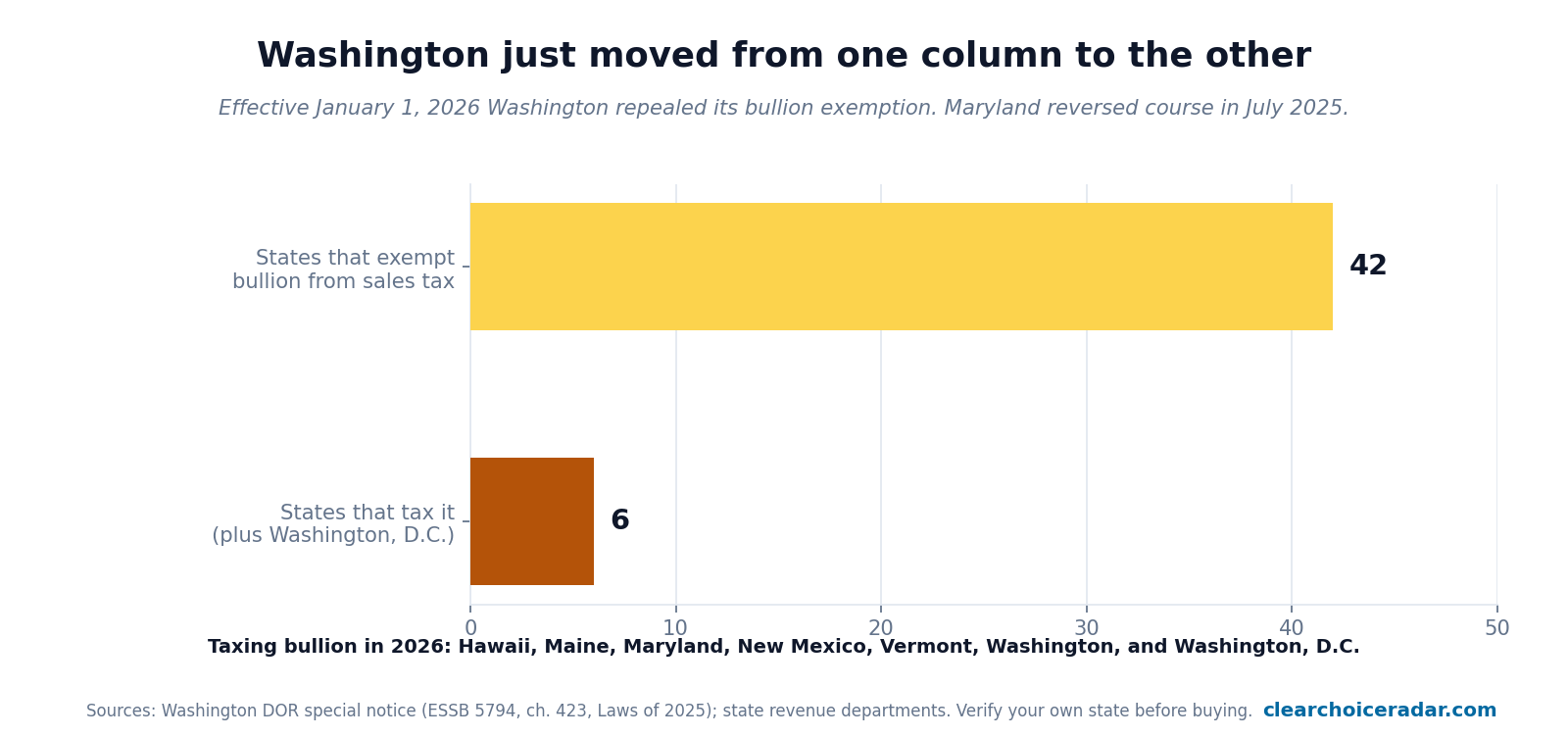
The direction of travel is worth noting precisely because it runs against the long-running trend. For years the movement was toward exempting bullion, on the theory that taxing money is different from taxing merchandise. Two states just went the other way, which is a reminder that these exemptions are ordinary legislation and can be repealed like any other.
What a sales tax actually does to a bullion purchase
Sales tax on bullion behaves differently from sales tax on most things you buy, because bullion is bought close to a published spot price and sold close to that same price.
On a $10,000 purchase in a jurisdiction with a combined rate around 9%, roughly $900 of sales tax is added at the register. That $900 is not part of what the metal is worth. For the position to break even in nominal terms, the metal has to appreciate enough to cover the tax and the dealer's premium over spot before you are back to level.
| Cost layer | Typical shape | Recoverable when you sell? |
|---|---|---|
| Spot value of the metal | The published market price | Yes, at the then-current price |
| Dealer premium over spot | Varies by product and quantity | Generally no |
| State and local sales tax | Applies where the state taxes bullion | No |
| Shipping and insurance | Per order | No |
This is the same reason the buy and sell spread matters so much in metals generally. Every layer that is not the metal itself is a cost you have to grow through, not an asset you own. Our gold IRA fees guide works through the same idea for the recurring fees inside a retirement account.
The IRA question is genuinely different, and worth asking
Here is where we are going to be careful rather than confident, because this is exactly the sort of question that gets answered too breezily in sales conversations.
Sales tax is a state tax on a retail transaction. Whether and how it applies to metal acquired inside a self-directed IRA depends on state law, on where the metal is delivered, and on how the dealer and depository structure the transaction. It is not governed by the IRS rules that control what an IRA may hold.
So the honest guidance is a question rather than an answer: ask the dealer, in writing, whether sales tax will be charged on your purchase, and on what basis. If a salesperson waves the question away, that is information about the salesperson. Get the answer before funds move, not after.
What the IRS rules do control is separate and unchanged by any of this:
- Metals must meet fineness requirements and be an eligible product type.
- The metal must be held by a qualified trustee or custodian, not at your home. See home storage gold IRAs.
- Rollover timing rules still apply, including the 60 day window on indirect rollovers.
Full detail is on our gold IRA rules page.
If you are comparing states, compare the whole picture
Sales tax is one line in a longer bill, and it is not always the biggest one. Before treating a state's tax status as the deciding factor:
- Compare the dealer premium first. A premium difference of a few percent between dealers can be larger than the sales tax you are trying to avoid.
- Understand your own state's rules, including thresholds. Some states exempt bullion only above a purchase amount, or treat legal tender coins differently from refined bars.
- Do not build a plan around buying across state lines without understanding use tax. States that impose sales tax generally impose a corresponding use tax on property bought elsewhere and brought in.
- Remember the sell side. Sales tax is a purchase-side cost; what you owe when you sell at a gain is a federal income tax question. Our taxes on selling gold page covers that separately.
More plain answers are on our gold IRA answers hub.
Related Gold IRA guides
Sources
- Washington Department of Revenue, Sales of precious metal bullion and monetized bullion now subject to B&O tax and retail sales tax
- RCW 82.04.062 (exclusion effective until January 1, 2026)
- IRS, Retirement plans FAQs regarding IRAs (investments)
- IRS Publication 590-A, Contributions to Individual Retirement Arrangements
General educational information only; not tax, legal, or investment advice. Precious metals involve risk, and IRA rules depend on individual facts. Consult a qualified tax professional before moving retirement funds. Not affiliated with the IRS or any government agency. Last updated July 2026.