Gold Fell About 25% From Its January 2026 Record. What That Means Inside a Gold IRA
What the price actually did
Gold ran hard through 2025 and into January 2026, set a record in the last days of that month, and has traded down since. As of late July 2026 it sits just above $4,000 an ounce.
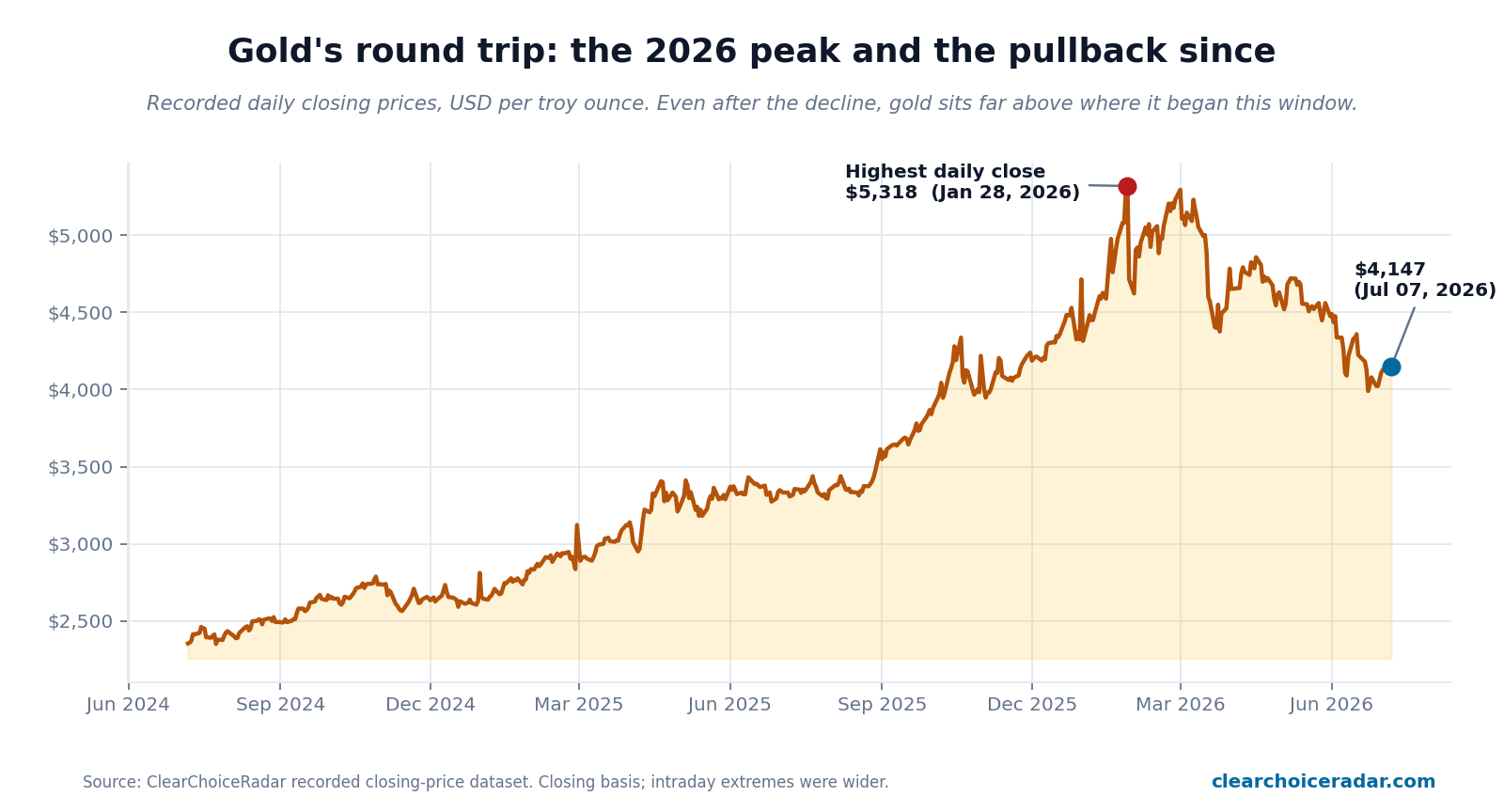
Two things are true at once here, and most coverage picks only one of them. Gold is roughly a quarter below its record. Gold is also still up substantially over the past year, and dramatically above where it traded two years ago. Whether the last six months reads as a crash or as digestion depends entirely on where you started counting, which is the honest answer and also the least satisfying one.
You can see the current number on our live gold price chart, and the year-by-year record on our gold price history page.
Why you will see four different numbers for the same record high
This is the part almost nobody explains, and it is the reason two articles can give you different peak figures without either one being wrong. There is no single "price of gold." There are several measures, and in late January 2026 they disagreed by nearly $300 an ounce.
| Measure | What it is | Late January 2026 peak |
|---|---|---|
| Spot, intraday | The highest tick the over-the-counter market printed at any moment | About $5,595 on January 29 |
| LBMA Gold Price | The London auction benchmark, set at fixed times and used for contract settlement | $5,405.00 on January 29 |
| Highest daily close | Where the market finished a session, the basis most price-history tables use (our own series uses futures closes) | About $5,318 on January 28 |
| Your dealer's price | Spot plus a premium that varies by product, quantity, and dealer | Higher than all of the above |
Notice that the intraday peak and the highest close fall on different days. January 29 was a violent session: spot spiked to a new high and then finished the session sharply lower. That single fact is why a chart built on closing prices peaks on the 28th while a headline built on intraday ticks says the 29th.
None of these are errors. They are different instruments measuring different things. The practical rule: when someone quotes you a gold number, ask which basis it is on, and make sure you are comparing the same basis on both ends before you compute a percentage.
What central banks said while the price was falling
The World Gold Council surveys central banks each year about their reserve intentions. The 2026 edition was published on June 16, 2026, with 76 respondents, and it was fielded during exactly the window in which the price was coming down.
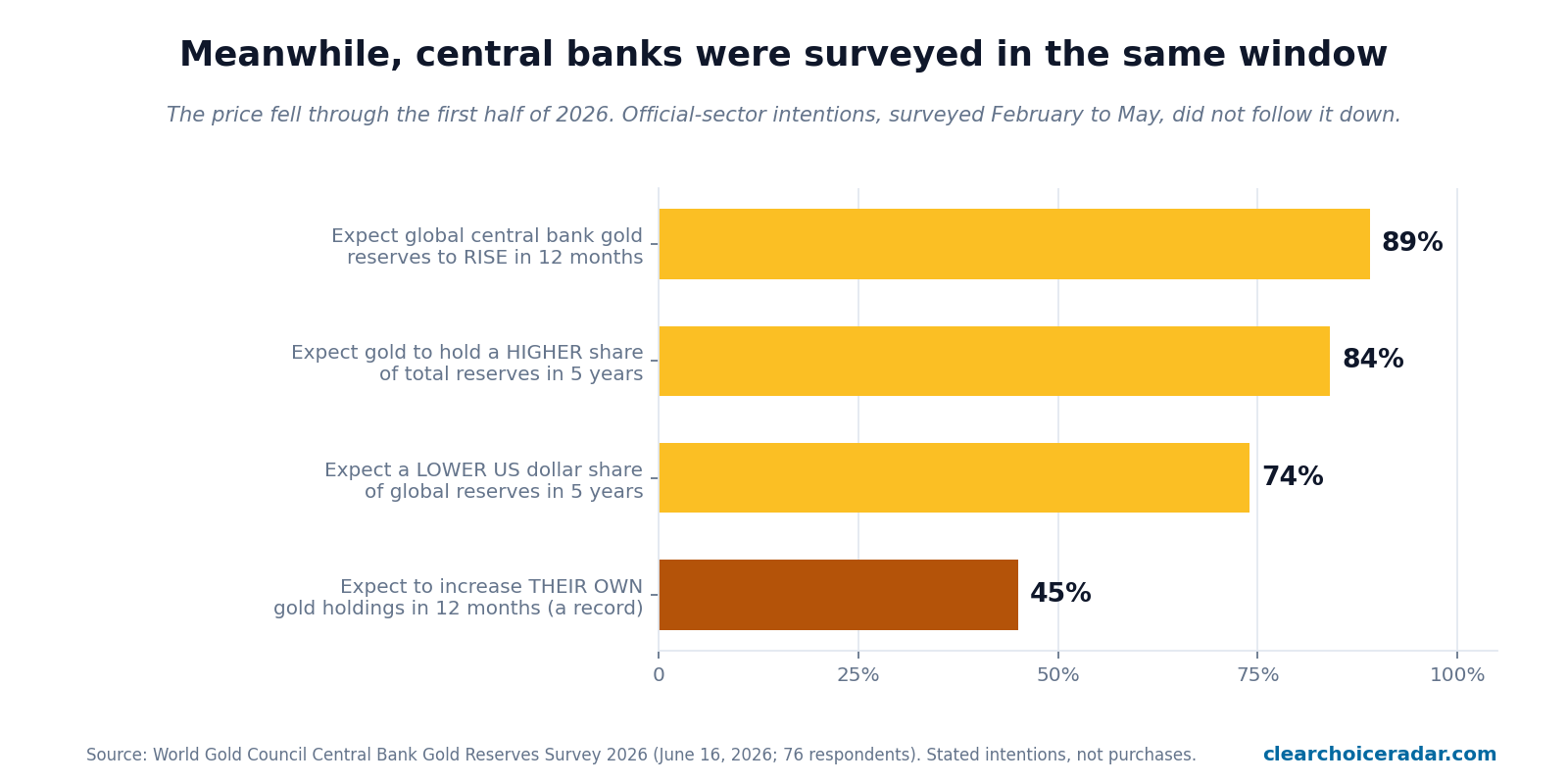
A record 45% of respondents said they expect to increase their own gold holdings over the next twelve months. 89% expect global central bank gold reserves to rise. 74% expect the US dollar to hold a smaller share of global reserves in five years, and 84% expect gold to hold a larger one.
Central banks bought a net 244 tonnes in the first quarter of 2026, against a four-year average that has run near 1,000 tonnes a year.
Here is the honest framing, and it cuts both ways. Official-sector buying is a real and unusually persistent source of demand, and it did not reverse when the price did. It is also a survey of intentions rather than a record of purchases, central banks are not obligated to follow through, and the same official buying was in place during the five months the price fell. Steady demand from one buyer class has never been a floor under a price, and anyone presenting it to you as one is selling something.
What a drawdown changes inside an IRA, specifically
Most commentary about a gold decline is written for someone holding coins in a safe. The mechanics are genuinely different inside a self-directed IRA, and the differences matter more than the price move.
You cannot harvest the loss. In a taxable brokerage account, an unrealized loss has a tax use. Inside an IRA it does not. Gains and losses inside the account are not reportable events, so a decline is simply a smaller balance with no offsetting benefit.
Flat fees get heavier as the balance shrinks. Gold IRAs typically carry custodian and depository storage fees, and those are frequently flat annual dollar amounts rather than a percentage of assets. A fixed fee is a larger share of a smaller account by definition. That arithmetic is worth running on your own statement. See our gold IRA fees guide.
Required minimum distributions do not care about the price. Once RMDs begin, the required amount is computed from the prior year end account value and an IRS life expectancy factor. If the account was valued at a peak on December 31 and the metal has fallen since, you are still distributing against the higher number. With physical metal that can mean selling into a lower market or taking an in-kind distribution. Our gold IRA withdrawal and RMD rules page covers the mechanics.
Liquidity is a spread, not a button. Selling metal out of an IRA runs through the dealer and custodian, and the buy and sell prices are not the same number. That spread is a fixed cost of moving in or out regardless of what the spot price is doing.
The rules do not change when the price does
A price move tends to generate a wave of marketing, and the marketing is where the compliance problems usually start. The IRS requirements are unaffected by whether gold went up or down:
- Metals must meet the fineness standards and be an approved product type. Collectibles generally are not eligible, and a purchase that fails the test can be treated as a distribution.
- The metal must be held by a qualified trustee or custodian. Storing IRA metal at your house is the single most common way people create a taxable event by accident. See home storage gold IRAs.
- Rollover timing rules still apply, including the 60 day window on indirect rollovers and the once per twelve months limit on IRA to IRA rollovers.
Full detail is on our gold IRA rules page, and the tax side of selling is covered in taxes on selling gold.
What we are not going to tell you
We are not going to tell you where gold goes next, and you should be wary of any page that does. Bank price targets exist, they are published, and they have been wrong in both directions often enough that reprinting them here would add noise rather than information. We do not publish forecasts and we are not licensed to give you investment advice.
What is worth doing after a move like this is unglamorous:
- Look at what percentage of your total retirement assets is in one metal, and decide whether that number is the one you actually chose or the one the last two years produced for you.
- Read your custodian statement and find the flat fees.
- If RMDs are close, find out what your December 31 valuation was and what that obligates.
- Talk to a fiduciary who is paid for advice rather than for a transaction.
More plain answers are on our gold IRA answers hub.
Related Gold IRA guides
Sources
- World Gold Council, Central Bank Gold Reserves Survey 2026 (published June 16, 2026)
- World Gold Council, Gold Demand Trends
- LBMA, Precious Metals Prices (LBMA Gold Price benchmark)
- IRS Publication 590-B, Distributions from Individual Retirement Arrangements (IRAs)
- IRS, Retirement topics: Required Minimum Distributions (RMDs)
General educational information only; not tax, legal, or investment advice. Precious metals involve risk, and IRA rules depend on individual facts. Consult a qualified tax professional before moving retirement funds. Not affiliated with the IRS or any government agency. Last updated July 2026.