Can't Afford a Tax Relief Company? Free and Low Cost Help That Actually Exists
Start with what the IRS shows you for free
Before anyone can help you, you need the real numbers, and the IRS hands those over at no charge. A free IRS Individual Online Account shows your balance by tax year, up to five years of payment history, digital copies of notices, and your transcripts. If a notice arrived and you are not sure what it means, our IRS notice decoder translates the common ones, and the main IRS individual line is 800-829-1040.
Knowing whether you owe $6,000 or $60,000, and which years it comes from, changes which of the options below fits. Everything that follows is free to request or close to it.
Low Income Taxpayer Clinics: real representation, free or nearly free
The least known option is the strongest one. Low Income Taxpayer Clinics are independent from the IRS, funded to represent people in audits, appeals, and tax collection disputes before the IRS and in court, for free or a small fee. That is not a hotline reading a script; it is representation, often from law school clinics and legal aid organizations.
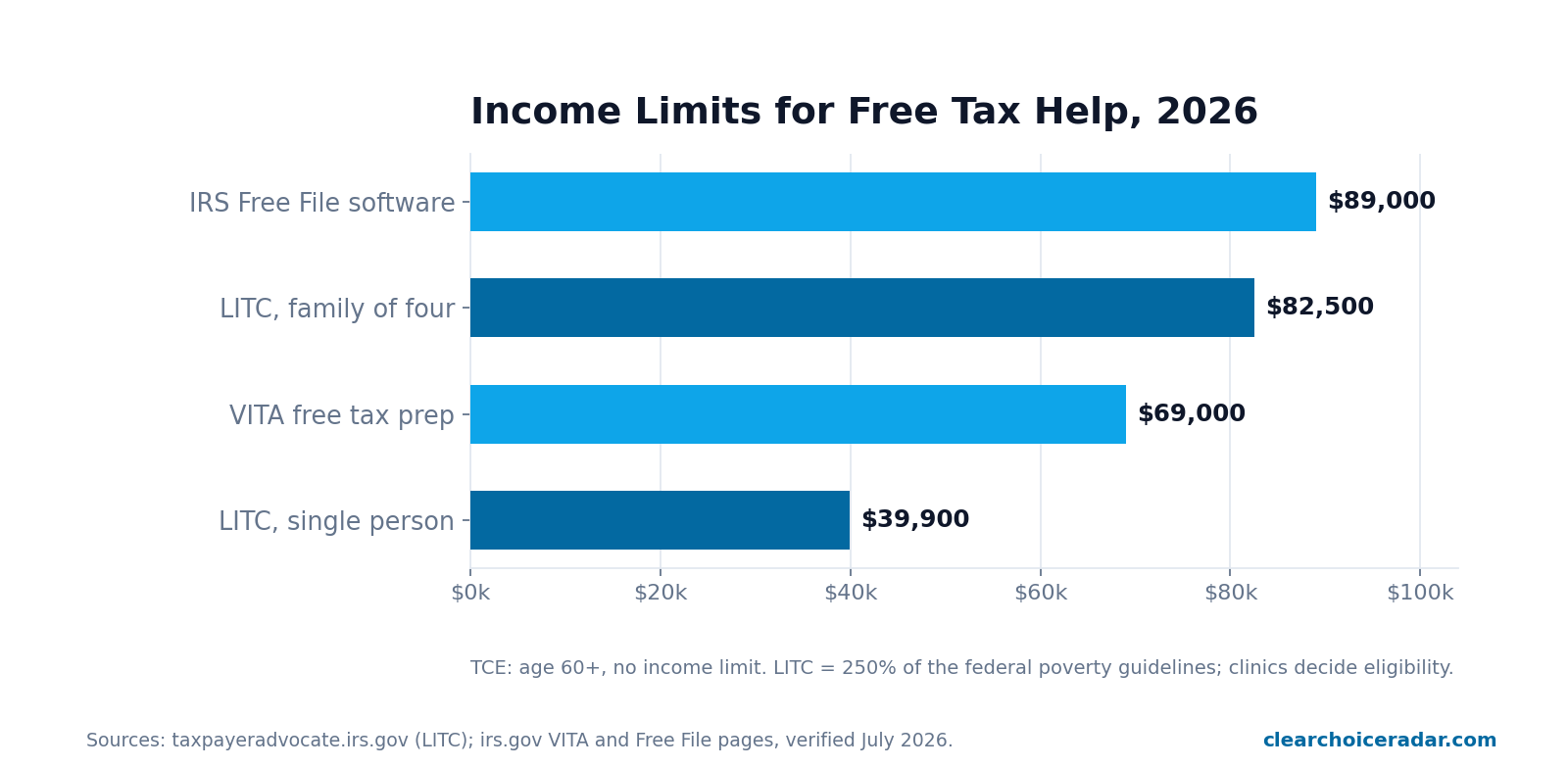
Eligibility generally means income at or below 250 percent of the federal poverty guidelines. For 2026 that works out to about $39,900 for a single person and $82,500 for a family of four in the lower 48, with each clinic making its own final call. Clinics also help people who speak English as a second language.
To find one, use the clinic finder on the Taxpayer Advocate Service LITC page or IRS Publication 4134, which lists every clinic by state.
The Taxpayer Advocate Service: free help when the IRS itself is the problem
The Taxpayer Advocate Service is an independent organization within the IRS, and its help is free. It exists for two situations: financial hardship, where IRS action or inaction threatens your housing, utilities, food, or your ability to get to work, and system failures, where the IRS has blown past its own deadlines, sent repeated interim letters without resolving anything, or gone silent past a promised date.
You can reach TAS at 877-777-4778, through local offices in every state, or by submitting Form 911. If a levy or garnishment is about to hit and you genuinely cannot absorb it, TAS is the free emergency lane.
Payment plans: the IRS fees are smaller than most people think
Setting up an IRS payment plan yourself is a form on IRS.gov, and the current fees are modest:
- Short-term plan (pay in full within 180 days, under $100,000 owed): $0 setup fee.
- Long-term plan with direct debit ($50,000 or less owed, what the IRS now calls a simple payment plan): $22 setup fee online.
- Long-term plan, other payment methods: $69 online.
- Low income taxpayers (at or below 250 percent of the federal poverty level): the direct debit setup fee is waived entirely, and the $43 fee for other methods may be reimbursed.
- Changing an existing plan online: $10.
Interest and late payment penalties continue while you pay, which is true no matter who sets the plan up. Our penalty and interest calculator shows what a balance actually costs over time.
The Offer in Compromise: check the free pre-qualifier before paying anyone
An Offer in Compromise settles tax debt for less than the full amount when the IRS agrees you cannot pay in full. The application fee is $205, and if you meet the low income certification in the Form 656-B booklet, both the fee and the initial payment are waived.
Before anything else, run the IRS's free Offer in Compromise Pre-Qualifier. It takes minutes and tells you whether you are even in the ballpark. The IRS put so called OIC mills on its 2026 Dirty Dozen scam list for overpromising settlements to people who do not qualify; the pre-qualifier is how you make sure any money you spend on help, from anyone, is spent on a case that can actually be made.
Two more free requests: hardship status and penalty forgiveness
Currently Not Collectible status. If paying anything would leave you unable to cover basic living expenses, you can ask the IRS, by phone at 800-829-1040 or the number on your notice, to mark the account currently not collectible. Collection activity pauses. Be clear about the fine print: the debt is not forgiven, penalties and interest keep accruing, refunds get applied to the balance, and the IRS may file a tax lien and can resume collection if your finances improve. It costs nothing to request; the IRS may ask for a financial statement on Form 433-F.
First Time Abate. If you have a clean three-year history, same return type filed on time, no penalties in those years, the IRS will often remove a failure to file or failure to pay penalty on request. One phone call to the number on your notice, or Form 843. No fee, and you do not even need to know the program's name; the IRS checks your account when you ask about penalty relief. More detail in our penalty relief guide.
If your return itself is the problem
Some tax debt starts as a filing problem, an unfiled year or a return done wrong. Free filing help exists too: VITA prepares returns at no charge for people making $69,000 or less this season, TCE does the same for people 60 and older, and IRS Free File guided software covers anyone with adjusted gross income of $89,000 or less. Getting the returns right is a prerequisite for every relief program above; the IRS will not approve an Offer in Compromise or most payment plans with unfiled returns outstanding.
When paying for professional help makes sense
The free routes have limits. If you owe well into five or six figures, have several unfiled years, are facing a revenue officer, a lien, or an active levy, or your case involves a business with payroll tax issues, professional representation can be worth real money: an enrolled agent, CPA, or tax attorney handles the financial disclosures, the negotiation strategy, and the deadlines while you keep living your life. The same is true if you simply do not want to face the IRS alone, which is a legitimate reason.
If that is where you are, start with our comparison of the most affordable tax relief companies, and see the tax relief cost guide for the government figures behind every program mentioned here. A good firm will tell you quickly whether your case justifies its involvement; the free pre-qualifier and the numbers from your IRS online account will help you judge that conversation.
Related Tax Relief guides
- 1099-R distribution codes
- Offer in Compromise
- IRS Fresh Start Program
- Does tax relief actually work
- IRS tax relief programs
- Best tax attorneys
- How to choose a tax relief company
- IRS penalty relief
- Currently not collectible
- Installment agreement
- IRS collections statistics
- IRS audit statistics
- What tax relief costs
- Penalties and interest
- IRS notice decoder
- California FTB notice decoder
- CP2000 notice
- Tax debt questions answered
- Final notice of intent to levy
Sources
- Taxpayer Advocate Service: Low Income Taxpayer Clinics
- IRS Publication 4134, Low Income Taxpayer Clinic List
- Taxpayer Advocate Service: Contact Us
- IRS: Payment Plans and Installment Agreements
- IRS: Offer in Compromise
- IRS: Dirty Dozen Tax Scams for 2026
- IRS: Temporarily Delay the Collection Process
- IRS: Administrative Penalty Relief
- IRS: Online Account for Individuals
- IRS: Free Tax Return Preparation (VITA/TCE)
General information only; not legal or tax advice. No attorney-client relationship is created by viewing this content or sending information through this site. Consult a qualified tax professional for advice specific to your situation. Last updated July 2026.