Illinois Offer in Compromise: How to Settle Illinois State Tax Debt in 2026
Illinois vs. the IRS: The Key Differences at a Glance
The comparison table below highlights the most important structural differences between Illinois state tax debt relief and the federal IRS process. The 20-year Illinois collection window is the single most critical difference: Illinois state tax debt is far harder to outlast than federal debt.
| Feature | Illinois (IDOR) | Federal (IRS) |
|---|---|---|
| Settlement mechanism | Board of Appeals petition (Form BOA-1) | Offer in Compromise (Form 656) |
| Collection statute of limitations | Up to 20 years | Generally 10 years (CSED) |
| Interest rate (2025 to 2026) | 7% simple daily | Tied to federal short-term rate + 3% |
| Streamlined installment threshold | None (case by case) | Available for balances under certain amounts |
| Approval body | Board of Appeals (2 of 3 members + IDOR Director) | IRS Office of Appeals / OIC Unit |
| Appeals after decision | Not available (BOA decisions are final) | IRS Independent Office of Appeals available |
| Published acceptance rates | Not publicly available | Reported in IRS Data Book |
What Is the Illinois Board of Appeals?
The Illinois Board of Appeals is a three-member panel within IDOR that acts as Illinois's closest equivalent to an IRS Offer in Compromise. It handles two types of relief requests: penalty and interest abatement based on reasonable cause, and settlement of a final tax liability for less than the full amount owed based on doubt as to collectibility (hardship).
The Board cannot redetermine whether the underlying tax is owed, and it cannot review decisions from IDOR hearings, the Illinois Independent Tax Tribunal, or courts. Relief requires at least two of three Board members to agree, plus final approval from the IDOR Director. BOA decisions are final and not appealable.
How to File a Board of Appeals Petition: Form BOA-1
To petition the Board of Appeals, you file Form BOA-1. For a doubt-as-to-collectibility (hardship) petition, you must also submit: the last 3 years of federal tax returns, last 3 years of Illinois tax returns, 6 months of bank and brokerage statements, 2 recent pay stubs, and either Form BOA-4 (individuals) or BOA-5 (businesses).
Because BOA decisions are final and not appealable, building a thorough, well-documented petition on the first attempt is critical. Missing documents can delay or sink your case.
Illinois Installment Payment Plans: Form CPP-1
If full payment is not possible but you do not qualify for BOA settlement, an installment plan may help. You apply using Form CPP-1. If the liability exceeds $15,000, you must also file Form EG-13-I (individuals) or EG-13-B (businesses). IDOR asks for a good-faith down payment upfront.
There is no published maximum term and no automatic approval threshold. Interest and penalties continue accruing during the plan. IDOR can still file a state tax lien at its discretion. Missing a payment, failing to file a future return, or incurring new tax debt can default the plan and trigger levy action.
Illinois Penalties and Interest: What You Owe Beyond the Tax
Late payment penalties in Illinois are 2% for 1 to 30 days late and 10% for 31 or more days late. A negligence penalty adds 20% of the deficiency, and fraud adds 50%. Illinois's current interest rate is 7% simple daily interest for January 1, 2025 through December 31, 2026, down from 8% in 2024. Illinois's flat individual income tax rate is 4.95%, in effect since July 1, 2017.
How Often Does Illinois Actually Settle Tax Debt? An Honest Answer
Illinois does not publicly publish Board of Appeals petition volumes, approval rates, or settlement counts. Obtaining that operational data would require a formal FOIA request to IDOR. No acceptance percentage exists to cite, and any firm quoting you one would be making it up.
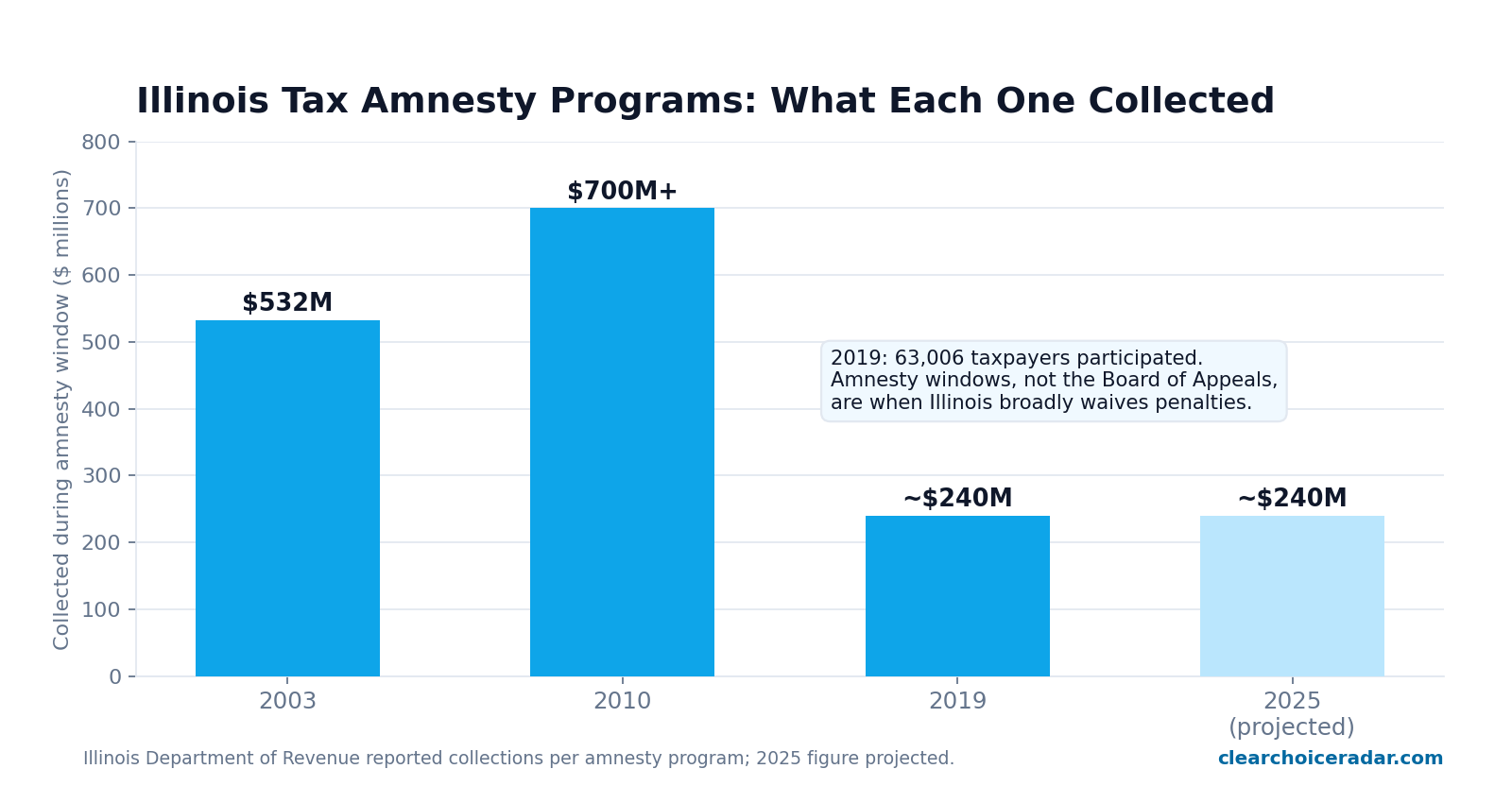
The most concrete public data on Illinois delinquent tax relief comes from state tax amnesties:
- 2003 Amnesty (Oct 1 to Nov 17, 2003): About $532 million collected; only roughly $32 million deemed genuinely new revenue by state analysts.
- 2010 Amnesty (Oct 1 to Nov 8, 2010): Over $700 million collected; roughly $12 million deemed genuinely new.
- 2019 Amnesty (approx. Oct 1 to Nov 15, 2019): About $237 to $240 million collected from 63,006 taxpayers (verified as of January 31, 2020), roughly $60 million above projections.
- 2025 Amnesty (Oct 1 to Nov 17, 2025): Full penalty and interest waiver offered; mid-program reporting cited over $100 million collected with projections near $240 million by close.
Illinois's own analysts have noted repeatedly that the large majority of amnesty dollars represent accelerated collections, not new revenue. Most participants were going to pay eventually; they just paid sooner given an incentive.
Illinois's Collection Powers: Why the 20-Year Window Matters
Illinois holds significant collection tools: state tax liens enforceable for up to 20 years, wage garnishment of up to 15% of gross pay, bank and asset levies, state and federal refund offsets, and holds on professional licenses, sales tax permits, and liquor licenses. IDOR also uses five contracted private collection agencies.
The 20-year lien and collection period is the most important number for any Illinois taxpayer to understand. You cannot simply wait out Illinois tax debt. Interest compounds throughout, and Illinois has two decades of tools to collect.
How to Prepare a Strong Illinois BOA Petition
Key steps for a stronger Board of Appeals petition: get current on all unfiled returns before you apply, gather every required financial document before submitting, write a clear factual hardship narrative with specific dates and evidence, make a realistic offer amount tied to your documented ability to pay, and consult a licensed tax professional. Because BOA decisions are final, there is no second chance if a petition is denied.
Key Takeaway: Illinois State Tax Debt Requires a Different Approach
Illinois does not have an IRS-style Offer in Compromise program. The path to settlement runs through the Board of Appeals using Form BOA-1, and decisions are final. The 20-year collection window makes delay costly. Understanding the actual process, forms, and realistic expectations is the first step toward resolving Illinois state tax debt.
Related Tax Relief guides
- 1099-R distribution codes
- Offer in Compromise
- IRS Fresh Start Program
- Does tax relief actually work
- IRS tax relief programs
- Best tax attorneys
- How to choose a tax relief company
- IRS penalty relief
- Currently not collectible
- Installment agreement
- IRS collections statistics
- IRS audit statistics
- What tax relief costs
- Penalties and interest
- IRS notice decoder
- California FTB notice decoder
- CP2000 notice
- Tax debt questions answered
- Final notice of intent to levy
Sources
- IDOR, Dispute Options (Board of Appeals and Informal Conference Board)
- IDOR, Board of Appeals Overview
- IDOR, Board of Appeals Forms (BOA-1, BOA-4, BOA-5)
- IDOR, Installment Plan CPP-1 Instructions
- IDOR, Collection Process
- IDOR, Penalties and Interest (Pub-103)
- IDOR, Illinois Interest Rate Table
- IDOR, Illinois Income Tax Rates
- IDOR, 2025 Tax Amnesty Bulletin (FY-2026-01)
- IRS.gov, The Collection Process
General information only; not legal or tax advice. No attorney-client relationship is created by viewing this content or sending information through this site. Consult a qualified tax professional for advice specific to your situation. Last updated July 2026.