How Long Does an Offer in Compromise Take? The Full Timeline Explained (2026)
How Long Does the IRS Take to Process an Offer in Compromise?
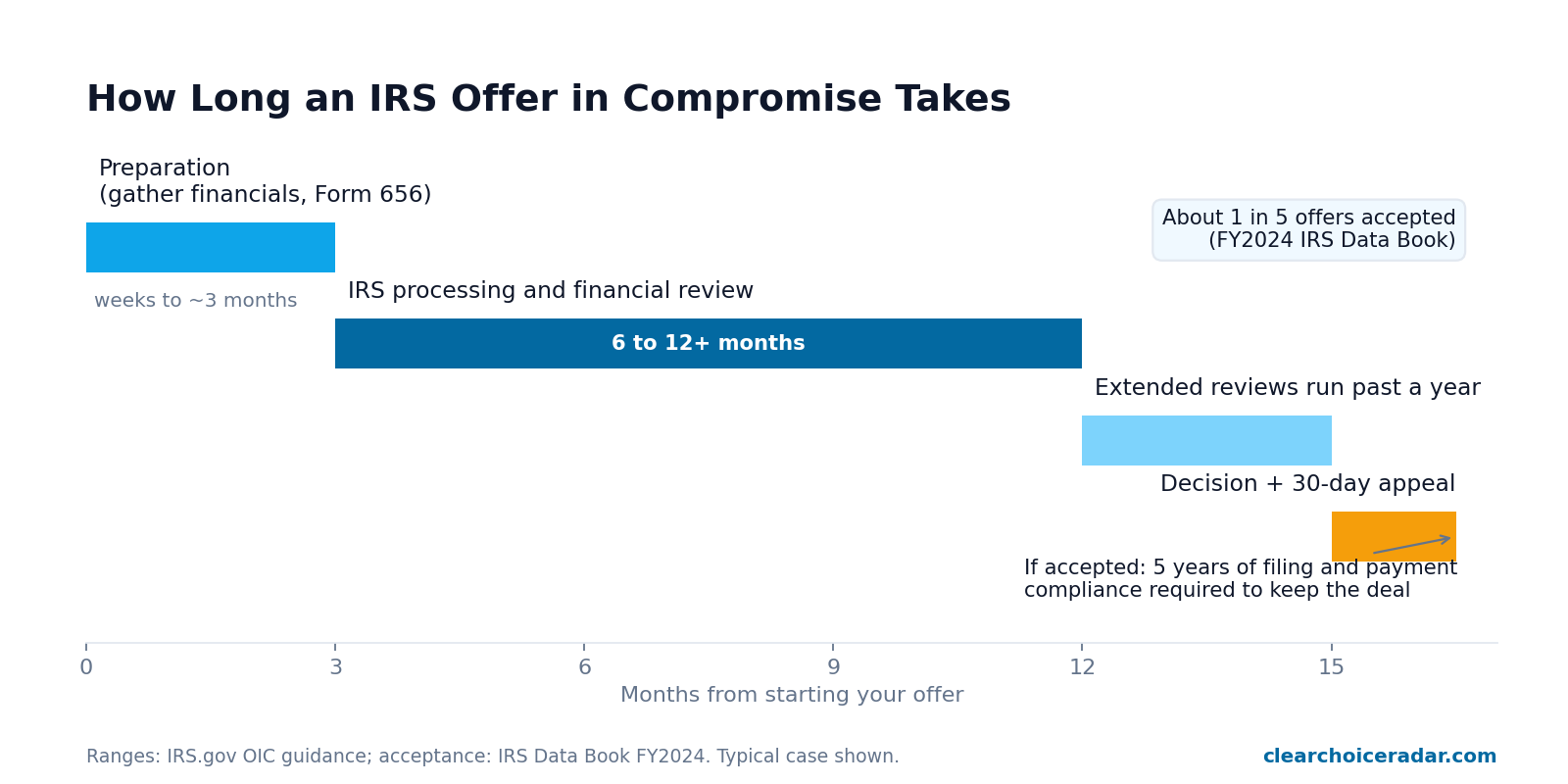
The IRS commonly takes many months to review and decide on an Offer in Compromise, and processing times vary considerably with IRS workload and the complexity of the taxpayer's financial picture (IRS.gov). Some straightforward cases move faster; others involving self-employment income, business assets, or multiple tax years can take considerably longer.
A few things drive the variation: completeness of the application (missing forms or documentation adds back-and-forth time), examiner caseload (OIC units at different IRS campuses carry different volumes of pending cases), and case complexity (multiple entities, real estate holdings, or disputed valuations all require more examiner time).
Because the timeline is genuinely unpredictable, it is worth building a financial plan that does not depend on a specific decision date.
What Happens Before You Even Submit? (The Preparation Stage)
Gathering documents and completing the paperwork is itself a meaningful stage of the offer in compromise timeline. The core application includes Form 656 and Form 433-A (OIC) or 433-B (OIC) for businesses, which require detailed financial disclosure covering income, expenses, assets, and liabilities.
You must also be current on all required tax filings before the IRS will accept your application (IRS.gov). If any returns are unfiled, the IRS will return the offer without reviewing it.
Preparation typically takes several weeks to a few months depending on how organized your records are.
What Happens Immediately After You Submit?
The IRS first checks whether your application is processable. This is not the financial review yet; it is a screening step to confirm you included the required forms, the application fee or low-income certification, and an initial payment (IRS.gov).
If the IRS finds the package incomplete, it will return it with a letter explaining what is missing. Resubmitting restarts the clock, so accuracy at this stage matters.
If your package passes the initial screen, the IRS officially accepts it for processing and a few important protections take effect.
What Is True While an Offer in Compromise Is Pending?
Once the IRS accepts your OIC for processing, several things happen that affect your situation right now.
Collection activity pauses. The IRS generally suspends levies and collection enforcement while an offer is pending, and for 30 days after a rejection, and during any appeal period (IRS.gov). This can provide meaningful breathing room for taxpayers facing wage garnishment or bank levies.
The collection statute of limitations is tolled. The IRS normally has 10 years from assessment to collect a tax debt (IRS.gov). The clock stops running while your offer is pending, plus the 30-day rejection window, plus any appeal period.
Penalties and interest keep accruing. The pause on collection does not stop penalties and interest from building on the underlying balance.
You must stay current. You are required to file all returns on time and make required estimated tax payments while your offer is pending. Falling out of compliance can result in the IRS returning or rejecting your offer.
What Happens During the IRS Financial Review Stage?
An assigned IRS examiner reviews your financial disclosure in detail. The examiner is calculating your Reasonable Collection Potential (RCP), which is the IRS's estimate of how much it could realistically collect from you by other means. Your offer amount must generally equal or exceed the RCP for the IRS to accept it (IRS.gov).
During this stage, the examiner may request additional documentation or clarification, verify asset values and income figures against IRS records, or contact third parties to verify information. Each request for more information can add weeks to the timeline, so responding promptly and completely is one of the few things within your control.
What Are the Possible Outcomes, and What Happens After?
At the end of the financial review, the IRS will do one of four things: accept the offer, reject the offer, return the offer, or counteroffer.
If accepted, you pay the agreed amount according to the payment terms. Once paid in full, the remaining tax debt is resolved, but you must stay in compliance with all tax obligations for five years after acceptance (IRS.gov).
If rejected, you have 30 days to appeal to the IRS Office of Appeals. A returned offer (different from rejection) typically happens because you fell out of compliance or failed to respond to requests, and it does not give you appeal rights.
OIC acceptance rates vary by year according to IRS Data Book statistics, and in fiscal year 2024 roughly one in five submitted offers was accepted.
Is the OIC Timeline Worth It? How Do You Decide?
Whether to pursue an OIC depends on your specific financial situation, not on the timeline alone. The process is long, requires full financial disclosure, and has no assured outcome. For taxpayers whose RCP is genuinely lower than their full tax liability, an accepted offer can be a meaningful resolution.
Key questions to weigh: Can you realistically pay the full balance through an installment agreement over the remaining collection period? Do you have assets the IRS could seize if you do not act? Is your financial hardship temporary or likely to be long-term?
Exploring the full range of IRS options as a whole gives you a broader view of what may fit your situation. If you receive confusing IRS letters during the process, an IRS notice decoder resource can explain the most common notice codes and what action each requires.
Key Takeaway: Plan for a Long Process With an Uncertain Outcome
The Offer in Compromise timeline commonly runs many months, sometimes well beyond a year. Collection enforcement is paused while your offer is pending, but interest and penalties keep accruing and the collection statute of limitations is tolled. Staying compliant with filings and estimated payments throughout the process is not optional; it is a condition of keeping your offer alive.
Because outcomes are never assured and the process is time-consuming, getting a clear picture of all available resolution options before you commit is the smartest first step.
Related Tax Relief guides
- 1099-R distribution codes
- Offer in Compromise
- IRS Fresh Start Program
- Does tax relief actually work
- IRS tax relief programs
- Best tax attorneys
- How to choose a tax relief company
- IRS penalty relief
- Currently not collectible
- Installment agreement
- IRS collections statistics
- IRS audit statistics
- What tax relief costs
- Penalties and interest
- IRS notice decoder
- California FTB notice decoder
- CP2000 notice
- Tax debt questions answered
- Final notice of intent to levy
Sources
General information only; not legal or tax advice. No attorney-client relationship is created by viewing this content or sending information through this site. Consult a qualified tax professional for advice specific to your situation. Last updated July 2026.