Arizona Tax Garnishment: How ADOR and the IRS Collect Tax Debt in 2026
How ADOR Garnishes Wages and Levies Assets
ADOR has the power to levy wages, bank accounts, and other assets under its levy and distraint authority. Before levying, ADOR typically files a state tax lien under ARS 42-1151, which becomes perfected when notice is filed under ARS 42-1152.
CRITICAL: The Arizona Proposition 209 Garnishment Cap Does NOT Apply to Tax Levies
Arizona Proposition 209 (effective December 5, 2022) reduced the maximum wage garnishment for ordinary consumer debts and court judgments from 25% to 10% of disposable earnings. That 10% cap does NOT apply to a state tax levy.
Under ARS 42-1204, an ADOR wage levy protects only the federal exempt amount calculated under IRC 6334(d), which is the same floor the IRS uses. ADOR takes everything above that exempt amount. The consumer-debt caps of 10% or 25% are irrelevant when ADOR is collecting a state tax liability.
If your employer or a debt collector tells you that Arizona tax garnishment is capped at 10%, that is incorrect for tax debts.
ADOR Bank Levies and Release
ADOR can also levy your bank accounts. Once you pay the full balance, ADOR sends a levy release to the employer or bank within 24 hours.
ADOR Interest, Penalties, and Collection Deadline
Late penalties under ARS 42-1125 include: late filing at 4.5% of the tax owed per month (capped at 25%) and late payment at 0.5% of the tax owed per month. Interest accrues at the federal short-term rate plus 3 percentage points, compounded annually (currently 7% as of 2026). ADOR generally does not abate interest.
Under ARS 42-2066, ADOR's obligation to collect is extinguished 10 years after the tax becomes final, unless ADOR filed a collection lawsuit, you agreed in writing to extend the period, or collection was stayed. The levy period itself is limited to 6 years.
How the IRS Garnishes Wages and Levies Assets in Arizona
The IRS does not use a flat garnishment percentage. A federal wage levy is continuous and protects only the exempt amount from IRS Publication 1494. That exempt amount is based on your filing status, the standard deduction, and the number of dependents you claim.
Your employer must give you a Statement of Dependents and Filing Status to complete. If you do not return it within 3 days, your exempt amount defaults to the married filing separately rate with zero dependents, which is the lowest possible floor.
IRS Publication 1494 Exempt Amounts (Rev. 12-2025, for 2026 Levies)
| Filing Status | Pay Period | Dependents | Protected Amount |
|---|---|---|---|
| Single | Weekly | 0 | $309.62 |
| Single | Weekly | 3 | $615.38 |
| Married Filing Jointly | Biweekly | 2 | $1,646.16 |
Everything above the exempt figure can be levied. Source: IRS Publication 1494 (Rev. 12-2025).
Federal Bank Levy and Tax Lien
When the IRS levies a bank account, there is a mandatory 21-day hold before the bank must send the funds. This window gives you time to contact the IRS, set up a resolution, or dispute the levy before the money leaves your account.
A federal tax lien arises automatically after the IRS assesses the tax, sends a Notice and Demand for Payment, and the taxpayer does not pay. The IRS may then file a public Notice of Federal Tax Lien, which can affect your credit and your ability to sell or refinance property.
Side-by-Side Comparison: ADOR vs. IRS Collection
| Feature | Arizona ADOR | Federal IRS |
|---|---|---|
| Wage levy amount | Takes everything above IRC 6334(d) exempt floor | Takes everything above Pub. 1494 exempt floor |
| Consumer garnishment cap (10%/25%) applies? | No. Tax levies are not capped at 10% or 25% | No. Tax levies are not capped at 10% or 25% |
| Bank levy hold period | Release within 24 hrs of full payment | Mandatory 21-day hold before bank remits |
| Tax lien authority | ARS 42-1151 / ARS 42-1152 | IRC 6321; public NFTL may be filed |
| Collection statute of limitations | 10 years from when tax becomes final (ARS 42-2066); levy period 6 years | 10 years from assessment date (IRC 6502) |
| Interest rate (2026) | Federal short-term rate + 3 pts, currently ~7% | Federal short-term rate + 3 pts (varies by quarter) |
| Interest abatement available? | Generally no | Yes, in limited circumstances |
| No-fee OIC application? | Yes, no application fee | No; $205 application fee (low-income waiver available) |
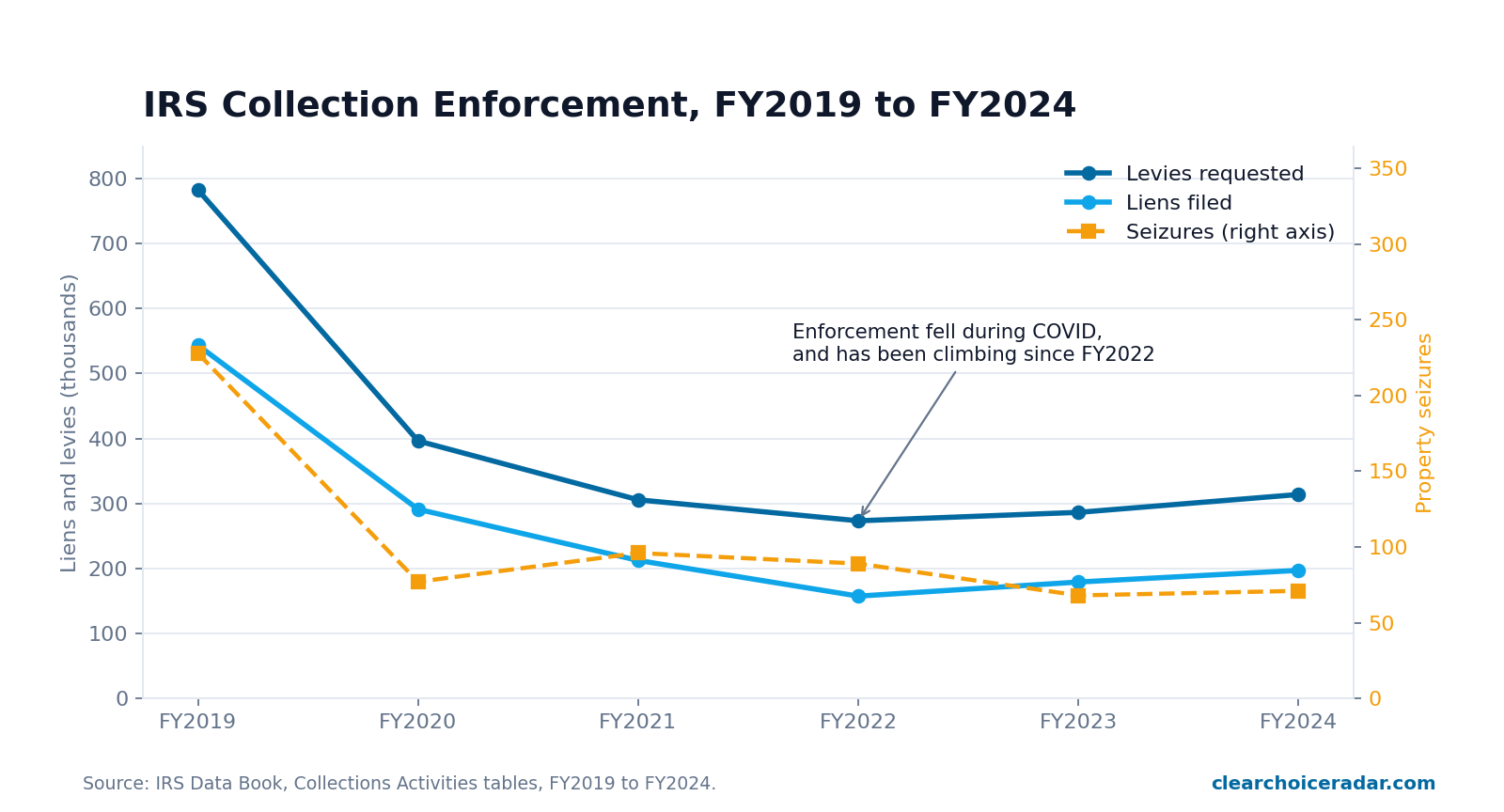
IRS National Enforcement Trends (FY2019 to FY2024)
A note on Arizona-specific data: ADOR does not publicly publish state-level enforcement statistics such as lien counts, levy counts, or a state tax gap estimate. The IRS Data Book reports Arizona gross federal collections but its lien, levy, and seizure counts are national only. No official Arizona-specific federal levy or lien count is available. The figures below are national IRS totals, provided for context.
| Fiscal Year | Liens Filed | Levies Requested | Seizures |
|---|---|---|---|
| FY2019 | 543,604 | 782,735 | 228 |
| FY2020 | 291,081 | 396,269 | 77 |
| FY2021 | 212,251 | 305,610 | 96 |
| FY2022 | 157,323 | 273,286 | 89 |
| FY2023 | 179,019 | 286,270 | 68 |
| FY2024 | 196,996 | 313,792 | 71 |
Source: IRS Data Book, Table 27 (national figures only). Enforcement dropped sharply after FY2019 and is only partially recovering. Still, the trend is ticking back upward.
How to Resolve Arizona State Tax Debt (ADOR)
ADOR offers a Payment Arrangement for Individuals. ADOR does not publish a fixed dollar threshold or a maximum term; settlement-related plans are commonly structured for up to 24 months. Setting up a plan typically stops active levy action while you remain in compliance.
Under ARS 42-1004(B), ADOR can accept an Offer in Compromise if it determines the liability is uncollectible or that the cost of collection exceeds what could be recovered. Key requirements: current on the last 3 years of returns, no application fee, individuals use Form 10896, businesses use Form 10847, and accepted offers are paid in full or within 30, 60, or 90 days.
Penalty review is available through ADOR's Penalty Review Unit using Form 290. ADOR does not generally abate interest.
How to Resolve Federal IRS Tax Debt in Arizona
The IRS offers several payment plan options. Setting up an installment agreement can stop a wage levy if the IRS agrees. User fees vary by payment method and income status; confirm current amounts at IRS.gov.
The IRS may accept less than the full amount owed through an Offer in Compromise if you cannot pay the full liability or if paying it would create an economic hardship. The IRS evaluates your income, expenses, assets, and future earning potential. Acceptance is not guaranteed, and acceptance rates vary by year.
If paying anything would prevent you from meeting basic living expenses, the IRS may place your account in currently not collectible status. The debt remains and interest continues to accrue, but active collection stops temporarily. The CSED clock keeps running.
The IRS also offers penalty abatement for reasonable cause and a First-Time Penalty Abatement for qualifying taxpayers who have a clean 3-year compliance history, filed all required returns, and paid or arranged to pay their balance.
Legal Disclaimer
General information only; not legal or tax advice. No attorney-client relationship is created by viewing this content or by sending information through this site. Tax laws and agency procedures change; verify current rules and figures directly with ADOR at azdor.gov and the IRS at irs.gov. Consult a qualified tax professional for advice specific to your situation.
Related Tax Relief guides
- 1099-R distribution codes
- Offer in Compromise
- IRS Fresh Start Program
- Does tax relief actually work
- IRS tax relief programs
- Best tax attorneys
- How to choose a tax relief company
- IRS penalty relief
- Currently not collectible
- Installment agreement
- IRS collections statistics
- IRS audit statistics
- What tax relief costs
- Penalties and interest
- IRS notice decoder
- California FTB notice decoder
- CP2000 notice
- Tax debt questions answered
- Final notice of intent to levy
Sources
- ADOR Collections for Individuals
- ADOR Tax Levies for Individuals
- ADOR Payment Arrangement for Individuals
- ADOR Offers in Compromise
- ADOR Interest Rates
- ARS 42-1204 (Property Exempt from Levy)
- ARS 42-2066 (Collection Statute of Limitations)
- ARS 42-1125 (Penalties)
- Arizona Courts - Proposition 209 Garnishment
- IRS.gov - Information About Wage Levies
- IRS.gov - Information About Bank Levies
- IRS Publication 1494 (Rev. 12-2025)
- IRS.gov - Understanding a Federal Tax Lien
- IRS.gov - Time the IRS Can Collect Tax (CSED)
- IRS.gov - IRS Data Book
- IRS.gov - Payment Plans / Installment Agreements
- IRS.gov - Offer in Compromise
- IRS.gov - Temporarily Delay Collection (CNC)
- IRS.gov - Penalty Relief
General information only; not legal or tax advice. No attorney-client relationship is created by viewing this content or sending information through this site. Consult a qualified tax professional for advice specific to your situation. Last updated July 2026.