Credit Score After Debt Settlement: What Really Happens (2026 Guide)
Advertising Disclosure: This website may receive compensation from companies featured, contacted, or linked through this page. Compensation may affect which companies appear and where they are placed, but it does not change the educational information or risk disclosures in this article.
Quick Answer: Debt settlement lowers your credit score, and settled accounts are reported as "settled for less than the full balance." That notation can remain on your credit report for approximately 7 years from the date of the original delinquency. For people already falling behind, settlement may be one possible alternative to unresolved collections or bankruptcy, but the credit impact varies widely and the risks should be reviewed with a qualified advisor.
Many consumers are struggling with credit card balances and missed payments. If you're weighing debt settlement as a way out and worried about what it does to your credit, you're asking exactly the right question before you commit.
This guide focuses specifically on the credit-score consequences of debt settlement, the drop, the timeline, the recovery, so you can make a genuinely informed decision.
Why Debt Settlement Damages Your Credit Score
Debt settlement doesn't hurt your credit in one clean moment. The damage builds up in two distinct stages.
Stage 1: Missed Payments During the Program
Most debt settlement programs work by asking you to stop paying your creditors and instead save money in a dedicated account. The goal is to accumulate a lump sum large enough to negotiate a reduced payoff.
The problem: every month you skip a payment, your credit report takes a hit. Payment history is the single largest factor in your credit score, accounting for roughly 35% of a FICO score (according to FICO). Multiple missed payments across multiple accounts can severely damage your score long before any debt is actually settled.
The CFPB warns that debt settlement companies often instruct consumers to stop paying creditors, which leads to late fees, penalty interest, and significant credit score damage during the waiting period.
Stage 2: The "Settled" Account Status
Once a creditor accepts a reduced amount, the account is updated on your credit report to show "settled" or "settled for less than the full amount." This status signals to future lenders that you did not repay the full debt as agreed, a negative mark that stays on your report.
The FTC cautions that even a successfully settled account remains a negative entry, and creditors are under no obligation to agree to settle. There's no guarantee any settlement will be reached, even after months of missed payments have already piled up.
How Many Points Will Your Credit Score Drop?
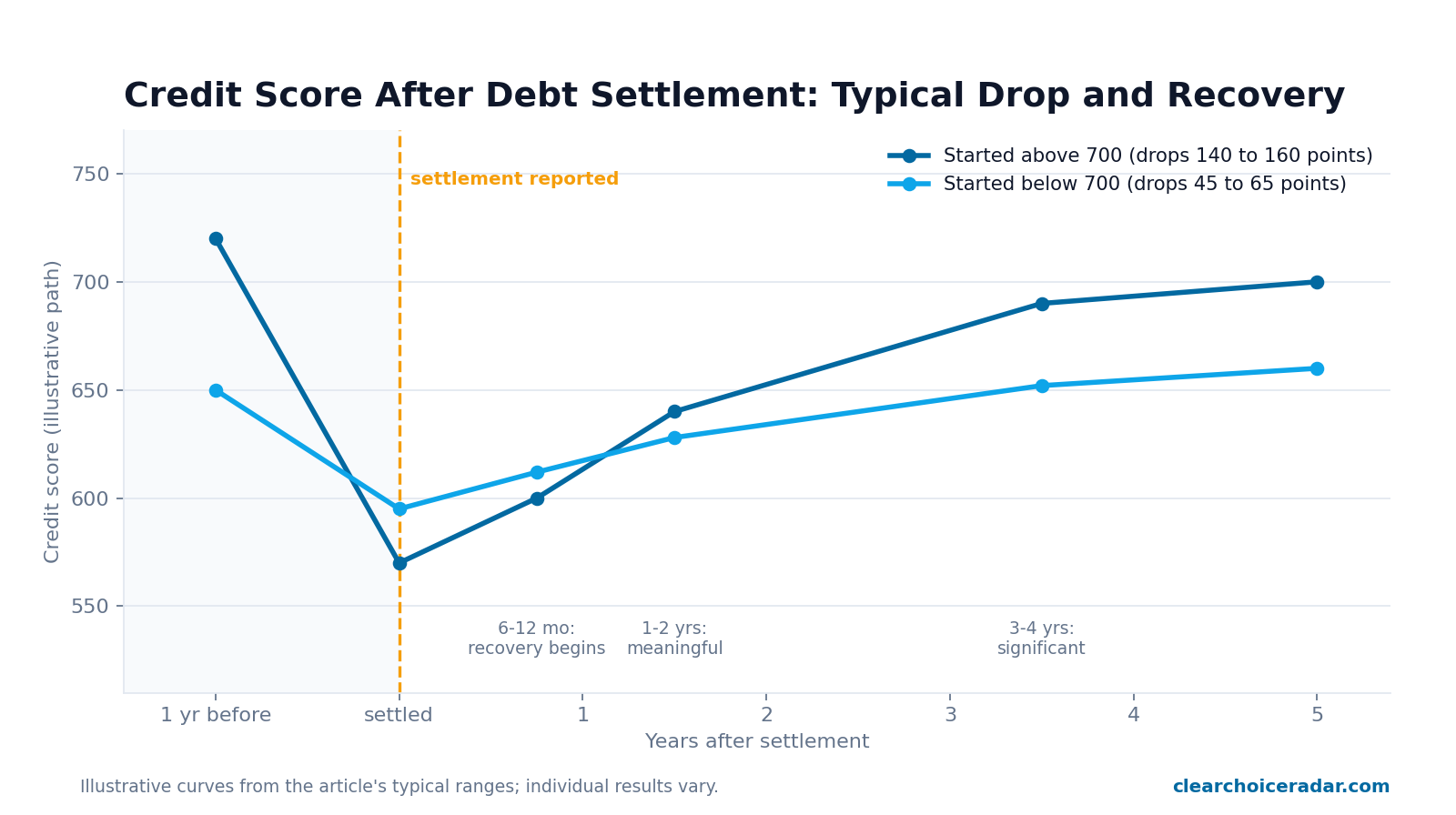
Here's a counterintuitive reality: the higher your credit score before settlement, the more points you stand to lose.
According to Experian, people with higher starting scores (roughly 700 or above) can see drops in the range of approximately 140 to 160 points after settlement. People with lower starting scores (under 700) tend to see smaller drops, roughly 45 to 65 points, because their scores already reflect prior negative activity.
Why the difference? Credit scoring models penalize a fall from a strong credit profile more heavily. A single "settled" account on an otherwise clean report is a bigger signal shift than the same account on a report that already shows late payments and high utilization.
Important: These are general ranges shared by credit bureaus like Experian for educational purposes. Your actual result will vary depending on your total number of accounts, current utilization, other negative items, and other individual factors.
How Long Does Debt Settlement Stay on Your Credit Report?
Settled accounts, along with the late payment history leading up to the settlement, remain on your credit report for approximately 7 years from the date of the original delinquency (the date you first fell behind).
This 7-year clock is set by the Fair Credit Reporting Act (FCRA). It doesn't restart when the debt is settled; it runs from when you first missed a payment.
In practice, this means: - The late payment entries appear on your report for 7 years. - The settled account status also appears for 7 years from the original delinquency. - After 7 years, these items should drop off automatically.
Debt Settlement vs. Alternatives: Which Hurts Credit More?
Understanding the credit impact of settlement only makes sense in context. Here's how it compares to other paths.
Leaving Debt in Collections
If you stop paying and do nothing, your accounts will eventually be charged off and sold to collection agencies. You'll still accumulate the same missed-payment damage, plus collection accounts, which are separate negative entries. The CFPB explains that collection accounts also stay on your report for up to 7 years, and having multiple collection entries often does more cumulative damage than a single settled account.
Creditors may also pursue lawsuits and wage garnishment if debts go unresolved, adding further financial and legal complications.
Chapter 7 Bankruptcy
Chapter 7 bankruptcy can discharge many unsecured debts, but it carries significant credit consequences. A Chapter 7 filing can remain on your credit report for up to 10 years from the filing date, according to the FCRA. The initial score drop is typically severe.
For people with truly unmanageable debt, bankruptcy may still be the right legal tool, but it's a decision that warrants consultation with a bankruptcy attorney, not a comparison-site article.
Debt Management Plans (DMPs)
Debt management plans through nonprofit credit counseling agencies work differently. You repay the full principal (often with reduced interest), and while enrollment may initially affect your credit, successful completion is generally viewed more favorably than settlement. The FTC recommends contacting a nonprofit credit counseling agency as a first step before considering more drastic options.
Debt Consolidation
Debt consolidation, combining multiple debts into a single loan, can actually improve your credit over time if you make consistent on-time payments. It's a fundamentally different approach from settlement and carries far less credit risk for people who can still afford monthly payments.
How to Rebuild Your Credit After Debt Settlement
The settled accounts won't disappear overnight, but your score can start recovering sooner than you might think, if you're intentional about it.
Start Immediately With On-Time Payments
After settlement, every on-time payment on any remaining account works in your favor. Payment history is the most heavily weighted factor in your score. Even one month of on-time payments begins rebuilding a positive pattern.
Keep Credit Utilization Low
Credit utilization, how much of your available revolving credit you're using, accounts for roughly 30% of a FICO score. Aim to keep balances below 30% of your credit limits on any remaining cards, and ideally below 10% for the best results.
Consider a Secured Credit Card
If your credit has taken a major hit, a secured credit card (where you deposit collateral equal to your credit limit) is one of the most effective rebuilding tools available. Used responsibly and paid in full each month, a secured card adds positive payment history without the risk of new high-interest debt.
Realistic Recovery Timeline
- 6 to 12 months: Score may begin to recover as on-time payment history accumulates and utilization drops.
- 1 to 2 years: Meaningful improvement becomes visible if you maintain clean payment habits.
- 3 to 4 years: Many consumers see significant recovery, enough to qualify for better loan rates, though the settled accounts remain visible until the 7-year mark.
Recovery timelines vary by individual. The more negative items you had going into settlement, the longer full recovery may take.
Is the Credit Hit Worth It? An Honest Assessment
This is the real question, and it deserves a straight answer.
If you're already missing payments and accounts are heading toward charge-off or collections, some credit score damage is already happening. You're not choosing between "credit damage" and "no credit damage." You're choosing between different types and durations of damage.
For someone who is deeply behind and can't realistically repay the full balances, settlement may represent a practical trade-off: accept a defined credit hit in exchange for resolving debts that are otherwise unmanageable. The CFPB notes that settlement is one option for people struggling with serious debt, but it comes with real risks, including the possibility that creditors refuse to settle, that lawsuits are filed during the process, and that forgiven debt may be treated as taxable income.
On that last point: if a creditor forgives $600 or more of your debt, they are generally required to report it to the IRS, and you may owe income tax on that amount (IRS.gov). There is an insolvency exclusion, if your liabilities exceed your assets at the time of the forgiveness, you may not owe tax on the forgiven amount, but this requires IRS Form 982 and may benefit from professional tax guidance.
Bottom line: Debt settlement is not a clean solution. It's a compromise, one that may make sense for people who are already in credit trouble and need a concrete path out of debt, but not a choice to make lightly. Always consult a qualified financial advisor or nonprofit credit counselor before enrolling in any program.
Compare Debt Relief Companies
Ready to explore your options? Our comparison evaluates debt relief companies based on factors like fees, transparency, accreditation, availability, and customer experience. This website may receive compensation from companies featured or contacted through this page.
Compare Debt Relief Companies →
General information only; not financial or legal advice. Debt relief options carry real risks, including credit score damage and potential tax liability on forgiven debt. Results vary by individual. Consult a qualified financial advisor or nonprofit credit counselor for advice specific to your situation.
Last updated June 2026.
Related Debt Relief guides
- Debt settlement
- Debt consolidation
- Debt management plans
- Alternatives to bankruptcy
- Time-barred debt
- Medical debt
- Canceled debt
- Debt relief scams
- Debt payoff
- Debt collection process
- Debt validation notice
- Sued for a debt
- Wage garnishment limits
- Wage garnishment calculator
- Debt-to-income calculator
- Debt validation letter generator
- Statute of limitations on debt by state
- Debt collection complaint statistics
- Average credit card interest rate
- Debt collection questions answered
Sources
General information only; not financial or legal advice. Debt relief options carry risks including credit score impact and potential tax liability. Consult a qualified financial advisor for advice specific to your situation. Last updated July 2026.