Gold IRA Rollover Rules: How to Move Retirement Money Without a Tax Bill
Two lanes: transfer versus rollover
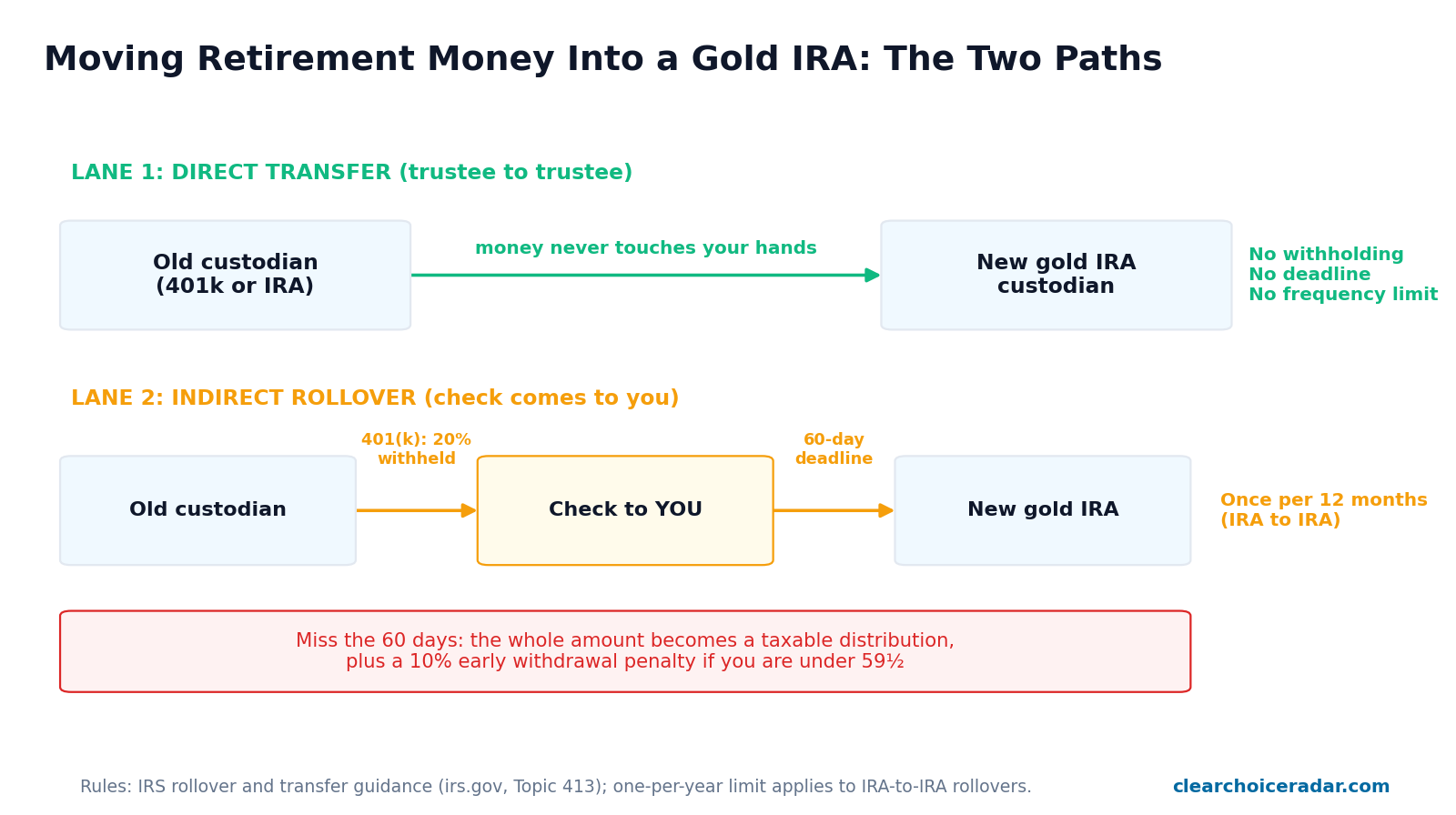
The words get used interchangeably in gold IRA marketing, but the IRS treats them very differently. A trustee-to-trustee transfer moves money directly from your current custodian to the new one. You never touch it, nothing is withheld, nothing is reported as a distribution, and you can do as many as you want. The IRS says plainly that this kind of direct movement is not a rollover at all.
A rollover means the money comes to you first: your current plan cuts you a check, and you redeposit it into the new IRA. That path works, but it carries two tripwires that the transfer lane does not.
Tripwire one: the 60-day fuse
From the day you receive a distribution, you have 60 days to get it into the new IRA. Miss the deadline and the entire amount becomes a taxable distribution, plus the 10 percent additional tax if you are under 59 and a half. The IRS can waive the deadline in hardship cases, but planning around a waiver is not a plan.
Workplace plans add a twist: a 401(k) paying you directly generally must withhold 20 percent for taxes, and to roll over the full amount you have to make up the withheld portion from your own pocket, then recover it at tax time.
Tripwire two: one rollover per 12 months
You can make only one IRA-to-IRA rollover in any 12-month period, no matter how many IRAs you own. A second one inside the window is a taxable distribution, and it can also count as an excess contribution to the receiving account. Trustee-to-trustee transfers are exempt from this limit, which is the main reason they are the default recommendation for funding a metals IRA.
What the metal changes
The movement rules above are ordinary IRA law; nothing about gold changes them. What the metal changes is what happens after the money lands. The receiving account must be with a custodian that is a bank or an IRS-approved nonbank trustee, the metals it buys must satisfy the eligibility rules in IRC 408(m), and the bars and coins must stay in the custodian's possession at a depository. If anyone in the process suggests the metal can come to your house, read about the home storage case before going further: the Tax Court treated exactly that arrangement as a taxable distribution.
The mistakes that actually cost money
- Taking a check when a transfer was available. It starts the 60-day clock and burns your one annual rollover for no benefit.
- Rolling twice in a year. Consolidating several old IRAs by serial rollover is how careful savers accidentally create taxable income. Use transfers for all but one.
- Confusing the contribution limit with the rollover amount. Rollovers and transfers are unlimited in size; the 2026 limit of $7,500 plus a $1,100 catch-up applies only to new annual contributions.
- Letting a dealer rush the funding step. The sales incentive is to get money moving fast. The transfer paperwork takes days longer and removes both tripwires.
Related Gold IRA guides
Sources
General educational information only; not tax, legal, or investment advice. Precious metals involve risk, and IRA rules depend on individual facts. Consult a qualified tax professional before moving retirement funds. Not affiliated with the IRS or any government agency. Last updated July 2026.